Rwanda is one of the youngest countries in the world. According to the 2022 Population and Housing Census, people under 30 make up roughly 65% of the population; a figure that will likely remain above 54% even by 2050.
This demographic reality sits behind the mandate of the Ministry of Youth and Arts (MoYA/Miniyouth); to turn the country’s youth bulge from a looming pressure point into a demographic dividend.
The Ministry is currently led by Dr. Jean Nepo Abdallah Utumatwishima, appointed Minister of Youth in March 2023, succeeding Rosemary Mbabazi, who moved on to become Rwanda’s High Commissioner to Ghana.
Before entering government, Dr. Utumatwishima worked as an epidemiology research fellow at the United States National Institutes of Health, studying cardiometabolic disease risk among African immigrant communities in the Washington, D.C. area while remaining active in youth development work with Rwanda’s National Youth Council.
Read More: National Women’s Council of Rwanda: Grassroots Power Behind a Global Model
At his swearing-in, President Kagame charged him with consolidating and building on his predecessor’s work; empowering young people as drivers of Rwanda’s socioeconomic development.
He is joined by Sandrine Umutoni, Minister of State for Youth and Arts since August 2023. Umutoni previously spent seven years as Director General of the Imbuto Foundation, the NGO founded by First Lady Jeannette Kagame, and earlier worked in international development and with immigrant and refugee communities in Atlanta. She also holds a personal connection to the arts side of the portfolio, having authored a children’s book, Nayima’s Prize.
Notably, the Ministry’s current structure is itself the product of a 2023 reorganization; culture-related functions were carried over to the Ministry of National Unity and Civic Engagement, while youth and arts (including creative industries) were consolidated together under this ministry. MoYA’s work centers on the following connected pillars:
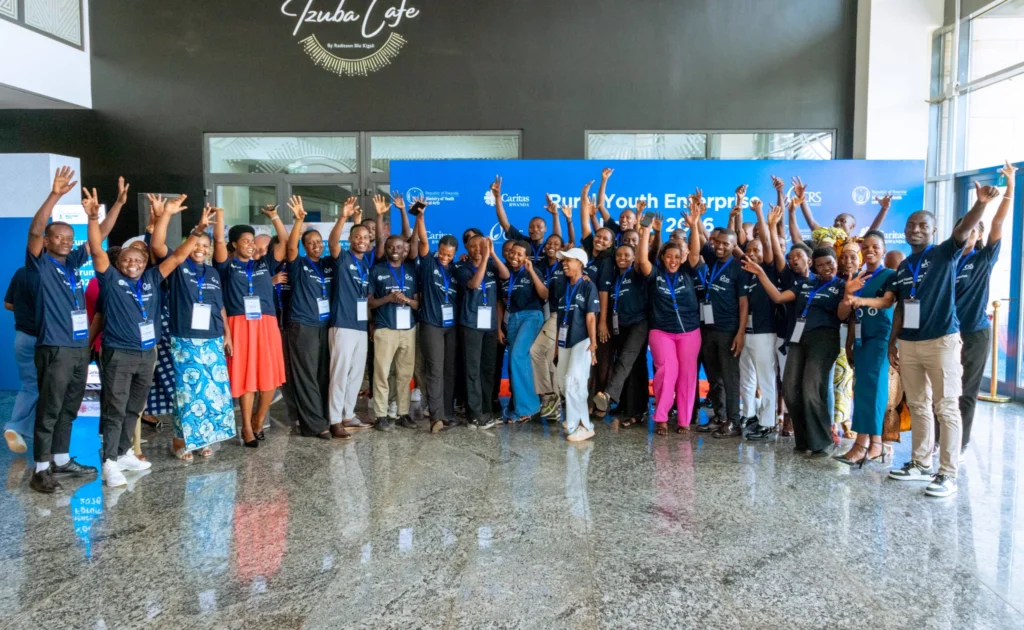
Youth employment and entrepreneurship: This is the Ministry’s highest-profile work, largely delivered through two flagship platforms. YouthConnekt, launched in 2012, connects young Rwandans to jobs, business incubators, mentorship, and access to finance, and has scaled with support from partners including UNDP, UNFPA, and Korea’s KOICA.
The related YouthConnekt Africa Summit, hosted in Kigali, has grown into one of the continent’s largest youth policy and business gatherings, drawing thousands of participants from across Africa.
Hanga Pitchfest, a startup pitch competition run with the Rwanda Development Board and UNDP, has hosted over 200 startups and helped facilitate more than Rwf600 million in funding since 2021. The Minister has pointed to an 85% success rate among past beneficiaries who went on to expand their businesses and hire other young people.
Leadership and mentoring: The Ministry works through structures like the National Youth Council – which, like the Women’s Council, runs an elected representation model from the grassroots up – to build youth leadership pipelines and civic participation.
Capacity building and skilling: Ministry programming emphasizes work-based learning, technical and vocational training (TVET) pathways, and digital skills, aimed at closing the gap between what young Rwandans learn and what the labor market needs; a priority the Minister has repeatedly stressed on occasions like Labor Day.
Youth partnerships and diaspora engagement: Programs such as the annual Rwanda Youth Tour, run with the Ministry of Foreign Affairs, bring diaspora youth back to the country to reconnect with its history and identify ways to contribute their skills.
The Ministry also partners heavily with international organizations, private-sector actors, and civic bodies like the Unity Club on national programs such as Ndi Umunyarwanda, which engages students on history, unity, and reconciliation.
Arts and creative industries: Since absorbing this portfolio, the Ministry has supported creative-sector talent alongside its entrepreneurship work. The YouthConnekt Awards, for instance, recognize both business innovators and creatives, with a 2026 edition awarding more than 140 young entrepreneurs and creatives.
Minister of State Umutoni has also championed film and remembrance culture, including launching Cine Kwibuka, a cinema platform for Genocide remembrance through documentary film.
Read More: Umuganura – The Festival of Harvest in Rwanda
Rwanda’s Youth Challenge
The Ministry’s urgency is rooted in numbers; with youth under 30 constituting roughly two-thirds of the population, Rwanda’s National Strategy for Transformation treats youth employment as central to the country’s development goals.
Programs like YouthConnekt were explicitly framed around job-creation targets (an early iteration aimed at 20,000 decent jobs through entrepreneurship support alone), and government officials consistently link youth skilling to Rwanda’s broader ambition of becoming a knowledge-based, upper-middle-income economy by 2035.
At the same time, ministry officials have been candid that self-employment or formal employment remains genuinely difficult for many young people, and closing that gap requires sustained investment in quality education, mentorship, and targeted support; particularly for disadvantaged youth outside Kigali.
Much like how the National Women’s Council channels half the population into Rwanda’s governance structures, the Ministry of Youth and Arts is trying to do something similar for the demographic that will define the country’s next several decades.
Its bet is that platforms connecting young people to capital, mentorship, and civic participation are what convert a youthful population into sustained national growth. Whether that bet pays off will be one of the clearer measures of Rwanda’s development trajectory through 2035 and beyond.

Established in December 2008, The Diplomatic Insight is Pakistan’s premier diplomacy and foreign affairs magazine, available in both digital and print formats.