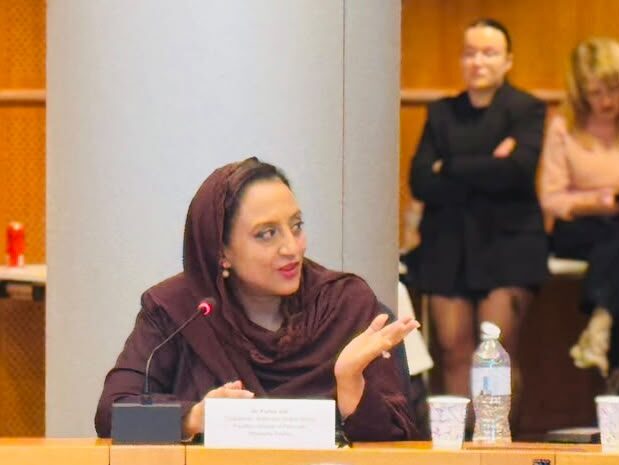
Brussels (TDI): Dr. Farhat Asif, Chairperson of the Diplomatic Insight Group (DIG) and President of the Institute of Peace and Diplomatic Studies (IPDS), addressed members of the European Parliament on Wednesday.
She spoke at a session titled “The Future of Global Governance,” co-organized by MEPs Ondřej Dostál and Michael von der Schulenburg.
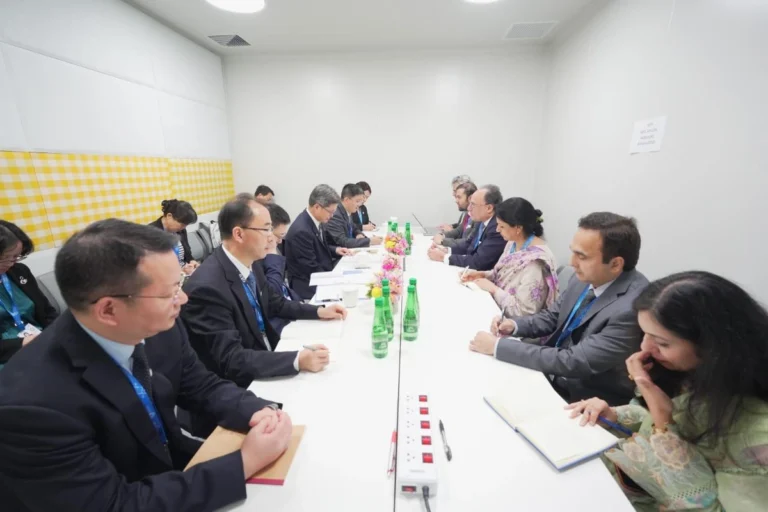
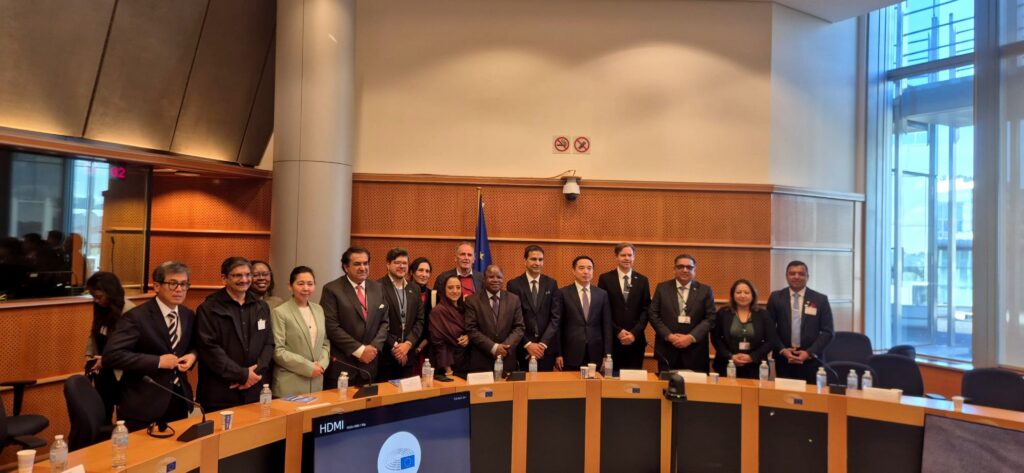
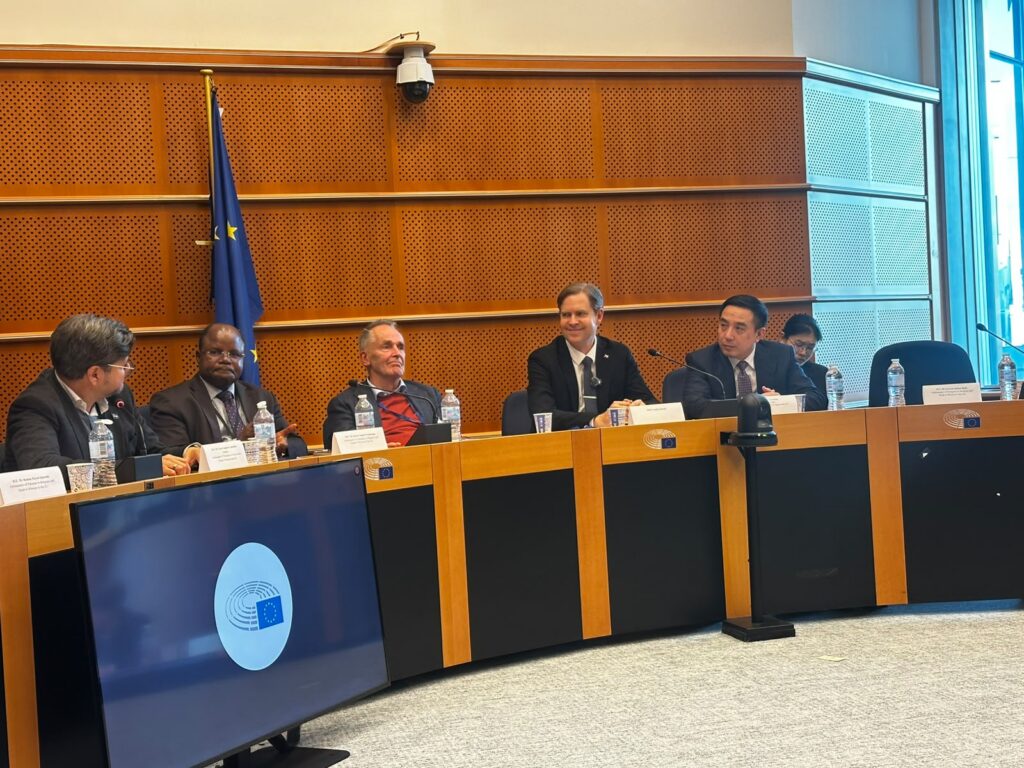
The session drew ambassadors from China, Nepal, Tanzania, Pakistan, Nicaragua and Indonesia, along with diplomatic representatives from Malaysia and Kenya.
Pakistan’s Ambassador to Belgium, Rahim Hayat, in his address “reaffirmed Pakistan’s commitment to multilateralism, with the UN at its center.”
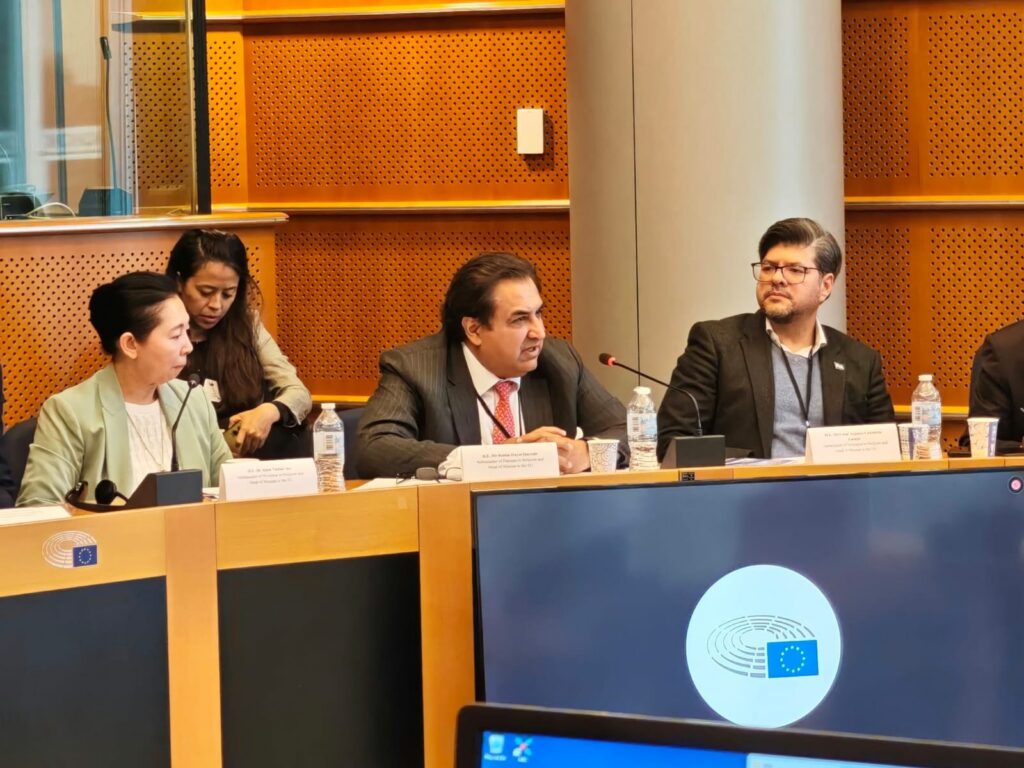
“He underscored the need for stronger global cooperation to foster respect for treaties and agreements as the bed-rock of the Rules-Based International Order. The Ambassador also underscored importance of inclusive international financial system, and enhanced collaboration on climate change and emerging technologies,” according to an X post shared by the Embassy.
Ambassador of Pakistan to Belgium, Luxembourg and the EU, @rahimhayat, delivered a statement at the European Parliament on “The Future of Global Governance,” organized by Members of European Parliament, @dostalondrej and @mvdschulenburg.
The Ambassador reaffirmed Pakistan’s commitment to multilateralism, with the UN at its center. He underscored the need for stronger global cooperation to foster respect for treaties and agreements as the bed-rock of the Rules-Based International Order. The Ambassador also underscored importance of inclusive international financial system, and enhanced collaboration on climate change and emerging technologies.
@ForeignOfficePk
@MoIB_Official
@epwing_official— Pakistan Embassy Belgium (@PakinBrussels) October 14, 2026
Dr. Asif told the gathering that the world was not short of international institutions. “It suffers from a shortage of trust, equal representation, and collective responsibility,” she said.
She argued that economic and political influence is spreading across more countries, but global governance structures have not kept pace.
Multilateralism, she said, is undermined when decisions are concentrated among a few powerful actors. “The challenge is not simply to manage a multipolar world,” she said. “It is to make multipolarity work for humanity.”
Dr. Asif said China’s contribution to the debate deserved serious attention. She pointed to President Xi Jinping’s Global Governance Initiative, introduced in September 2025, and its five principles: sovereign equality, international rule of law, multilateralism, a people-centered approach and practical action.
These speak to developing countries’ concerns about fairness and representation, she said, and merit “constructive engagement, rigorous discussion, and practical implementation.”
She cautioned against replacing one dominant power with another. Global governance, she said, should build a system “in which every nation has dignity, every region has a voice, and every institution carries responsibility.”
Dr. Asif described the European Union as living evidence that countries with different histories and interests can build institutions for collective progress.
She suggested Europe’s institutional experience and China’s development capabilities could complement each other on climate change, development finance, technology governance, trade and global health.
Turning to Pakistan, she described its partnerships with China, including the China-Pakistan Economic Corridor, and with the European Union, including the GSP+ trade framework, as complementary rather than competing.
Drawing on her doctoral research on the Shanghai Cooperation Organization, she called for a sustained Europe-Asia dialogue among parliamentarians, scholars, diplomatic institutions and emerging voices from the Global South.
International law must apply consistently, she said, and a developing country’s voice must not shrink because its economic or military power is smaller.
Dr. Asif closed with three reflections: “Multipolarity without cooperation will produce greater divisions. Multilateralism without equality will lose legitimacy. And global governance without justice will lose the trust of humanity.”
Pakistan, she said, stands ready to contribute “not merely as an observer of global change, but as a partner in shaping it.”

Established in December 2008, The Diplomatic Insight is Pakistan’s premier diplomacy and foreign affairs magazine, available in both digital and print formats.