When we talk about Rwanda’s remarkable record on women’s representation, its majority-female parliament, the conversation often centers on Kigali’s legislature.
Less visible but arguably just as important is the institution setting the ground for that success – the National Women’s Council (NWC), known locally as CNF (Conseil National des Femmes).
Established in 1996, in the aftermath of the genocide, the NWC was built as a structure through which Rwandan women could organize, be heard, and take part in rebuilding the country.
Rather than sitting as a single office in the capital, it was designed to run from the grassroots all the way up to the national level, giving women a formal channel for participation in local governance at every administrative tier.
Read More: Rwanda Launches African Academy for Women in Political Leadership
This grassroots design is the Council’s defining feature. At the village level, women elect their own representatives to sit on the Village Executive Committee of the National Women’s Council. Layer by layer, women elect delegates upward, creating an unbroken chain of representation.
The Council’s operations are set out in law, which establishes the General Assembly as its primary governing body, convening annually in the first quarter at every level, from the Village to the National.
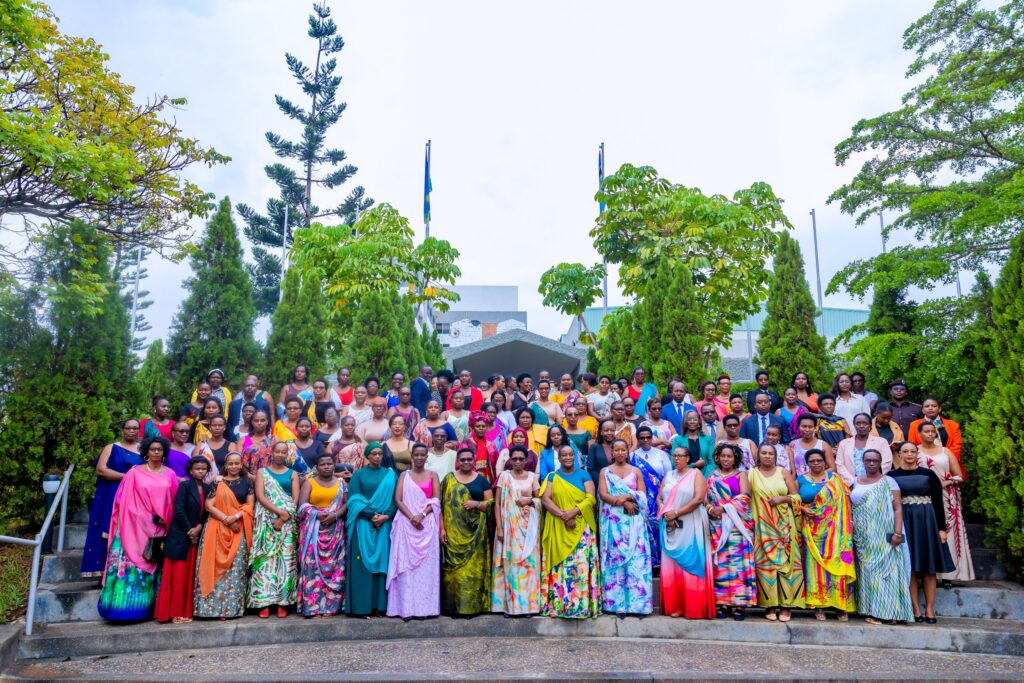
It is this General Assembly that reviews the Council’s performance and sets its direction. At the 23rd National General Assembly, held in September 2024 at Rwanda’s Parliament, roughly 180 women representatives gathered, alongside ministers and MPs, to review the prior year’s work and approve the coming year’s action plan, all under the theme “Women’s Development, National Development.”
Belancille Nyirajyambere currently chairs the Council as President while past presidents have been Dr. Jeannette Bayisenge and Dr. Diane Gashumba, both of whom went on to serve as government ministers; a reflection of how closely the NWC’s leadership pipeline feeds into national public life.
Read More: International Women’s Day Message: Fatou Harerimana, High Commissioner of Rwanda to Pakistan
The NWC’s mandate spans several interlocking functions:
- Advocacy and representation: Pushing for women’s voices in decision-making bodies at every level of local and national government.
- Capacity building: Running leadership trainings, mentorship, and peer-learning programs. In partnership with UN Women and government gender institutions, initiatives run through the Council have helped over a thousand women and girls strengthen their leadership skills and confidence in recent years, including women with disabilities and women living with HIV.
- Grassroots mobilization: Organizing women at the cell and village level around development priorities: cooperatives, savings groups, digital literacy, hygiene and sanitation, and civic participation, including turnout and engagement around elections.
- Community sensitization: Using its General Assemblies and local gatherings to raise awareness on issues like gender-based violence, child protection, school dropout, and teenage pregnancy.
Recent Council initiatives illustrate this reach. Its Mutimawurugo performance-contract program, for example, centers on model villages designed to empower women through digital literacy, links to microfinance institutions and SACCOs, and support for vocational training and household sanitation.
Rwanda’s Gender Story
The NWC is one piece of a larger institutional architecture, alongside the Ministry of Gender and Family Promotion, the Gender Monitoring Office, and the Forum of Rwandan Women Parliamentarians, that has helped make Rwanda a global reference point on gender equality.
Rwanda is the only country in the world with a female-majority national parliament. Following the 2024 elections, women’s representation in the Chamber of Deputies rose to roughly 63.75–64%, up from about 61% in the prior term. Women hold around 53–54% of Senate seats and 52% of Cabinet positions.
Rwanda’s Constitution guarantees a minimum 30% quota for women in decision-making bodies; a floor the country has long since exceeded.
At the local level, women now hold about 46–47% of elected cell council seats, and roughly 46% of district council seats; closing a gap that, historically, lagged behind national-level representation.
Read More: Rwanda Hosts Women Deliver 2023 Conference
On the 2024 World Economic Forum Global Gender Gap Index, Rwanda ranked 39th globally and 2nd in Africa, while remaining first in the world on women’s parliamentary representation.
None of that is a coincidence but a product of deliberate legal design, such as constitutional quotas, decentralized election structures, paired with organizing infrastructure like the NWC that turns quotas into genuine participation.
A majority-female parliament means little if women outside Kigali have no path into public life. The NWC’s elected, tiered structure is what turns constitutional guarantees into an actual pipeline.
It enables an ordinary woman in a village to have a formal, elected route to a voice that, in principle, connects all the way to national policy debates.

Established in December 2008, The Diplomatic Insight is Pakistan’s premier diplomacy and foreign affairs magazine, available in both digital and print formats.