Aden (TDI): A powerful explosion rocked Yemen’s temporary capital, Aden, on Tuesday, targeting a high-level military convoy in an incident that revives fears of a renewed wave of political assassinations and terrorist bombings that had largely subsided over the past two years.
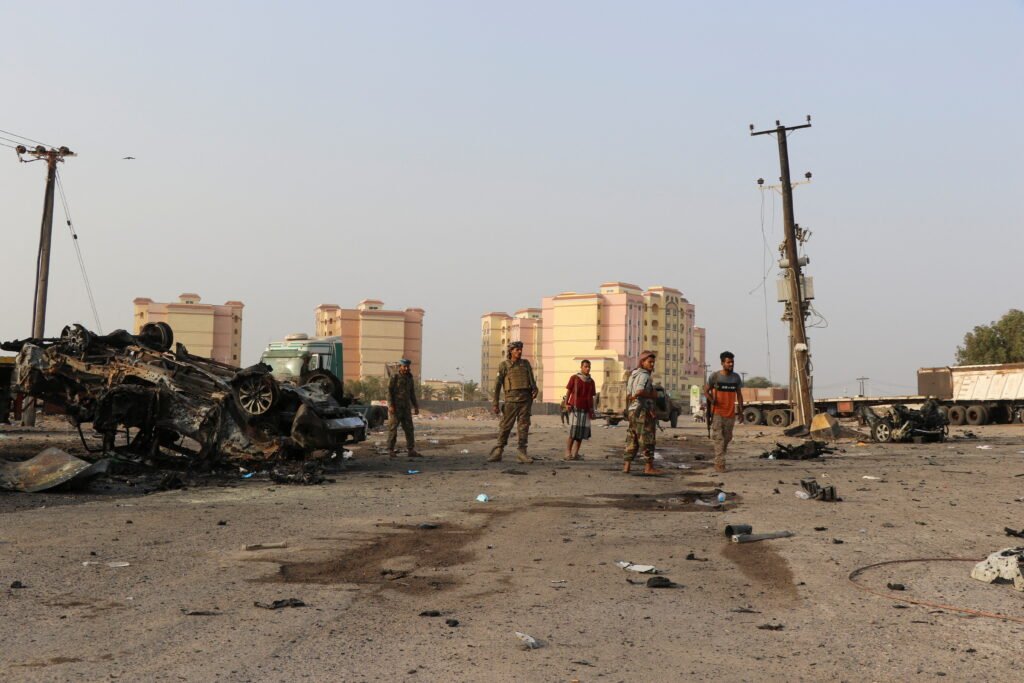
Security and military sources said a car bomb parked by the roadside in the Jawala area on the northern outskirts of Aden detonated as the convoy of Brigadier General Hamdi Shukri, a senior commander in the Southern Giants Brigades, was passing by.
The attack killed two soldiers from his escort and wounded five others, including Brig. Gen. Shukri, who was transferred to hospital for treatment. Several military vehicles were destroyed, and nearby civilian cars were damaged.
The attack comes at an extremely sensitive political and military moment, coinciding with the start of new security arrangements aimed at clearing Aden of armed formations.
Under the plan, internal security duties inside the city are to be handed over to police and security forces, while combat units, including those led by Shukri, are to be redeployed to front lines against the Houthi militia or to the city’s strategic entrances.
Brig. Gen. Hamdi Shukri, who hails from Al-Subaiha, one of the largest and most powerful tribes in southern Yemen, is among the commanders tasked by the Saudi-led security committee in Yemen with securing the temporary capital Aden and working to replace forces loyal to Aidarous Al-Zubaidi, who currently control the city, with national security forces.
The internationally recognized Yemeni government has not accused any party so far, limiting its response to a statement by the Ministry of Human Rights condemning what it described as a “terrorist attack.”
Read More: Saudi Arabia Announces $500m Development Plan for Southern Yemen
The Southern Giants Brigades, which received support and training from the United Arab Emirates during their participation in the Arab Coalition, are considered a cornerstone of the military structure in southern Yemen.
Observers believe that targeting a commander of this stature is intended to directly obstruct efforts to reorganize the military institution and disrupt stability initiatives led by the internationally recognized government.
Analysts also argue that the attack targets Saudi Arabia’s efforts, as Riyadh currently leads a military committee in Yemen seeking to unify armed formations under a single command, relocate military forces out of Aden, and replace them with security forces to ensure stability in the temporary capital.
Although no group has claimed responsibility at the time of writing, accusations in Yemen have followed two main tracks. Activists and local officials have accused the Houthi militia of being behind the attack in an attempt to destabilize liberated areas.
However, Saudi journalists have accused the United Arab Emirates of involvement. Abdullah Al Hutaillah, editor-in-chief of the Riyadh-based Okaz newspaper, hinted in a post on X that the UAE was behind the explosion, writing: “The sister Gulf state has begun its dirty game by carrying out terrorist operations in Aden.”
He explained his accusation by saying the UAE seeks to send a message to the world that it and its fugitive proxy Aidarous Al-Zubaidi and his allies have left a security vacuum that cannot be filled.
Saudi analysts echoed this view. Saudi analyst Mohammed Al-Amer said that “Aidarous’s Abu Dhabi cells (Aidarous Al-Zubaidi and Hani bin Buraik) have begun bombings in Aden, but God willing, everyone who tampers with security will be arrested.”
Read More: The Decisive Retake of Hadhramout by Saudi-backed Forces in Yemen
Other Saudis have accused Hani bin Buraik, vice president of the Southern Transitional Council headed by Al-Zubaidi, of being behind the attack. Bin Buraik has previously been accused of involvement in terrorist operations targeting prominent clerics opposed to the Transitional Council in Aden and Shabwa.
On the other hand, security experts have not ruled out the involvement of Al-Qaeda in the Arabian Peninsula (AQAP), particularly as the group still maintains notable activity in the neighboring Abyan governorate.
Experts note that the return of car bombings to Aden signals an attempt by terrorist cells to regain the initiative and test the security apparatus amid ongoing structural changes.
This attack is the most significant in Aden after a period of relative calm. The last major terrorist incident in the south dates back to October 21, 2025, when Al-Qaeda targeted a government complex in Abyan with car bombs and suicide attackers, killing four soldiers and five militants.
International reports describe the security situation in southern Yemen as fragile. The Yemeni government has repeatedly warned of what it describes as operational coordination and collaboration between the Houthi militia and Al-Qaeda, asserting that both sides exchange information and weapons to weaken the legitimate government’s front and undermine public security in southern governorates.
With this explosion, Aden enters a new phase of security challenges, placing the effectiveness of recent military arrangements and the ability of intelligence services to protect senior military leaders under intense international scrutiny.

Mahmoud Assamiee
Mahmoud Assamiee is a Yemeni Journalist who is currently working in Yemen News Agency,
the government news agency of Yemen. He has been writing in English and Arabic as a journalist for many
years in different domains, and is a leading member of the Yemeni Journalist Syndicate. He can be reached at mahmoudassamiee@gmail.com