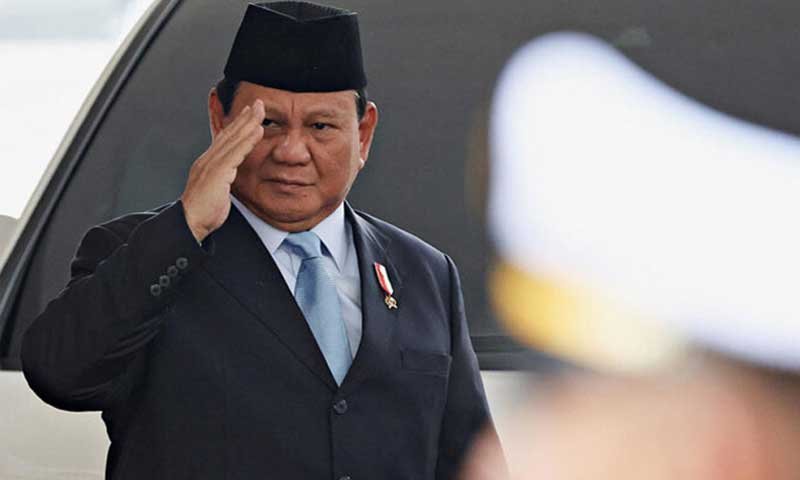
In a country navigating rapid economic growth alongside social and political challenges, the question arises: can a leader with both discipline and pragmatism guide Indonesia toward stability and progress? The presidency of Prabowo Subianto in October 2024 sparked both anticipation and scrutiny as he assumed leadership of one of southeast Asia’s largest democracies.
A former general and seasoned politician, Prabowo Subianto Djojohadikusumo became Indonesia’s 8th President in 2024, marking the culmination of a long career spanning the military, business, and politics.
Born on October 17, 1951, in Jakarta, Prabowo comes from one of Indonesia’s most powerful and intellectually influential families. He is the third of four children. His father, Soemitro Djojohadikusumo, was a distinguished economist who served in the administrations of both Sukarno and Suharto.
Although he initially worked closely with Sukarno, political tensions eventually forced him into exile, leading Prabowo to spend much of his childhood overseas. This upbringing exposed him to diverse cultures, and he became fluent in several languages, including French, German, English, and Dutch.
In 1983, Prabowo married Siti Hediati Hariyadi, the daughter of former President Suharto. The couple separated following Suharto’s resignation in 1998 and have one son.
Military Career and Controversies
Before formally entering politics, Prabowo rose to the rank of three-star lieutenant general. However, he was discharged from the military in 1998 following internal investigations. Over the years, he has faced allegations related to the abduction of pro-democracy activists, as well as human rights violations in Papua and East Timor, claims he has consistently denied.
He has been linked to controversial operations in East Timor, including a 1978 mission to capture Nicolau dos Reis Lobato East Timor’s first prime minister, and the 1983 Kraras massacre, in which over 200 civilians were killed.
Prabowo has strongly rejected these accusations, and none have resulted in legal proceedings. Though once barred from entering the US over these allegations, he was later awarded the honorary rank of four-star general by President Widodo in 2024.
Read More: Pakistan, Indonesia Agree to Deepen Trade, Health and IT Cooperation
These long-standing allegations, combined with some of his recent statements, have raised concerns among human rights advocates, who argue that Indonesia’s democratic institutions remain vulnerable.
Former President B.J. Habibie once claimed that Prabowo arrived at the presidential palace with armed soldiers during the tense transition of 1998, an allegation Prabowo denied. More recently, he described democracy as tiring, costly, and disorderly, suggesting that significant improvements were needed.
Political Career, Presidential Victory
Prabowo entered politics in 2004, seeking the Golkar Party’s presidential nomination. He fails to secure it but remains on the party’s advisory board until 2008, when he resigns to launch his own Gerindra Party.
In 2009, Gerindra partnered with the Indonesian Democratic Party of Struggle (PDI-P) to nominate Prabowo as vice president on Megawati Sukarnoputri’s ticket; they lost to Susilo Bambang Yudhoyono and Boediono. He contested the presidency election in 2014 and 2019, losing both times to Widodo, but later reconciled and joined his cabinet as defense minister.
The 2024 presidential election represents the peak of Prabowo’s political journey. Partnering with Gibran Rakabuming Raka as his deputy, he campaigns on themes of sustainability and the advancement of national strategic initiatives.
Supported by a broad coalition, Prabowo secures a decisive one-round victory, confirming his role as President for the 2024–2029 term. As President, Prabowo faces both complex global geopolitical challenges and pressing domestic priorities to accelerate Indonesia’s economic growth.
Prabowo’s past continues to influence his presidency. He forms a Cabinet of over 100 members , his Cabinet includes longtime friend and former military colleague Sjafrie Sjamsoeddin as defense minister, whose career in Kopassus involved operations in East Timor, Aceh, and Papua.
Their appointments highlight the military’s renewed role in Indonesian politics. While this experience strengthens their governance capabilities, but human rights advocates warn that it may pose risks for Indigenous communities, pro-independence groups, and other vulnerable civil society actors.
Read More: Pakistan, Indonesia Set to Deepen Ties as President Prabowo Lands in Islamabad
Asta Cita, Leadership Style and Diplomacy
As President, Prabowo pursues a vision called Asta Cita, consisting of eight core missions that guide his administration focuses on Ideological Strengthening, National Independence, People’s Economy, and Human Resource Development.
Among his flagship initiatives is the Free Nutritious Meal Program for schoolchildren and pregnant women, designed to reduce stunting and improve the next generation’s quality, which he considers Indonesia’s most valuable asset.
Drawing on his experience as defense minister, Prabowo maintains an extensive diplomatic network. His leadership style is firm yet pragmatic. Internationally, he emphasizes a free and active foreign policy, prioritizing Indonesia’s national interests while fostering friendly relations with all nations. His “good neighbor policy” aims to attract foreign investment while safeguarding the country’s sovereignty.
As the 8th President, he carries the aspirations of millions, blending military discipline, business experience, and political insight, Prabowo now leads Indonesia with the goal of realizing the nation’s independence, stability, and sustainable growth.

Minahil Khurshid holds a master’s degree in Peace and Conflict Studies from CIPS, NUST. She has a strong interest in current affairs, geopolitics, and policy analysis.