New York (TDI): After more than three decades as a United Nations member state, Kyrgyzstan has secured a seat on the United Nations Security Council for the first time in its history.
The UN General Assembly elected Kyrgyzstan on Wednesday to serve as a non-permanent member of the Security Council for a two-year term beginning on 1 January 2027, alongside Austria, Portugal, Trinidad and Tobago, and Zimbabwe.
Kyrgyzstan led the first ballot with 105 votes to the Philippines’ 85, before steadily increasing its support through three head-to-head rounds of voting, ultimately prevailing by 142 to 49 in the fourth round.
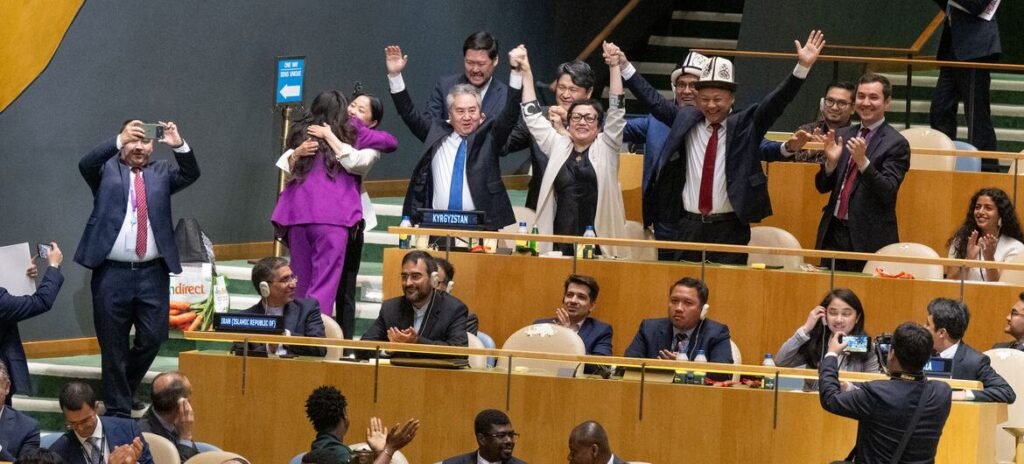
Delegates from the Kyrgyz mission broke into applause and celebration in the General Assembly Hall immediately after the result was announced.
Kyrgyzstan wins seat on UN Security Council for first time ever https://t.co/MAhLjdcvZm
— Kyrgyz Mission to UN (@KyrgyzMissionUN) June 4, 2026
The election marks a historic milestone for Kyrgyzstan, which will serve on the Security Council for the first time since joining the United Nations in 1992.
It is also the first Central Asian country to win election to the 15-member body in more than a decade, following Kazakhstan’s seat during the 2017–2018 term.
Bishkek had been campaigning actively for the seat. President Sadyr Japarov urged world leaders to support Kyrgyzstan’s bid, calling for greater representation of countries that have never held a Council seat.
On the eve of the vote, Kyrgyzstan’s Foreign Minister Jeenbek Kulubaev called on the UN to reform the Council by expanding representation from Asia, Africa, and Latin America among its permanent members.
Read More: Five Countries Elected to UNSC as Germany Fails in Bid
The incoming members will take their seats at a moment when the Council faces some of its most difficult tests in years, with deep divisions over conflicts including Ukraine and Gaza having led to repeated stalemate, and the use of vetoes at times preventing agreement on resolutions addressing major crises.
The Security Council comprises 15 members; five permanent members, China, France, Russia, the United Kingdom, and the United States, who hold veto power, and 10 non-permanent members elected for staggered two-year terms.
While non-permanent members cannot veto resolutions, they can meaningfully shape negotiations and spotlight issues of concern to their regions.
The five newly elected countries will replace Denmark, Greece, Pakistan, Panama, and Somalia when their terms conclude at the end of 2026.
For Kyrgyzstan, a landlocked nation of around seven million people in the heart of Central Asia, the victory represents an opportunity to amplify its voice on the world stage.