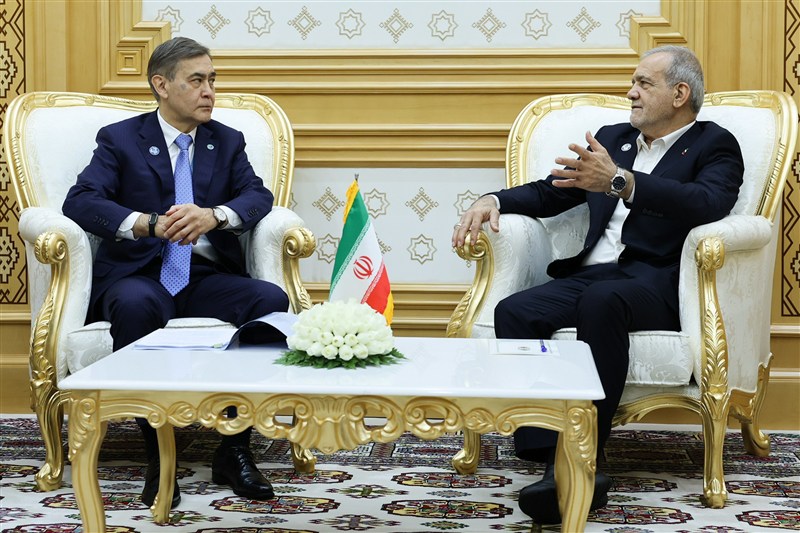
Tehran (TDI): Iranian President Masoud Pezeshkian has urged the Shanghai Cooperation Organization (SCO) to ensure that US domestic policies do not influence its decisions, warning that such considerations could weaken the organization’s unity and collective effectiveness.
Pezeshkian made the remarks during a meeting with SCO Secretary-General Nurlan Yermekbayev on the sidelines of a summit in Turkmenistan on Friday, according to Iran’s Tasnim News Agency.
The Iranian president said multilateral organizations such as the SCO and BRICS were established to provide common frameworks for financial, economic, trade, security and political cooperation among their member states.
He argued that allowing the domestic policies of an external power to shape decisions within such organizations could undermine their cohesion and ability to act collectively.
“If the domestic policies of a country like the US are allowed to influence the decisions of these summits, these organizations will lose their power and cohesion,” Pezeshkian said, according to Tasnim.
Read More: SCO Members Conduct Joint Counterterrorism Drills in Belarus
He added that some SCO decisions concerning Iran continued to be influenced by considerations of Washington’s position. Pezeshkian called for multilateralism to take precedence over unilateral policies and approaches based on coercion and colonialism. He questioned why countries should not be able to strengthen relations with neighbouring states independently of the policies pursued by distant powers.
He also stressed the need for stronger regional cooperation and greater independence in collective decision-making, urging SCO members to resolve disputes through dialogue rather than coercion.
Beyond decision-making independence, Pezeshkian emphasized the need to translate agreements and summit declarations into practical outcomes.
He urged the SCO secretary-general to ensure that decisions taken by the organization’s leaders were implemented, saying that shared understanding and coordinated action were essential to achieving its objectives. The Iranian president also called on countries to cooperate in preventing powerful states from exerting pressure on others.
He described a vision of a world in which people could live in prosperity, security and good health without countries seeking to seize or exploit the resources of others. Pezeshkian reaffirmed Iran’s commitment to its principles and to cooperation through multilateral platforms.
Yermekbayev agreed on the importance of multilateralism, describing the SCO as a platform for translating commitments made by heads of state and government into practical action.
He referred to the organization’s 25-year record of implementing commitments by member-state leaders, while acknowledging that proposals required concrete mechanisms and frameworks to be put into effect.
Read More: Iran Says Security, Counterterrorism Cooperation is Main Goal of SCO Drill
The SCO chief suggested that member states appoint coordinators to monitor proposals and follow up on their implementation. He also emphasized that decisions within the organization depended on consensus among its members.
Yermekbayev noted that some member states placed greater emphasis on bilateral relations than on cooperation through the organization as a whole, a situation that could result in decisions that were not fully aligned with the SCO’s broader policies.
To address implementation gaps, he proposed compiling a list of agreements with Iran that remained unfulfilled, allowing them to be pursued through ambassadors and other representatives.
Yermekbayev also reaffirmed the SCO’s commitment to peace, respect for territorial integrity and the non-use of force. He said countries had the right to use nuclear energy for peaceful purposes while complying with nuclear non-proliferation principles.
The meeting highlighted both Tehran’s call for greater autonomy in the SCO’s collective decisions and the organization’s emphasis on consensus, coordination and the implementation of commitments already made by its members.