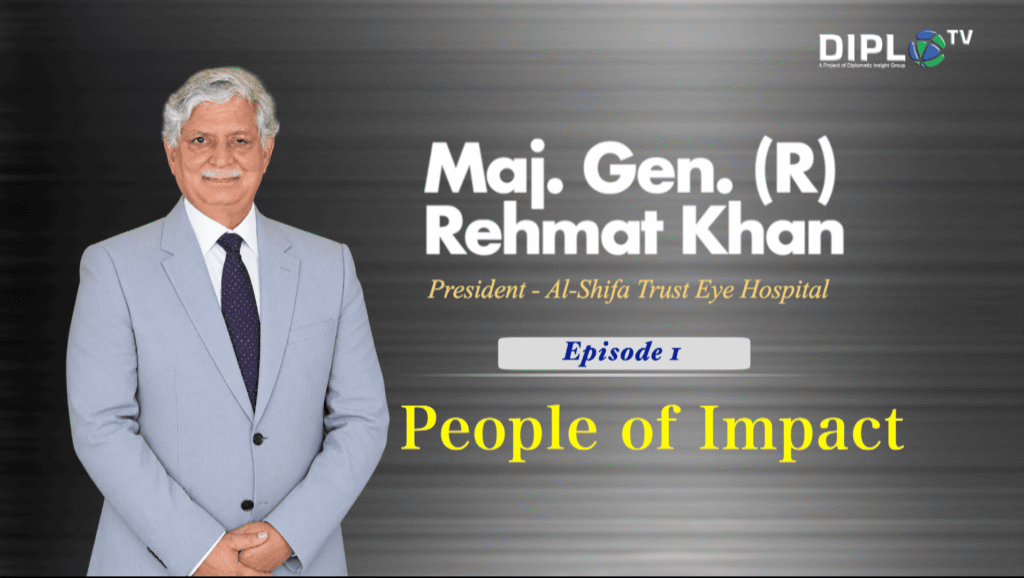
In this episode of People of Impact, Dr. Farhat Asif speaks with Maj. Gen. (R) Rehmat Khan, President of Al-Shifa Trust Eye Hospital, about his journey from military and corporate leadership to serving in the nonprofit healthcare sector.
The conversation explores Al-Shifa Trust’s mission to combat blindness in Pakistan, its commitment to providing quality eye care free of cost, its outreach to underserved communities, and its focus on research, medical training, and technological advancement.
Maj. Gen. (R) Rehmat Khan also discusses the Trust’s international collaborations, its support for patients from other countries, and its plans to expand its network of hospitals.
To watch the full interview, click the link below!
TDI: You have served in the military, the corporate sector, and now in healthcare. What inspired you to dedicate this chapter of your life to Al-Shifa Trust?
Maj. Gen. (R) Rehmat Khan: To be honest, I was ushered into this role somewhat accidentally. My predecessor was a friend of mine, and he inducted me as one of the trustees. There are 19 trustees, and I was one of them.
Unfortunately, my predecessor passed away after a very brief illness. According to our system, one of the trustees had to be elected as President of the Trust, and the trustees decided to elect me.
I had never thought that I would be managing a charity in my life. But I was essentially thrown into this responsibility of serving the people of Pakistan. I consider it a great honor to be of any service to the people of Pakistan.
TDI: Could you tell us about Al-Shifa Trust? What are its core values, and what exactly does Al-Shifa Trust Eye Hospital aim to achieve?
Maj. Gen. (R) Rehmat Khan: Al-Shifa Trust is, as I like to say, an asset for Pakistan. We have a mission to eliminate blindness in Pakistan.
Over our 30-year journey as a Trust, we have treated more than 35 million people. Our treatment is not limited to outpatient services. It includes very complex procedures and treatments for conditions such as eye cancer, retinopathy, glaucoma, and corneal diseases, including corneal transplants.
We provide all types of eye treatment to the people of Pakistan, and what is more important is that we provide this treatment free of cost. We give treatment without asking questions and, above all, we give dignity to our patients.
TDI: Since becoming President of Al-Shifa Trust, what achievements are you particularly proud of?
Maj. Gen. (R) Rehmat Khan: There have been very proud moments, as well as moments of grief, when managing a hospital chain. But I would highlight our expansion of services.
One of the proudest moments has been the project we initiated to establish a state-of-the-art eye hospital in Lahore. We have a foreign architecture firm and a foreign project management company working on the project.
I was in China two weeks ago, and one of the people I met there, a senior executive associated with one of their largest hospital chains, asked me how we were collecting so much money and where the funding was coming from.
I told her that we were collecting money from the people of Pakistan to be spent on the people of Pakistan.
She asked me this question three times because she did not believe that I would be able to collect $25 million to construct this hospital in Lahore.
I am very confident that the project will move forward and will not be held up. Insha’Allah, it will be completed within two years, and we should be functioning by July or August 2028.
TDI: Al-Shifa Trust has grown significantly over the years. What makes it unique compared with other hospitals, not only in Pakistan but internationally?
Maj. Gen. (R) Rehmat Khan: I would highlight three points.
First of all, as a system, we believe in a triangle headed by quality. Our number one value is that we must provide quality eye care and treatment.
Second, we need sympathetic and competent professionals. Competence among our doctors, paramedical staff, and optometrists is extremely important.
Third, we have to be very cost-effective.
These are the three points within which we operate. These are our operational values.
As a principle, we also want to give dignity to our patients. Someone once told me that the sympathy you have for people is among the qualities associated with the names of Allah Almighty. If our doctors demonstrate that compassion as part of their routine, then we are trying to follow that principle.
TDI: Al-Shifa Trust serves many people who cannot afford treatment. How do you ensure that they receive the same quality of healthcare?
Maj. Gen. (R) Rehmat Khan: I would again highlight three points.
Anyone who comes to our hospital should leave talking about the quality of care and the treatment they received.
I would refer to a comment made by Shahzad, an accomplished actor in Pakistan. He said that he had seen equality where there was no difference between the rich and the poor in two places: the mosque and Al-Shifa Trust Eye Hospital.
We want to be known as a hospital where the quality of service is unmatched.
Second, we reach out to the remotest areas. We have the Al-Shifa Centre for Community Ophthalmology, through which we reach far-flung areas of Pakistan, from north to south, and provide services at people’s doorsteps.
Third, people in the media can support us by telling people that this is where they can seek treatment. Many times, I am less concerned about whether we receive donations and more concerned about whether people know that we can provide this service.
TDI: As one of the major eye-care institutions in Pakistan, how important are research and training facilities in improving eye care in the country?
Maj. Gen. (R) Rehmat Khan: Our research center has been recognized as one of the best in Pakistan and is internationally recognized. Our research is not limited only to eye diseases because other diseases can also have an impact on the eyes.
For example, when you visit an eye specialist, one of the first questions you may be asked is whether you are diabetic.
We have conducted research in the past and continue to do so. We cover a broad spectrum of medical science, and our research center is well organized and staffed by highly qualified professionals.
We are also a teaching hospital. Every year, we select between 16 and 20 people for FCPS eye specialization and then subspecialization.
In the five or six years that I have been here, I can say that I have not seen a single case where someone was selected outside merit. I would challenge anyone to show me one such case.
We have not taken pressure from any quarter, whether from senior government officials, friends, or relatives. We have promoted merit.
The quality of our training is also significant. When I interview people for induction at Al-Shifa Trust, I ask trainees how many surgeries they have performed. They may have performed somewhere between 10 and 50.
Under our supervision, however, by the third or fourth year, a trainee may have independently performed more than 500 surgeries. That demonstrates the quality of training, the quality of induction, and the quality of our research.
TDI: What international partnerships does Al-Shifa Trust have for training and research?
Maj. Gen. (R) Rehmat Khan: The Royal College of Medicine is a very well-known institution worldwide. We are the only hospital in the region, apart from an institution in India, affiliated with the Royal College.
The examinations are conducted here at our hospital. Pakistani doctors do not have to travel to the UK to appear for these examinations. The examination team comes here, and they conduct the examinations every year.
In research, we have linkages with several well-known institutions. We have also conducted clinical trials for the Bill & Melinda Gates Foundation.
We are also helping other countries. Because of the situation in Afghanistan, we are not currently sending camps there, but we routinely receive Afghan patients. Some of those who come to us are suffering from serious conditions, including eye cancer, and we treat them free of cost.
This year, we are planning medical and eye camps in two countries: Kenya and Uzbekistan. In Uzbekistan, we have referred the case to our Foreign Office, and once we receive clearance, we will proceed. In Kenya, we are working through the OIC office here, which is sponsoring the collaboration.
Last year, we sent a camp to Somalia.
It is important for the people of Pakistan to feel proud that we are also helping other Muslim countries where healthcare facilities are inadequate.
TDI: Healthcare technology is changing rapidly, and we are now living in the age of artificial intelligence. How is Al-Shifa Trust incorporating technology into its healthcare and administrative systems?
Maj. Gen. (R) Rehmat Khan: I would first talk about the other equipment and machinery we have before discussing AI.
I have a relative living in Australia who came to Al-Shifa because she was suffering from glaucoma. She received her tests and treatment here. When she returned to Sydney, she needed follow-up treatment.
When she showed her test reports and diagnosis to doctors there, she was asked where the tests had been carried out. She told them they had been done in Pakistan.
She was told that they did not have the same latest machinery and that the tests and treatment provided here were appropriate. She was advised to continue with the recommended treatment.
As for AI, I mentioned that I was in China two weeks ago, and one of the reasons for that visit was to explore this area. We are now working toward incorporating equipment in which AI software is already integrated.
TDI: What role do the private sector and philanthropists play in supporting Al-Shifa Trust and expanding access to healthcare?
Maj. Gen. (R) Rehmat Khan: There is an impression in Pakistan that only glamorous personalities, celebrities, or recognized national figures can collect funds for charity. I do not think this is entirely correct.
What people really look at is the management of a charity. They want to know whether the organization is honest and whether it is delivering the promised service.
When we provide quality service, deliver it free of cost, and have no personal agenda whatsoever, people open their hearts and support us.
TDI: What is your vision for Al-Shifa Trust over the next five to ten years?
Maj. Gen. (R) Rehmat Khan: I may not be around in ten years, but I can talk about the next five.
Apart from Lahore, we want to establish a hospital in Karachi. The Governor of Khyber Pakhtunkhwa has visited us, and the Chief Minister’s Office is also in contact with us. Although we already have a hospital in Kohat, we want to establish another hospital in Peshawar.
So, these are three places where we would like to establish hospitals.
I know I am stretching myself, but if the Chinese can manage a chain of 700 hospitals, I can manage these 15 hospitals.
TDI: Finally, for DiploTV, our audience includes ambassadors, diplomats, young people, philanthropists, and others interested in your work. What message would you like to share with them?
Maj. Gen. (R) Rehmat Khan: First, I want to assure everyone that if I were to describe my vision for ten years, I would say that we will eliminate, at the very least, preventable blindness in Pakistan, if not blindness altogether.
That is the direction in which we are working. We want to eliminate preventable blindness.
My second message is that any eye disease that can be treated anywhere in the world can, by the grace of God, be treated by us, and we are treating it.
My third message is that our treatment is based on quality. We believe in empathy and sympathy for people, and we believe in giving them dignity.
I would also like to tell the people of Pakistan who donate to us that they can verify where their donations go. Whatever they donate, we add our affection and passion to it, and we deliver a much greater value in terms of the service provided.

Established in December 2008, The Diplomatic Insight is Pakistan’s premier diplomacy and foreign affairs magazine, available in both digital and print formats.