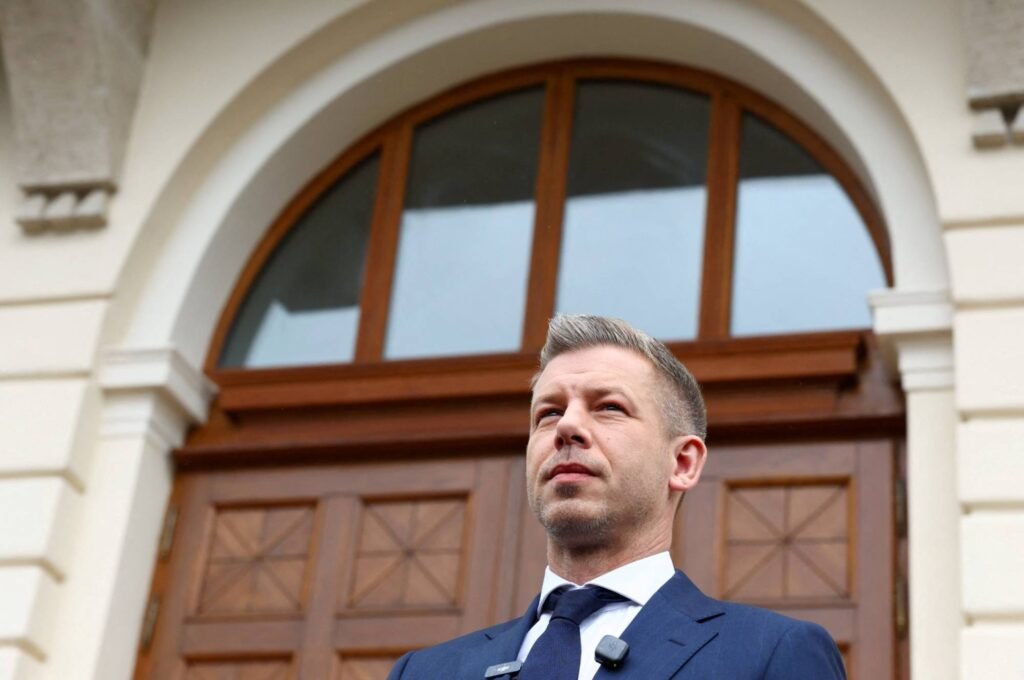
Warsaw (TDI): Hungarian Prime Minister Péter Magyar arrived in Poland on Tuesday for his first official trip abroad since taking office, meeting with Polish Prime Minister Donald Tusk in what both governments are calling the dawn of a new era in Polish-Hungarian relations.
The choice of Poland as his first destination carries clear symbolic weight. Magyar is seeking both to draw a line under the Viktor Orbán era and to build a bloc of Central European countries capable of wielding genuine influence within the European Union.
Magyar’s itinerary spans Kraków, Warsaw, and Gdańsk, and he arrived with an unusually large delegation that includes six cabinet ministers; a signal of how seriously Budapest is treating the relationship.
The visit comes weeks after Magyar’s Tisza party ended Orbán’s 16-year grip on power in April’s general election. Tisza secured 138 out of 199 parliamentary seats, and polling shows 91% of the party’s voters want the new government to fundamentally change Hungary’s approach to the EU.
Read More: Hungary Signals Policy Shift, PM-Elect Peter Magyar Backs ICC Warrant for Netanyahu
The two leaders come from different political traditions, but their paths to power share striking parallels. Tusk returned to office in 2023, ending the eight-year rule of the Orbán-aligned Law and Justice party.
These 8 years were marked by clashes with Brussels, frozen EU funds, and rule-of-law disputes. Tusk campaigned on restoring judicial independence and normalizing relations with the EU.
Magyar has proposed merging the Visegrad Group, the informal alliance of Hungary, Poland, the Czech Republic and Slovakia, with the Austerlitz format, comprising the Czech Republic, Slovakia and Austria; arguing that such a combined bloc could exercise greater sway over EU cohesion fund policy.
“The peoples of central Europe are stronger together than apart,” he said ahead of the trip. The economic stakes are also considerable.
Read More: In Hungary, Viktor Orbán’s Rule Comes to an End After 16 Years
The EU has tied the release of up to €35 billion in frozen funds to sweeping reforms and a shift in Budapest’s stance on Ukraine.
European Commission President Ursula von der Leyen struck an optimistic tone, saying the EU would work with the new government to achieve “swift and overdue progress.”
Among the immediate priorities is unlocking roughly €10 billion in COVID-19 recovery funds, contingent on Hungary meeting 27 milestones; mostly relating to judicial independence and anti-corruption measures, before the Recovery and Resilience Facility closes at year’s end.
Poland’s reception has been warm. Warsaw’s deputy foreign minister voiced hope for more “loyal” cooperation going forward, and the visit is being framed in Polish media as the possible start of a transformed relationship.