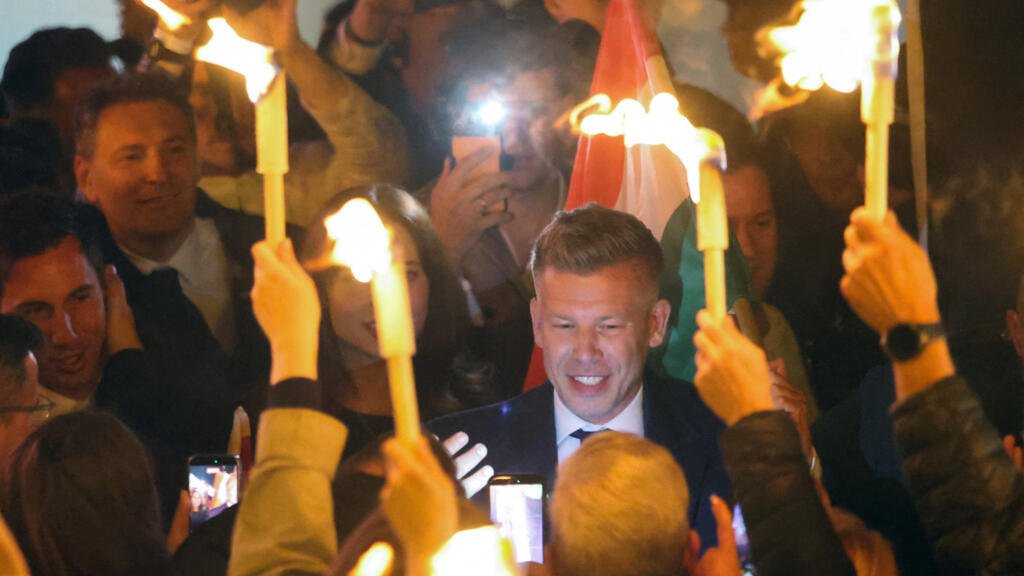
Budapest (TDI): Early results from Hungary’s parliamentary election indicate a dramatic political shift, with opposition leader Péter Magyar and his Tisza party taking a decisive lead over Prime Minister Viktor Orbán’s long-dominant Fidesz party.
Partial official results on Sunday showed Tisza heading toward a landslide victory, prompting Orbán to concede defeat after 16 years in power. Magyar announced that the prime minister has personally called to congratulate him as celebrations erupted across the capital.
The election, marked by high voter turnout of 80%, reflects a significant appetite for change among Hungarian voters. Tisza’s strong performance positions it to secure a two-thirds parliamentary majority, a threshold that would allow it to amend the constitution and reverse key policies enacted during Orbán’s tenure.
Magyar, a former insider who broke with the ruling establishment, campaigned on promises of tackling corruption, restoring democratic institutions, and improving relations with the European Union.
His message appears to have resonated widely, drawing support from a broad coalition of voters dissatisfied with economic conditions and governance under Fidesz.
Read More: JD Vance Visits Budapest Days Before Hungary Election to Back Orbán
Orbán, one of Europe’s longest-serving leaders and a prominent figure in right-wing populist politics, acknowledged the scale of the defeat, describing the result as clear and decisive.
His government had faced mounting criticism in recent years over its stance on media freedom, judicial independence, and relations with Brussels.
Scenes of jubilation filled Budapest as supporters of the opposition gathered to celebrate what many described as a historic turning point. Some voters expressed hope that a Magyar-led government would “build bridges” and create a more inclusive political climate after years of deep polarization.
A Tisza-led administration is expected to pursue closer alignment with the European Union and potentially unlock billions in frozen funding, while also recalibrating the country’s foreign policy stance.
Meanwhile, Magyar will need to unify a diverse support base and navigate entrenched institutions shaped by years of Fidesz rule. The election, however, is already being viewed as one of the most consequential in the country’s post-communist history.