Freedom Holding Corp.’s stock has risen more than twelvefold in seven years in Nasdaq. Behind that growth is a transformation from a brokerage business into a digital ecosystem that founder Timur Turlov sees as both a competitive advantage and a potential export for Kazakhstan. Backed by growing institutional investor interest, Freedom’s expansion offers a real-world test of that strategy, which, so far, appears to be successful.
Seven Years of Growth
On October 15, 2026, Freedom Holding Corp. (FRHC) shares closed at $180.39 on the Nasdaq stock exchange, giving the company a market capitalization of $11.45 billion. Seven years earlier, when the stock began trading on Nasdaq under the ticker FRHC, the figures were on a very different scale. The shares debuted at $14.40, and the company’s market capitalization exceeded $800 million.
“We are very pleased to become part of this major stock market… A Nasdaq listing gives us access to a large number of clients and opens up new growth opportunities,” said Freedom Holding founder and CEO Timur Turlov at the time of the listing. He was right: over the past seven years, the company’s share price has increased 12.5-fold.
The stock has traded even higher at times. In August 2025, the stock reached an intraday high of $194.01, putting the company’s market capitalization at approximately $11.76 billion.
During its seven years on Nasdaq, Freedom’s share price has significantly outperformed the broader US small-cap market. Thus, the Russell 2000, a representative index of US small-cap stocks, gained 80% over the same period.
The company’s inclusion in the Russell 3000 (where the Russel 2000 is a small-cap part of it) in June 2025 marked recognition of its scale and standing in the US equity market. The index tracks approximately 3,000 of the largest publicly traded US companies, representing about 98% of the investable US equity market, with the Russell 2000 being a small-cap segment of the Russell 3000.
Compared with publicly traded fintech companies, Freedom’s shares on Nasdaq significantly outperformed its peers. From January 2 to September 30, 2026, Freedom shares rose 34.7%, compared with a 21.3% gain for Kazakhstan-based Kaspi.kz. Over the same period, SoFi Technologies fell 42.8%, Klarna dropped 56.6%, Upstart declined 49.8%, Nu Holdings lost 25.6%, PayPal fell 9.6% and Affirm slipped 6.5%.
Ecosystem Approach
By the time it made history as the first financial firm from the CIS region to list on a major US exchange in autumn 2019, Freedom Holding was a compact, specialized financial group with a presence in a handful of countries across Eastern Europe and Central Asia. Its services included retail securities brokerage, investment counseling, securities trading, market making, corporate investment banking, and underwriting. These services were provided through several brokerage firms, banks, the Freedom24 online trading portal for retail clients, and the TraderNet platform for qualified investors. These businesses were brought together under the US-incorporated Freedom Holding Corp. ahead of its Nasdaq listing.
Over the seven years since its Nasdaq listing, Freedom Holding has evolved from a brokerage-led financial group into a diversified digital fintech ecosystem present in 24 countries in the US, Europe and Asia. Its operations now span brokerage, banking, insurance and payments, as well as consumer services such as online grocery shopping, travel booking and event ticketing. The group is also expanding into telecommunications and digital infrastructure, including cloud computing and artificial intelligence.
Read More: How Timur Turlov Forged the Global Freedom Holding Corp.
At the center of this universe is Freedom SuperApp, which brings most of the services together on a single mobile platform. Launched in Kazakhstan, it connects banking, investments, insurance, payments and everyday consumer services, using data analytics and AI to personalize the offer and encourage customers to use more of the ecosystem. As of June 30, 2026, Freedom Holding served 8.7 million customers across its business segments. Together with partner projects within its ecosystem, Freedom serves more than 14 million customers.
For fiscal 2026, ended March 31, Freedom Holding Corp. reported net revenue of $2.19 billion, up from $2.00 billion a year earlier. Net income more than doubled to $153.3 million from $76.2 million. In the first quarter of fiscal 2027, ended June 30, net revenue rose 40% year over year to $732.5 million. Total assets reached $14.05 billion, compared with $13.16 billion at the end of fiscal 2026.
From Vision to Export
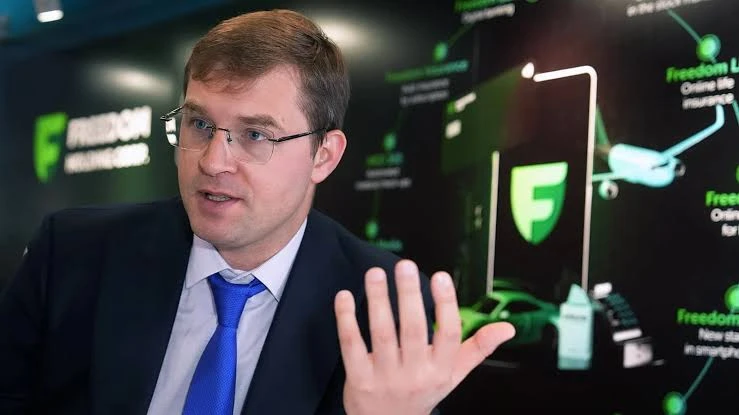
Timur Turlov began publicly outlining the logic behind building a digital ecosystem around Freedom’s financial business in August 2020. In a column for Forbes Kazakhstan, titled “Becoming an Ecosystem,” he argued that companies could strengthen their competitive position by offering additional products and services to their existing customer base and integrating them into a broader ecosystem. He argued that companies operating within ecosystems would benefit from the synergies between their services.
A year and a half later, the idea had become a clearly articulated strategy for Freedom Holding. In another interview with Forbes Kazakhstan in December 2021, Turlov explained that the company’s strategy was to integrate a wider range of businesses into one ecosystem. “Today, specialized players focused on a single business line inevitably lose market share in competition with companies offering a broader range of services. We see how different businesses brought together in one ecosystem complement one another and expand the sales funnel while reducing customer acquisition and servicing costs,” he said. That same month, Freedom announced the acquisition of ticketing service Ticketon and online payment aggregator PayBox.money, adding lifestyle and payment services to its business.
By 2026, Turlov was framing the idea in broader economic terms. In a column for Oninvest, he argued that digital ecosystems could become not just a way for companies to compete, but a source of export revenue for Kazakhstan. In his view, the next stage of economic development would be driven by knowledge and technology, with countries creating value by exporting digital services and platforms rather than relying primarily on raw materials or manufactured goods.
Wall Street Takes Notice
Timur Turlov’s vision of digital ecosystems and Freedom Holding’s progress in turning that vision into reality are finding support in the market. This is reflected in the company’s shareholder base, which includes some of the most prominent names in the financial industry.
Among the ten largest institutional holders, listed by Nasdaq, BlackRock held 597,074 shares valued at $107.7 million as of June 30, 2026, making it the largest institutional investor in Freedom Holding. State Street held 230,249 shares worth $41.5 million, followed by Geode Capital Management with 171,415 shares valued at $30.9 million. AQR Capital Management held 115,495 shares worth $20.8 million, while Morgan Stanley held 109,215 shares valued at $19.7 million. Other names among the top ten were Vanguard Group, Northern Trust, UBS Group, Bank of New York Mellon and JPMorgan Chase.

Established in December 2008, The Diplomatic Insight is Pakistan’s premier diplomacy and foreign affairs magazine, available in both digital and print formats.