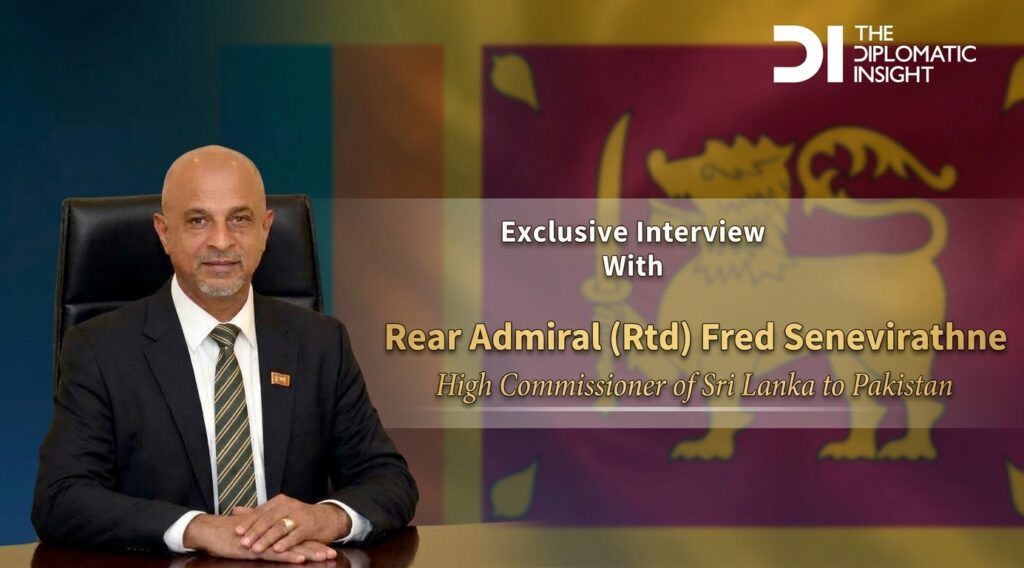
Rear Admiral H.L.A.D. Fred Senevirathne (Retd.) is serving as the High Commissioner of Sri Lanka to Pakistan, bringing to the diplomatic assignment 34 years of distinguished service in the Sri Lanka Navy. This is his first diplomatic posting, following a long military career during which he rose to the rank of Rear Admiral.
His assignment in Pakistan carries a particular personal significance. He first arrived in Pakistan in 1985 for military training, shortly after joining the Sri Lankan forces. Nearly four decades later, he returned to the country as High Commissioner, describing the experience as a homecoming.
As Sri Lanka’s representative in Pakistan, Rear Admiral Senevirathne has placed emphasis on strengthening the longstanding relationship between the two countries and translating their historic ties into greater practical cooperation. His priorities include political engagement, trade and investment, tourism, cultural exchanges and the revitalization of economic cooperation under the Pakistan-Sri Lanka Free Trade Agreement.
In this exclusive interview with Diplomatic Insight, Rear Admiral Senevirathne reflects on his transition from naval service to diplomacy, his enduring connection with Pakistan, and his vision for advancing Sri Lanka-Pakistan relations. He discusses the opportunities for stronger economic and cultural cooperation, the importance of people-to-people ties, and the role of diplomacy in turning longstanding goodwill into meaningful partnerships.
TDI: What inspired you to pursue a career in diplomacy?
Allow me first to express my sincere appreciation to DIPLOMATIC INSIGHT Magazine for providing me with this valuable opportunity. It is a great honour to contribute to such a respected publication and to share my views on the current state of relations between Sri Lanka and Pakistan, as well as the many possibilities for strengthening cooperation between our two countries in the years ahead.
In response to your question, this is my first diplomatic assignment. Prior to this, I served for 34 years in the Sri Lanka Navy and retired with the rank of Rear Admiral. Sri Lanka and Pakistan have maintained close and enduring defence and military relations, and there has been a longstanding tradition of appointing distinguished retired senior military officers to serve as High Commissioners. I believe that my record of dedicated and honourable service, together with my leadership experience and the responsibilities and sacrifices associated with my naval career, gave the Government of Sri Lanka the confidence to entrust me with the responsibility of representing our country in Pakistan.
TDI: Looking back, what has been the most defining moment of your diplomatic journey?
Looking back, I would say the most defining part of my diplomatic journey has not been a single event, but the way I grew through the challenges of my first posting. As I mentioned earlier, this is my first diplomatic posting, and I have completed 15 months. Honestly, it was challenging because it involved a transition from one profession to another; therefore, the entire period has been very significant to me.
Within that period, two experiences stand out. First, I played a key role in ensuring the continuation of the Sri Lankan cricket team’s tour last year after the bomb explosion in Islamabad. Second, I coordinated with the Pakistani government and the business community to assist Sri Lanka during the devastating Cyclone Dithwa in December last year. These experiences defined my journey because they showed me how diplomacy can protect relationships, support people in crisis, and deliver results under pressure.
TDI: What does serve as Sri Lanka’s Ambassador to Pakistan mean to you?
To me, serving as Sri Lankan envoy to Pakistan is a deeply meaningful convergence of professional honour, personal nostalgia, and strategic duty.
Firstly, it is a great honour to follow the longstanding tradition of appointing distinguished retired senior military officers to this diplomatic post, and I take immense pleasure in upholding that legacy.
Furthermore, Pakistan holds a profoundly personal significance for me. My military career effectively began here when I arrived for training in 1985, shortly after enrolling in the Sri Lankan forces. Returning to Pakistan as High Commissioner after nearly four decades feels like a homecoming. Beyond this sentimental journey, I have always admired Pakistan as a beautiful country with remarkably hospitable people.
Against this rich backdrop of history and affection, I consider my current role a unique and valuable opportunity. I am determined to leverage my extensive experience, forged over decades, to translate this personal connection into tangible diplomatic outcomes, working diligently to further enhance Sri Lanka-Pakistan relations in all possible aspects.
TDI: How would you describe the current state of Sri Lanka-Pakistan relations?
Pakistan and Sri Lanka share a strong, longstanding friendship, deeply rooted in mutual understanding, trust, and a legacy of solidarity. Over the decades, we have consistently stood by each other in times of need, whether through disaster relief, economic assistance, or unwavering support on multilateral platforms.
In recent years, however, regular high-level consultations and bilateral exchanges in key areas experienced a slowdown due to a confluence of unavoidable challenges, including the COVID-19 pandemic, Sri Lanka’s recent economic crisis, and certain evolving regional dynamics.
As the Sri Lankan Mission, we have clearly taken note of this hiatus and are now actively working to re-energize our engagement. Our current efforts are focused on resuming structured policy dialogues, enhancing cooperation in trade, investment, tourism, and defense, and exploring emerging sectors such as agricultural technology, renewable energy, and pharmaceuticals. By diligently harnessing this untapped potential, we aim not only to restore but also to significantly elevate the depth and breadth of our bilateral relations for the mutual benefit of both nations.
TDI: Which areas of bilateral cooperation hold the greatest potential in the coming years?
Given the political and economic landscape in both countries, I believe the areas of bilateral cooperation with the greatest potential in the coming years are trade and investment, particularly in tourism and hospitality, agriculture and livestock, pharmaceuticals and chemicals, and textiles and apparel. These sectors represent the most viable areas for investment, especially through joint ventures.
Recognizing this potential, we have planned several delegations to visit Pakistan. Accordingly, our Prime Minister will visit Pakistan during the current quarter. In addition, Pakistan will host the 13th Joint Economic Commission meeting and the 8th Commerce Secretary-level talks this year. Through these meetings, we hope to strengthen political, trade, and investment cooperation.
TDI: How do cultural and people-to-people exchanges strengthen the friendship between our two countries?
Cultural and people-to-people exchanges strengthen the friendship between Pakistan and Sri Lanka by fostering mutual understanding, respect, and appreciation for each other’s rich traditions and heritage. Cultural diplomacy is therefore a powerful means of bringing the two peoples closer together.
However, this potential has not yet been fully realized. Although a Memorandum of Understanding (MoU) on cultural cooperation exists between the two countries, it has not been functioning as expected. We therefore look forward to renewing it during our Cultural Minister’s forthcoming visit and to incorporating more workable articles into it.
Another important gap is awareness. The majority of the Buddhist community in Sri Lanka remains unaware of the Buddhist heritage of the Gandhara civilization in Pakistan and of how the Pakistani government preserves and safeguards it. Despite this lack of awareness, Sri Lankans deeply value this heritage, including the artifacts preserved in museums and at the Dharmarajika Stupa. For instance, the sacred Buddha relic kept at the Taxila Museum is regarded as a very holy religious object.
Given this, I believe Pakistan should leverage the Gandhara region, a major pilgrimage site for Buddhists, to attract travelers from Sri Lanka’s majority-Buddhist population. By doing so, Pakistan can turn cultural diplomacy into a concrete driver of religious tourism and stronger people-to-people ties.
TDI: What are your key priorities during your tenure in Pakistan?
My key priorities during my tenure in Pakistan center on addressing the untapped potential that still exists within our longstanding friendship. Despite our deep bilateral ties, certain areas of cooperation have remained underutilized. To address this, our Mission has placed special emphasis on fostering regular consultations across critical fronts, namely political dialogue, economic cooperation through the Pakistan-Sri Lanka Free Trade Agreement (PSFTA), tourism, and cultural exchanges.
On the political front, we recognized that high-level visits had been sparse in recent years. Bridging this gap became an immediate priority for our Mission. Through diligent facilitation and sustained engagement, we are pleased to have made concrete progress, Sri Lanka’s Prime Minister has now scheduled an official visit to Pakistan, which we believe will significantly reinvigorate our bilateral dialogue.
Closely tied to this political momentum is our economic agenda, particularly the revitalization of the PSFTA. We acknowledge that both countries share largely similar export baskets, which limits the scope for conventional trade expansion. However, we see clear room to introduce new, nation-specific products that are increasingly in demand on each side. This issue will be formally taken up during the upcoming meeting of the Economic Joint Commission, where we hope to chart a practical path forward.
Complementing these institutional efforts, we are equally committed to strengthening cultural ties. To this end, we recently commemorated Vesak Day by organizing Buddhist rituals at the Dharmarajika Stupa and hosting an International Vesak Day Seminar at Taxila Museum on May 1st, in collaboration with the embassies of Nepal, Vietnam, Myanmar, and Thailand. We intend to continue this as an annual cultural event, reinforcing our shared heritage and people-to-people connections.
Building on these cultural initiatives, we have also turned our attention to promoting tourism. The Sri Lanka Tourism Development Bureau (SLTDB) successfully conducted two road shows in Karachi and Lahore on May 8th and 10th, respectively. We plan to expand this initiative by holding these road shows annually and including Islamabad as well, so that a wider audience can engage with what Sri Lanka has to offer.
Finally, to sustain and support all these efforts, whether trade, tourism, or cultural exchange, better air connectivity is essential. We have received strong demand from the Pakistani business community for Sri Lankan Airlines to operate flights from Islamabad and Sialkot. In response, we are currently in the process of preparing a formal proposal to the relevant authorities on this matter. In short, my overarching priority is to translate our historic friendship into tangible, forward-looking partnerships across every sector.
TDI: What qualities do you believe every successful diplomat should possess?.
In my experience, successful diplomats need a combination of key qualities that work together. I believe four qualities stand out the most.
First is adaptability and curiosity. It takes time for anyone to settle into a new country, but a diplomat must adjust quickly. At the same time, they must make an effort to learn about the host country, its politics, economy, and culture, and look for ways to strengthen ties and build new partnerships. This curiosity helps diplomats go beyond surface-level engagement.
Once a diplomat understands the country well, the next step is to build strong networks. This is essential today. Diplomats cannot work only from the embassy. They must connect with business leaders, civil society groups, and international organizations. They also need to understand that people-to-people ties, culture, and trade are all closely linked. However, networks alone are not enough, what makes them truly valuable is trust.
That brings me to the third quality: building trust and confidence with the host country. This means engaging with all sections of society, understanding unspoken signals, listening carefully, and earning genuine trust across different cultures and political systems. It is not about delivering prepared speeches, but about showing sincerity and reliability over time. Once trust is built, it becomes the foundation for all meaningful cooperation.
Finally, even the most adaptable and well-connected diplomat will face challenges. This is where perseverance matters. I have personally faced delays caused by administrative errors and red tape, but diplomats must keep pushing forward and not give up until they achieve their goals. In short, adaptability, networking, trust-building, and perseverance are not just good to have, they are the foundation of a successful diplomatic career.
TDI: How do you lead and motivate your team in a challenging diplomatic environment?
In today’s challenging diplomatic environment, the role of a diplomat has fundamentally evolved. In my experience, we can no longer function solely as political negotiators; we must also act as cultural curators, tourism promoters, and matchmakers for B2B collaborations. This expanded role requires my team to step out of the chancery and engage directly with relevant agencies, ministries, and private-sector stakeholders to translate high-level policy into tangible, on-the-ground partnerships.
To lead my team effectively, I believe in leading by example. Our embassy maintains very close contacts with all chambers of commerce across Pakistan. I have personally visited chambers in Gujranwala, Wazirabad, Rawalpindi, Islamabad, Lahore, Faisalabad, and Sialkot, as well as the Women Chambers of Commerce in Gujranwala and Lahore, alongside the FPCCI and the Gujranwala Business Centre. During these interactions, I brief business leaders on Sri Lanka’s current political and economic landscape and highlight promising investment opportunities. By actively stepping into the field myself, I demonstrate to my staff the practical impact of our work and encourage them to adopt the same proactive approach.
This hands-on engagement is anchored in a clear vision statement I have set for the Mission, which defines exactly how we should work to serve both our country and the host nation. To motivate my team, I ensure they understand that this vision is a shared mission and that their contributions are valued. As a result, my staff remains highly dedicated, ready to work around the clock and often willing to go beyond standard protocols and procedures to achieve our collective objectives.
TDI: Finally, what message would you like to share with the people of Pakistan and Sri Lanka?
I take this opportunity to explain the current political and economic situation in Sri Lanka.
As you know, our country has gone through severe hardships, a 30-year civil war, the 2019 Easter Sunday attacks, and a deep economic crisis in 2022–2023 caused by mismanagement. These events tested us greatly. However, from these difficulties, a new Sri Lanka has emerged, one that is determined to rebuild as a stable, transparent, and forward-looking nation.
This determination led to a strong mandate for a new government, the National People’s Power (NPP), which came to power with more than a two-thirds majority. Under the leadership of President Anura Kumara Dissanayake, we are now on a clear path of recovery. Politically, the country is stable. Economically, we are growing again. With IMF guidance, we have regained stability, our currency is steady, our reserves are much healthier, exports have increased, and tourism has recorded its best numbers in years.
Importantly, this recovery is backed by strong governance and anti-corruption reforms. These efforts have gained international notice. Just three months ago, the IMF Managing Director acknowledged our progress during her visit. Also, Sri Lanka recently climbed 14 places in Transparency International’s Corruption Perceptions Index, now ranking 107th out of 180 countries.
Because of this combination of stability, reform, and growth, we see great opportunities for investment, whether independently or through joint ventures. I respectfully invite the Pakistani business community to explore Sri Lanka as a trusted and rewarding destination for your investment.

Established in December 2008, The Diplomatic Insight is Pakistan’s premier diplomacy and foreign affairs magazine, available in both digital and print formats.