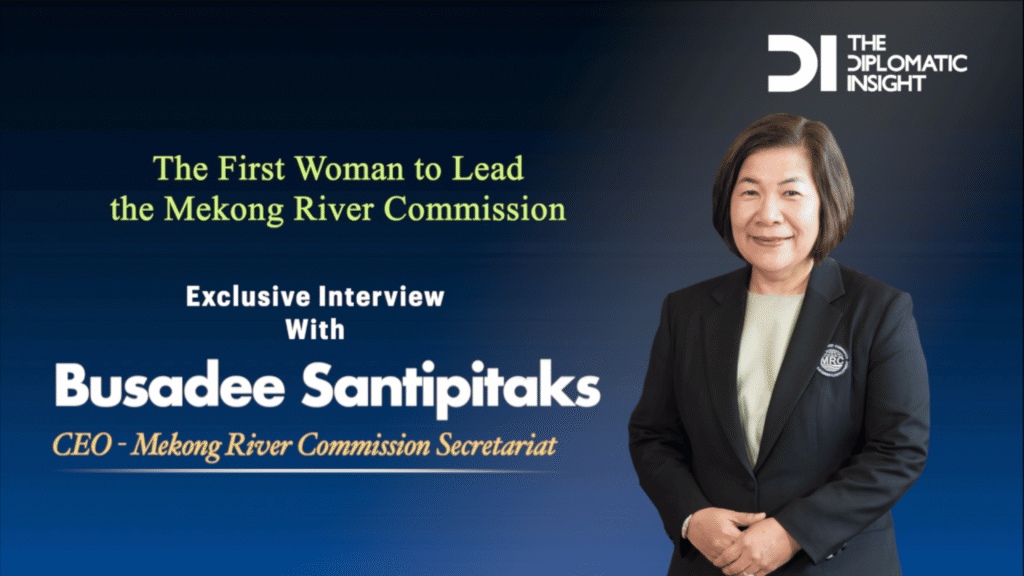
This year marks 31 years since the signing of the 1995 Mekong Agreement — the foundation of one of the world’s most complex exercises in shared water diplomacy across Cambodia, Lao PDR, Thailand, and Vietnam.
Leading that effort today is Busadee Santipitaks, the first woman and fourth riparian Chief Executive Officer of the Mekong River Commission Secretariat, who brings nearly four decades of Thai diplomatic experience to the task of turning four nations’ competing interests into shared solutions.
In this interview, she discusses what it takes to build trust between countries that don’t always agree, how the MRC is helping communities prepare for worsening floods and droughts, and the balance between hydropower development and the livelihoods that depend on the river.
Conversations like this reflect why The Diplomatic Insight engages directly with multilateral institutions — because the decisions shaping shared resources, regional stability, and millions of lives are rarely made by one country alone, and understanding them requires hearing directly from those doing the work.
TDI: Could you share your professional journey and what inspired you to lead the Mekong River Commission Secretariat?
I spent nearly four decades in Thailand’s diplomatic service, working across bilateral, regional and multilateral affairs. I had the privilege of being assigned to key overseas postings covering the United Nations, ASEAN, the European Union, Australia, among others. Before joining the MRC Secretariat, I served as Deputy Permanent Secretary at the Ministry of Foreign Affairs of Thailand. My professional diplomatic career shaped my views and support on the importance of multilateralism, diplomacy, dialogue and regional cooperation. Having served many years on ASEAN matters, I believe that cooperation in the Mekong sub-region can support regional peace and prosperity.
Diplomacy taught me to listen carefully, understand the concerns behind each country’s position and look for areas where cooperation remains possible. Agreement does not always come quickly. Sometimes progress begins simply by keeping the door open, communicating, building confidence and taking one practical step at a time. Each step entails building trust and confidence to achieve cooperation and shared objectives.
Leading the MRC Secretariat has given me an opportunity to apply that experience to one of our region’s most important shared resources. The Mekong is not simply a river on a map. It is the world’s 10th largest river. It supports food and energy security, ecosystems and millions of people’s livelihoods. The MRC is unique as it brings diplomacy and science together. Reliable evidence helps countries understand what is happening in the river, while dialogue allows them to discuss different interests, find common ground and solutions. Through collaborative efforts, regional cooperation can turn into practical action that significantly improves the lives of the Mekong peoples and communities.
Since the beginning of my tenure in 2025, continued engagement has been central to my approach. I have focused on maintaining open dialogue with our Member Countries and Dialogue Partners, strengthening technical cooperation and partnership with our Development Partners, civil society, communities and other stakeholders. I have found that trust is built through these regular exchanges, not only at formal meetings but also through the daily work of sharing data, examining evidence and responding to common challenges.
As the first woman to lead the MRC Secretariat, the role also carries personal significance for me. I hope my appointment will inspire other women and young people that they have a place in regional leadership and in decisions about the Mekong’s future. Different voices and experiences make our institutions stronger, particularly supporting inclusive processes when we are dealing with challenges that affect communities in very different ways.
For me, leading the Secretariat is a continuation of the work I have pursued throughout my career: bringing people together, building trust, bridging shared interests and benefits and helping countries move from dialogue towards practical cooperation for the sustainable management and development of the Mekong River Basin.
TDI: As the CEO of the Mekong River Commission Secretariat, how would you describe the Commission’s mission and its importance for the people and countries of the Mekong River Basin?
The MRC was formally established more than 30 years ago with a shared vision of a prosperous, socially just and environmentally sound Mekong River Basin. Guided by the 1995 Mekong Agreement, it provides a neutral platform where Cambodia, Lao PDR, Thailand and Viet Nam can share information, build trust and work together on transboundary challenges. The MRC also maintains cooperation with its Dialogue Partners, China and Myanmar.
In practical terms, we provide a platform where countries can discuss transboundary issues that no country can manage alone. We monitor river conditions, produce forecasts, assess development plans, facilitate data sharing and support dialogue when national interests differ. We respect each country’s sovereignty and development aspirations while promoting the reasonable, equitable and sustainable use of the Mekong’s water and related resources. Our approach of “Meeting the Needs, Keeping the Balance” reflects this effort to support development with the “One Mekong One Spirit” mindset while protecting the river and the communities that depend on it.
We also bring together governments, communities, researchers, civil society, the private sector and development partners into the conversation. For the people of the Mekong, this cooperation has practical value. It helps countries prepare for floods and droughts, monitor water quality, assess development impacts and manage shared risks. By keeping people and ecosystems at the centre of its work, the MRC continues to serve as a cornerstone of regional cooperation and sustainable water management based on basin-wide strategy in the Mekong Basin.
TDI: The Mekong River is shared by multiple countries. Why is regional cooperation so essential for ensuring the sustainable management of these shared water resources?
A shared river creates shared opportunities, but it also creates shared responsibilities. What happens upstream can affect water levels, fisheries, sediment, agriculture and communities downstream. At the same time, development in one country may bring benefits that extend beyond its borders. No country has a complete view of the river on its own.

Regional cooperation gives countries a more complete picture for cooperation and collaboration. When information is shared early and concerns are discussed openly, governments can make better decisions and prepare for possible solutions beyond their borders. This does not mean every country will always have the same priorities. They will not. The purpose of cooperation is to manage those differences through dialogue, scientific evidence and agreed procedures.
Trust is especially important. It is not created by one meeting or one agreement. It is a process which develops when countries share information consistently, listen to one another and follow through on what they have agreed. The MRC provides the platform and technical foundation for that process. Our role is not to replace national decision-making, but to help Member Countries reach decisions with a clearer understanding of achieving shared benefits for the basin as a whole.
TDI: Climate change is increasing the risks of floods and droughts across the region. How is the MRC helping Member Countries strengthen resilience and preparedness?
Climate change is making conditions across the Mekong Basin harder to predict. Long dry periods may be followed by intense rainfall, flash floods or sudden rises in water levels, leaving governments and communities with little time to respond.
Typhoon Yagi in 2024 showed how quickly extreme weather can affect several countries at once. During the typhoon, the MRC worked closely with its Member Countries to monitor river conditions, provide timely information and support flood forecasting and preparedness. The experience also highlighted the need for faster and more consistent information sharing, including operational information from hydropower operators during emergencies. We are prioritising our work on improving joint flow and hydropower coordination.
We now face another period of uncertainty. Current climate outlooks indicate the rapid development of a strong El Niño, which may bring hotter and drier conditions to parts of the region. However, El Niño does not remove the risk of tropical storms or heavy rainfall. We must be ready for both extremes. We therefore need to be better prepared for both extremes.
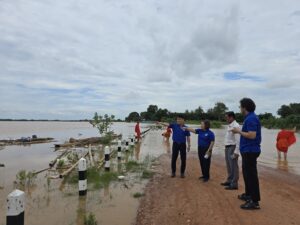
The MRC supports Member Countries through basin-wide monitoring, daily and seasonal forecasts, flood and drought information, and technical analysis. To protect the Mekong’s ecological functions, we have consolidated our river and environmental monitoring under the approved Core River Monitoring Network, covering hydrology, sediment, water quality, ecological health and fisheries. In 2024, 10 hydrometeorological stations were newly installed or upgraded, while 13 high-frequency water-quality monitoring stations were installed.
We have also introduced CCTV monitoring at CRMN stations, giving us a clearer view of river conditions on the ground. The Pha Phin Monitoring Station in Pakse, Champassak Province, was inaugurated in November 2024. As the MRC’s most advanced integrated monitoring site, it transmits data on rainfall, water levels and water-quality indicators at 15-minute intervals, while its CCTV system provides live images of river conditions. This improves the accuracy, speed and efficiency of our monitoring and helps us detect changes across the basin more quickly.
Furthermore, we have constructed 38 new drought-monitoring stations to strengthen drought monitoring and forecasting across the Lower Mekong Basin. Data from these stations are combined with satellite data to provide a more complete picture of drought conditions.
Operational data sharing and bias-correction tools have improved the accuracy of our short-term flood forecasts. Their contribution has been widely recognised, particularly during extreme weather events such as Typhoon Yagi. We are also developing medium- to long-term forecasting tools to support basin operations and planning.
At the same time, we are communicating this information more effectively and making it easier for the public to access through Situation Updates and the Mekong Flood and Drought TV on our social media platforms.
We also leverage the use of technology and innovation. The MRC Secretariat developed the One Mekong App, as a major step towards disaster preparedness. This app provides real-time data on water levels and weather conditions, integrates AI for timely disaster warnings, and fosters a community-driven network for sharing critical information. In the app, we integrated the iReport function, allowing everyone, including communities, national and local authorities, to report and share flood and drought incidents, river conditions, and incidents in specific locations. This complements the technical monitoring that helps alert and give communities the time to protect their homes, businesses, and livelihoods. These reports can provide a clearer picture of what communities are experiencing on the ground.
TDI: Sustainable hydropower remains an important topic in the Mekong Basin. How does the MRC work to balance energy development with environmental protection and the livelihoods of local communities?
Hydropower can support economic growth, energy security and the transition towards greener and lower-carbon electricity. However, it can also affect river flows, sediment, fisheries, ecosystems and the people whose livelihoods depend on them. Both sides of that picture must be carefully considered.
The MRC does not approve or reject national hydropower projects. Our role is to provide Member Countries with basin-wide evidence and a regional process for examining potential transboundary effects. We assess the impacts of hydropower development through basin-wide monitoring, scientific studies, environmental assessments, and modelling tools that help evaluate potential changes to river flow, sediment movement, fisheries, water quality, freedom of navigation, ecosystems across and livelihood of riparian communities along the Mekong Basin.
For proposed mainstream hydropower projects, the MRC facilitates regional consultation through the Procedures for Notification, Prior Consultation and Agreement, or PNPCA, where the Member Countries review project documents, assess potential transboundary impacts, and engage in technical discussions and dialogue.
The MRC Secretariat also provides technical support and reviews by using the agreed Preliminary Design Guidance for the mainstream dams and scientific analysis to support the process. In addition, the MRC has approved Guidelines for Transboundary Environmental Impact Assessment to support the assessment of impacts that may extend across national borders. By reviewing the proposed project, the MRC Secretariat provides technical recommendations to improve the design, construction and operation in order to avoid, minimise and mitigate the impacts.
Beyond project-level consultation, hydropower development and operations must also be consistent with the MRC’s basin-wide rules. The Procedures for Maintenance of Flows on the Mainstream commit Member Countries to maintain acceptable flow regimes on the Mekong mainstream, in the dry season, during the wet season, and for the reverse flow into the Tonle Sap, which dam operations upstream must respect. The Procedures for Water Quality set agreed criteria for maintaining acceptable water quality across the basin. Together, these procedures provide the reference conditions against which the effects of hydropower operations can be assessed and managed.
To better understand cumulative and long-term impacts, the MRC uses its Decision Support Framework and other basin models to analyse different development scenarios and assess how hydropower projects may affect river hydrology, fisheries, sediment transport, and livelihoods. These assessments are supported by using data collected through the MRC’s basin-wide monitoring network and specialised programmes on fisheries, environmental monitoring, sediment, water quality and river basin management.
Taken together, the findings help Member Countries improve project planning, identify mitigation measures, strengthen monitoring, and support more informed and sustainable decision-making on hydropower development in the Mekong Basin.
Also, the MRC has been working with Member Countries in implementing the Joint Action Plans (currently for Pak Beng, Pak Lay, and Luang Prabang Hydropower Projects) which were agreed by the MRC as a post-PNPCA mechanism to keep dialogue amongst Member Countries including dam developers to exchange the update on project development, as well as further follow-up and discuss technical recommendations and measures taken based on the Technical Review Report and Joint Statement formulated and agreed during the Prior Consultation process.
Under the MRC Strategic Plan 2026–2030, one of our five strategic areas focuses on advancing coordinated river basin management operations, including stronger cooperation on water flows and hydropower. We are encouraging closer engagement with dam operators because sharing operational data, coordinating reservoir management and giving timely notice of water releases can reduce risks, particularly during floods and droughts. In August 2026, the MRC will convene the first Mekong Hydropower Forum to bring governments, hydropower operators, the private sector and development partners together to discuss these practical areas of cooperation.
Communities must be part of these discussions. Their experience can reveal changes that technical models may not fully capture. For this reason, the MRC holds an annual roundtable with civil society organisations and stakeholders, providing a platform for civil society and community representatives to raise concerns, share local knowledge and propose solutions that reflect conditions in their communities.
TDI: Data and information sharing are central to effective water governance. How has cooperation among Member Countries and development partners strengthened the MRC’s work in this area?
Good water governance begins with reliable information. No country can fully understand a river basin as large and interconnected as the Mekong by looking only within its own borders. By combining data from Cambodia, Lao PDR, Thailand and Viet Nam, we can build a more complete picture of the river and make better-informed decisions.
The 1995 Mekong Agreement provides the foundation for regional cooperation among Member Countries on the sustainable development and management of shared water resources in the Lower Mekong Basin. Under this framework, the MRC facilitates cooperation through a range of agreed procedures, technical mechanisms, and institutional platforms. One of which is the Procedures for Data and Information Exchange and Sharing, or PDIES, adopted by the MRC Council in 2001. The PDIES provides the agreed framework for Member Countries to exchange the data needed to implement the 1995 Mekong Agreement. It covers 12 broad areas, including water resources, floods, infrastructure, agriculture, navigation, natural resources, environmental conditions and socio-economic information. It also requires data to be relevant, timely, accurate and provided in usable formats, while respecting national laws, security concerns, commercial confidentiality and copyright.
The responsibilities are clearly shared. National Mekong Committees work with their national line agencies to collect and provide the agreed data. The MRC Secretariat serves as the custodian of the MRC Information System, where the information is consolidated, checked, managed and made available to Member Countries. The MRC Joint Committee oversees the implementation of the Procedures.
In practical terms, this shared information supports flood and drought forecasting, water-quality and environmental monitoring, fisheries assessments, basin planning, modelling and the assessment of possible transboundary impacts. Common standards, delivery schedules and quality checks also help ensure that information collected in different countries can be compared and used together.
We continue to strengthen how the PDIES works in practice. The revised Guidelines for Custodianship and Management of the MRC Information System, approved by the Joint Committee in November 2024 and published in 2025, provide clearer arrangements for data delivery, quality assurance, metadata, access and responsibilities among the Secretariat, National Mekong Committees and national line agencies.
We are now developing the MRC-IS PDIES Unique/Single Gate to connect national information systems more closely with the regional MRC system. It is intended to improve the tracking, validation and exchange of data from Member Countries and other authorised providers, including operational information shared by participating hydropower projects.
Engaging both upstream and downstream countries is also important. China and Myanmar became MRC Dialogue Partners in 1996. In 2002, cooperation with China was strengthened through a Memorandum of Understanding on the provision of daily river-flow and rainfall data from two monitoring stations in Yunnan Province during the flood season. During the severe drought in 2016, China released emergency water supplies from its Lancang cascade dams, followed by a joint evaluation conducted by the MRC Secretariat and China’s Ministry of Water Resources. In 2020, the data-sharing arrangement was expanded to include year-round hydrological data, strengthening the MRC’s ability to monitor river conditions and support flood and drought forecasting.
More recently, cooperation with the Lancang-Mekong Water Resources Cooperation Center has expanded through the Joint Study, Joint Survey and the Joint MRC-LMC Expert Group on Data, Modelling and Forecasting. These efforts have strengthened upstream-downstream understanding and supported flood monitoring and preparedness, including during the severe flooding in September 2024. This shows that consistent technical cooperation can build the trust needed to respond more effectively during emergencies.
Development partners have also played an important role by contributing equipment, technical knowledge, training and system improvements. For example, France, Germany, Japan and the United Kingdom supported equipment and upgrades for 11 integrated river-monitoring stations in 2024. These stations strengthened the collection of near real-time information on rainfall, water levels and water quality.
Ultimately, the value of data lies in how it is used. When countries share reliable information in a timely and consistent way, forecasts improve, risks become clearer and governments have a stronger basis for coordinated action. Data sharing is therefore not only a technical process. It is also a practical way to build trust among countries and find solutions based on available data.
TDI: As the MRC advances its long-term strategic vision, what are the Commission’s key priorities for the coming years?
Looking ahead, our priority is to turn regional Mekong cooperation into impact-focused for the Mekong River and its people. I believe this will depend on three fundamental factors: trust between countries, shared responsibility and our collective ability to act.
The MRC Strategic Plan 2026–2030 sets out five strategic areas to guide this work. First, we will strengthen the MRC’s institutional foundations and governance, including the effective implementation of the 1995 Mekong Agreement and the MRC Procedures.
Second, we will improve joint monitoring, near real-time data sharing, forecasting and predictive capabilities. When countries work from the same reliable evidence and share a common understanding of risks, trade-offs and benefits, dialogue becomes more constructive and common ground is easier to find.
Third, we will advance coordinated river basin management operations. The challenges facing the Mekong, including climate change, infrastructure development, floods, droughts, sediment loss and declining water quality, do not stop at national borders. We therefore need to move beyond coordination on paper and put it into practice through closer cooperation on water flows, coordinated hydropower operations, sediment management and joint responses to extreme weather events.
Fourth, we will deliver significant joint and transboundary projects that bring benefits to communities in the region. People remain at the heart of water governance. This means supporting practical solutions that protect livelihoods, strengthen climate resilience and improve the health of the river. It also means promoting citizen science and giving greater attention to gender equity, young people and vulnerable groups. When communities help shape the solutions, cooperation becomes stronger and more sustainable.
Finally, we will deepen strategic partnerships with our Member Countries, Dialogue Partners, Development Partners, ASEAN, civil society, research institutions, the private sector and other stakeholders. These partnerships will help us combine expertise, resources and experience to address increasingly complex challenges.
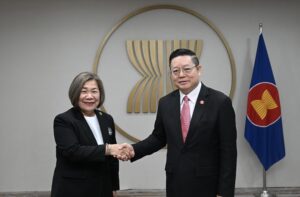
The MRC is well placed to lead this work as a trusted water diplomacy platform and a basin-wide knowledge hub. For me, success will not be measured by the number of meetings held, but by the progress we make towards safer communities, protected livelihoods, shared prosperity and a healthier Mekong River.
TDI: Water security is becoming an increasingly important global issue. What lessons from the Mekong River Commission’s experience could benefit other transboundary river basins around the world?
When we speak about water security, we must consider both the quantity and quality of water. Communities need reliable access to enough water, but it must also be safe for people, ecosystems and economic activities. Managing these two dimensions becomes more complex when a river crosses national borders.
From the Mekong experience, I would highlight several lessons that may be useful to other transboundary river basins. The first is the importance of a strong legal and institutional foundation. The 1995 Mekong Agreement sets out the principles for cooperation among Cambodia, Lao PDR, Thailand and Viet Nam. The MRC provides a neutral platform where the four countries can share information, discuss different interests and manage disagreements through science and diplomacy.
The second lesson is that effective river management must involve both upstream and downstream countries. China and Myanmar are not MRC Member Countries, but both became Dialogue Partners in 1996. This relationship gives the upper and lower Mekong countries a regular channel for discussing shared concerns and exploring areas where they can work together.
Over the years, this cooperation has expanded through annual dialogue meetings, high-level exchanges, joint research, technical workshops and capacity-building activities. It covers practical areas such as flood and drought management, water quality, hydropower, environmental management and basin-wide assessment. China and Myanmar have also sent junior professionals to work at the MRC Secretariat, helping to develop personal relationships and technical networks that support longer-term cooperation.
Joint activities have brought all six riparian countries together. In 2024, experts from the six countries took part in the first joint survey to the source of the Lancang–Mekong River in China. They examined water resources and ecological conditions in the headwaters and exchanged knowledge that could support future basin management. Such activities help countries understand conditions beyond their own borders and build a more complete picture of the river.
A third lesson is that broad commitments must be translated into practical procedures. Member Countries recognised that different uses of the river carry different levels of risk. Without agreed processes, transboundary water use can create uncertainty, suspicion and misunderstanding. To address these concerns, the MRC Council adopted five Procedures between 2001 and 2011. They cover:
- Procedures for Data and Information Exchange and Sharing;
- Procedures for Water Use Monitoring;
- Procedures for Notification, Prior Consultation and Agreement;
- Procedures for the Maintenance of Flows on the Mainstream; and
- Procedures for Water Quality.
These five Procedures provide an agreed framework for sharing data, monitoring how water is used, consulting on proposed developments, maintaining river flows and responding to water-quality concerns. They are cooperative mechanisms designed to strengthen transparency, accountability and mutual understanding rather than impose decisions on Member Countries.
The wider lesson is that countries do not need to agree on every issue before cooperation can begin. Cooperation grows through regular dialogue, shared evidence, agreed procedures, practical action and a willingness to compromise. Compromise does not mean abandoning national interests. It means recognising that decisions about a shared river affect others and finding a workable balance among different needs, risks and development priorities. Progress may take time, but sustained engagement builds trust and helps countries manage shared risks while protecting the river and the people who depend on it.
TDI: What have been the most important leadership lessons you have learned while leading a regional organisation such as the Mekong River Commission?
Since taking up this role, I have learned that leading a regional organisation is not about directing countries but supporting and working with the Member Countries in arriving at joint decisions. My responsibility is to ensure that the technical arm of the Secretariat is professional, impartial and knowledgeable to support the guidance of the Member Countries and find appropriate solutions and advance cooperation. Continued engagement is essential to achieve cooperation and the best solution for the Member Countries.
I have also learned that credibility must be protected through providing accurate, transparent and reliable information. The Secretariat must remain adhere to its mandate. We must provide verified scientific evidence to every country on the same basis, acknowledge when the evidence is incomplete and bring the right experts into the discussion. Trust depends on countries knowing that their concerns will be treated with equal seriousness. Additionally, the organisation’s credibility must also be built with having strong internal control and risk management systems to ensure transparency, accountability and maintain international standards of operations.
Trust also increases when cooperation results in something useful. Allow me to give you an example. In July 2025, in response to concerns regarding arsenic contamination in the Kok River in Thailand and in parts of the Mekong, the Secretariat collaborated with all four Member Countries and with Myanmar, our Dialogue Partner. A regional meeting was held in Chiang Rai, Thailand, at which the representatives examined the scientific findings, clarified the responsibilities of the various institutions and assisted in drawing up a proposal and a roadmap for joint water-quality monitoring. The proposal then obtained strong support from the four Member Countries and from Myanmar. To me, this demonstrates that trust cannot be established merely by making statements; it is built up when countries look at the evidence together, sit down and discuss in order to reach an agreement on concrete actions.
Regional consensus cannot be achieved with convening a single meeting. A leader must keep the door open, maintain momentum and help turn each discussion into the next practical step. Compromise is often necessary, but it does not mean asking countries to abandon their interests. It means helping them find a workable balance between national priorities and their shared responsibility for the river.
Leadership is a collective effort. The MRC brings together diplomacy, science, engineering, environmental knowledge and the experience of many, including communities. I do not need to have every technical answer myself. My role is to ask the right questions, bring the right people together and make sure different voices are heard. Setting a direction matters, but bringing people with you is what turns that direction into action.
TDI: Finally, what message would you like to share with policymakers, development partners, and the younger generation about the importance of protecting and sustainably managing shared water resources for the future?
The Mekong has supported generations of people, but we should not assume that it will always remain healthy without care. Climate change, development pressures, pollution and the growing demand for water and energy are placing the river under increasing strain. The choices we make now will shape what the next generation inherits. Protecting it is not the responsibility of one country, one institution or one generation. It is a responsibility we all share.
For policymakers, cooperation should not be seen as a choice, but as a shared duty. Climate change, floods, droughts, development pressures and environmental risks do not stop at national borders. Managing them requires trust, openness, shared knowledge and mutual respect.
Development partners also have an important role in supporting long-term regional cooperation, stronger national capacity and practical solutions that respond to local needs. Sustainable development must bring real and lasting benefits to the people who depend on the river every day.
To the younger generation, I would say that the future of the Mekong is also your future. Your ideas, energy and participation matter. We must listen to young people, women and communities, and give them a meaningful role in decisions that affect their lives.
As CEO of the MRC Secretariat, I remain committed to strengthening cooperation among our Member Countries, turning dialogue into action and ensuring that our shared decisions lead to improvements on the ground. In 2026 and beyond, I believe we can build a more resilient, inclusive and sustainable Mekong Basin if we continue to care for the river and for one another.

Established in December 2008, The Diplomatic Insight is Pakistan’s premier diplomacy and foreign affairs magazine, available in both digital and print formats.