War no longer has fixed front lines.
Modern conflict reaches everywhere. It stretches across deserts, cities, and digital spaces. And wherever war has gone, women have been there too. They have served, fought, and in many cases, died beside men. They were not waiting for permission; they had already been part of the battle long before any laws officially recognized their roles.
As Gabriel Coeli wrote, any place touched by war is “close to combat.” Policy simply had to catch up with what women were already doing.
From Support Roles to the Front Lines
For centuries, women stood close to battlefields but rarely within them. The National Army Museum traces their history in the British Army back to the 1600s. They worked as camp followers, caring for soldiers and maintaining supplies.
Others served as nurses, like Florence Nightingale, whose work during the Crimean War redefined military medicine. Later, women joined the Women’s Royal Army Corps which remained active until 1992. Yet it was only in 2018 that all combat roles in the British Army officially opened to women, including infantry and special forces.
A similar transformation took place in the United States. In 2016, the Department of Defense lifted all gender restrictions across military jobs. Women could now serve in infantry, armor, artillery, and even special operations units. The decision did not lower standards but it simply made them fair.
However, equality on paper does not always mean equality in practice. Women still face the “brass ceiling.”
They make up roughly 16 percent of the US military but only six percent of four-star generals. Figures like Admiral Lisa Franchetti, the first woman to serve on the Joint Chiefs of Staff, signal progress but representation remains unfinished work.
Much of the resistance to women in combat has centered on questions of strength, endurance, and unit cohesion. Critics often argue that women face higher injury rates or may affect morale. These concerns echoed in the IDEA report on Women in Combat, which cites “longevity in sustained combat” and “higher physical attrition.”
Yet evidence from real operations tells another story. Modern warfare rewards teamwork, precision, and strategic thinking more than brute force. In Afghanistan and Iraq, women performed under pressure, commanded mixed units, and proved that leadership and courage are not defined by gender.
As Brookings emphasizes, “The military is a meritocracy – we all start on the same playing field with the same oath.” Therefore, when women are given equal training, modern equipment, and institutional trust, units don’t fracture rather they evolve. Inclusion broadens the pool of talent and helps build a fighting force that truly mirrors the society it defends.
Pakistan’s Progress and Promise
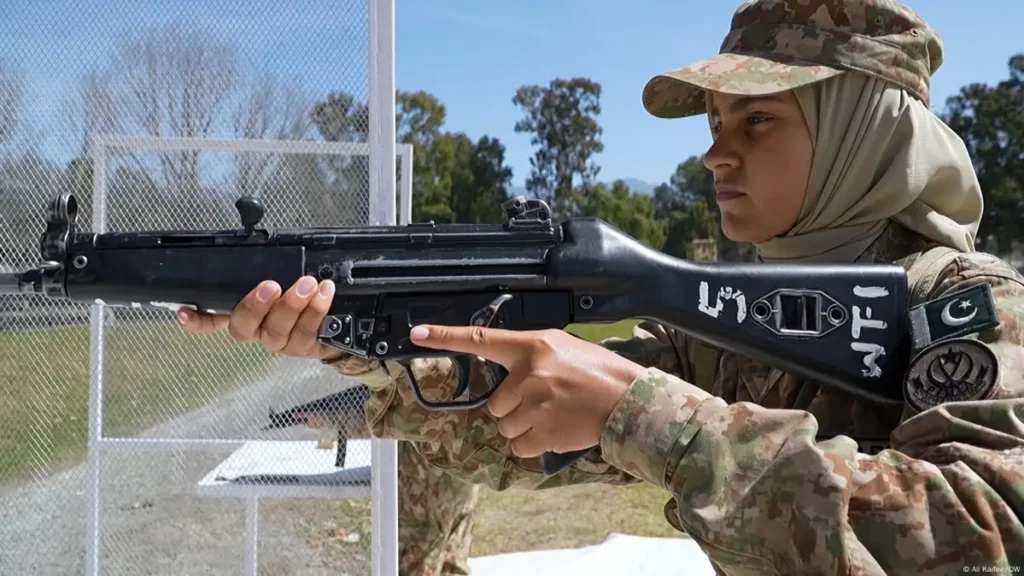
In Pakistan, the inclusion of women in uniform has gained new momentum. Since 2013, the number of female officers in the IMET program has more than doubled. These women study cyber defense, counterterrorism, and strategic leadership at US institutions before returning home to shape national defense.
Trailblazers like Major General Shahida Malik, the country’s first female general, and Flight Lieutenant Ayesha Farooq, Pakistan’s first woman fighter pilot, have broken deep-rooted barriers. Their stories reflect not only courage but quiet transformation.
They have redefined what service and bravery look like in Pakistan. By stepping into combat-related roles and UN peacekeeping missions, these women show that patriotism and perseverance are not defined by gender but by commitment.
Their growing visibility signals a generational shift; one that inspires young women to see themselves as protectors and not just dependents.
Read More: Pakistan’s First All‑Women Expedition Scales 5,400m Bari La Peak
Toward an Equal Battlefield
Across the world, the question is no longer “should women fight?” rather it is “how can we ensure they lead, serve, and return safely?”
The debate has shifted from justification to preparation. Nations that open every role to women, from combat infantry to command positions, not only uphold fairness but also strengthen their strategic capability. A diverse military is a smarter military as it reflects the society it protects.
The next chapter in this journey depends on three essentials: equal standards, fair access to training, and genuine institutional respect. Equal standards ensure that every soldier is evaluated by skill and performance, not gender.
Fair training access gives women the chance to build the same level of readiness and experience as their male counterparts. And institutional respect, which is perhaps the hardest to achieve, can change the culture of the defense forces so that women are valued not as exceptions, but as equals.
Moreover, as experience across the world has shown, inclusion does not dilute an army’s strength; it completes it. Women bring critical thinking, adaptability, and emotional intelligence. These are the qualities that modern warfare increasingly depends on.
When women fight, strategize, and lead, they do more than defend a nation; they redefine it. Their presence expands what courage, leadership, and loyalty mean in the 21st century.
As more doors open in Pakistan and beyond, the future of defense will not be measured by who stands at the front, but by how many stand together.
The battlefield of tomorrow will belong not to men or women alone, but to those united by skill, resolve, and the shared duty to protect.

Noor ul Sabah
Noor ul Sabah is a feminist researcher focused on intersectional approaches to gender, technology, and governance. Her work explores how power and identity shape experiences of violence, migration, and citizenship.