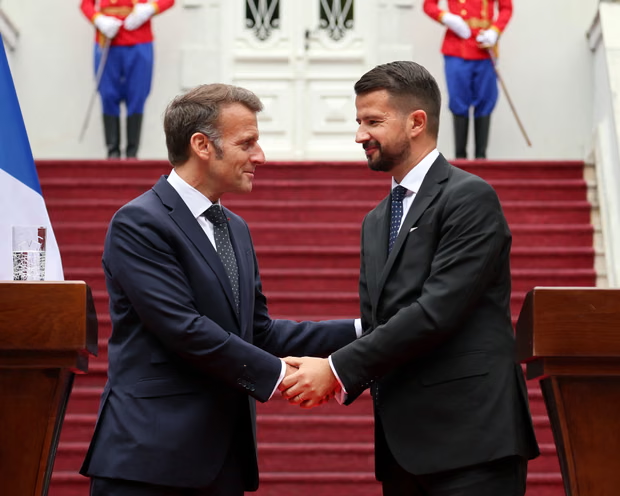
Tivat, Montenegro (TDI): Today, Friday, European leaders have gathered on the shores of Montenegro’s Bay of Kotor for the most significant European Union enlargement summit in years.
The meeting in the coastal town of Tivat has brought together European Commission President Ursula von der Leyen, European Council President António Costa, French President Emmanuel Macron, German Chancellor Friedrich Merz, and Italian Prime Minister Giorgia Meloni.
Around 42 delegations and some 300 journalists are attending the summit, which also coincides with the 20th anniversary of Montenegrin independence.
The summit’s theme, “Shared Prosperity and Stability of the EU and the Western Balkans,” reflects a shift in how Brussels now frames the enlargement question.
No longer merely a reward for democratic progress, membership is increasingly spoken of as a geostrategic investment.
With Moscow maintaining energy ties and political networks across the region, and Chinese infrastructure investment advancing under the Belt and Road Initiative, EU is increasingly aware of the cost of leaving the Balkans in limbo.
Read More: Finland’s President Proposes EU Expansion to 40 States, Including Canada
Montenegro enters the summit as the bloc’s most advanced accession candidate, and von der Leyen is expected to announce a new enlargement acceleration package that would include additional pre-accession funding and a streamlined assessment process.
Albania is also considered a frontrunner while Serbia remains a more complicated picture; its absence from the declaration at the previous December summit in Brussels, where President Aleksandar Vučić declined to attend, cast a shadow.
EU Council President, Costa, spent the days before Thursday’s summit touring all six Western Balkan capitals, Albania, Bosnia and Herzegovina, Kosovo, Montenegro, North Macedonia, and Serbia.
Montenegro has spent nearly two decades in accession negotiations, weathering reform demands, judicial overhauls, and political turbulence.
To stand at the head of the table, welcoming the presidents and prime ministers of Europe’s major powers, represents a moment of arrival; even before the membership papers are signed.