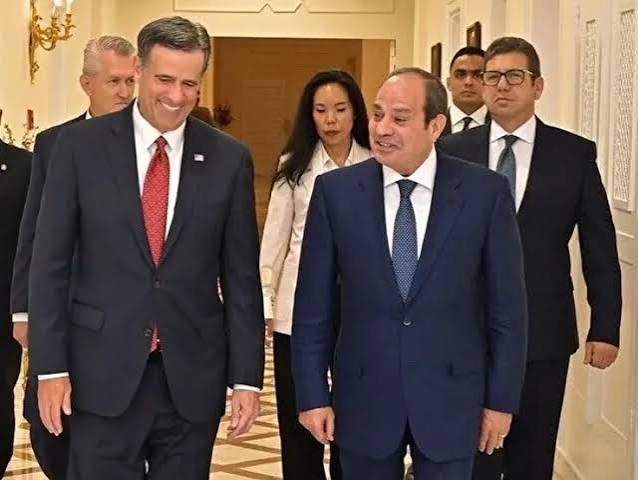
Egyptian President Abdel Fattah el-Sisi has met CIA Director John Ratcliffe in Cairo as Egypt steps up diplomatic efforts around the Iran conflict and seeks a wider regional settlement that addresses both security and maritime concerns.
The talks focused on the war, regional stability, freedom of navigation, and the need for a comprehensive political solution capable of reducing tensions across West Asia.
Sisi expressed support for an agreement that would end the crisis, restore regional security and protect international maritime routes, while Washington reaffirmed the importance of coordination with Cairo on regional issues.
The meeting comes as Egypt increases its diplomatic engagement with both Iranian and American officials and positions itself as a potential channel between the two sides.
Read More: Egypt, Ethiopia and Sudan: The Emerging Geopolitical Triangle in the Horn of Africa
Cairo has maintained contact with Tehran while preserving a close strategic relationship with Washington, giving it room to operate as an intermediary at a time when direct US-Iran diplomacy remains uncertain.
Egypt’s role is shaped by strategic interests that extend beyond political mediation. Continued instability in the Red Sea and Bab Al-Mandab directly threatens traffic through the Suez Canal, which remains a critical source of revenue for the Egyptian economy.
Disruption to energy flows and maritime trade also increases economic pressure at home, giving Cairo a strong incentive to push for de-escalation.
Egypt has also expanded its engagement with Gulf states and regional actors seeking to prevent the Iran conflict from becoming a wider confrontation involving Yemen, the Red Sea and neighboring countries.
Read More: Xi Visits Egypt As US-Iran Conflict Threatens Regional Ties
Sisi-Ratcliffe meeting therefore connects several files at once: US-Iran diplomacy, Arab security concerns, Red Sea stability and the protection of international shipping.
The talks also point to a broader diplomatic pattern emerging across the region. Qatar has taken on a prominent role in relaying messages between Tehran and Washington, while Egypt appears to be developing a parallel track focused on wider Arab and maritime concerns.
Rather than competing channels, these efforts could become complementary if they converge around a shared objective of preventing further escalation and ensuring that regional states are included in any future settlement. For Cairo, the challenge is to turn its strategic position into concrete diplomatic influence.
If the current mediation efforts continue, Egypt could become an important bridge between Washington, Tehran and Arab governments seeking a more comprehensive security framework beyond a temporary ceasefire.

Anoush Taimur is an International Relations graduate from DHA Suffa University, Karachi, currently based in Doha. Her research interests include Gulf politics, small-state diplomacy, Global South studies and conflict
mediation. Her work examines how states create influence through connectivity, institutions and strategic relationships. She can be reached at [email protected]