

A trade agreement can open a market; itcannot tell two partners whether they understand one another well enough to use it.
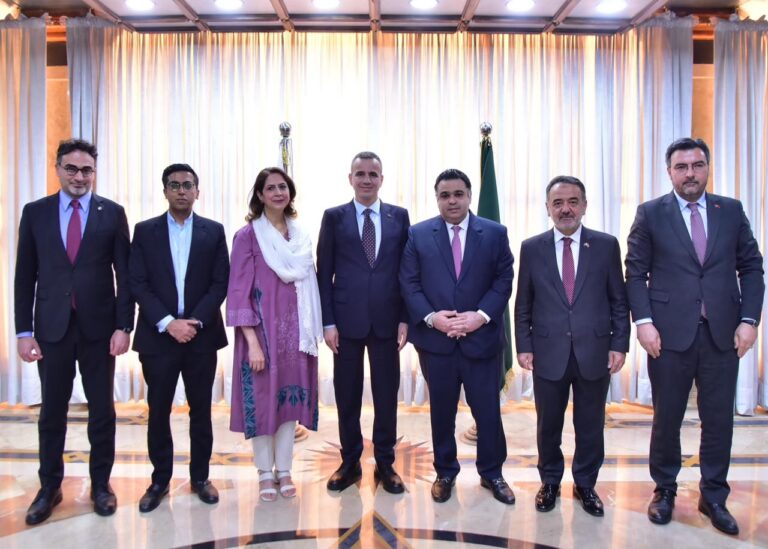
In October 2024, a delegation from the Austrian–United Arab Emirates Society (ÖVAEG) visited Vienna Airport. The airport’s executive board member Günther Ofner received the group, while Emirates Austria manager Elisabeth Zauner explained the airline’s operations and the Vienna–Dubai connection.
It was reported as an institutional visit, not a contract-signing ceremony. But that is precisely the point: people were able to examine a commercial relationship in its actual setting rather than through a ministerial communiqué.
As ÖVAEG’s secretary and treasurer, I work with the less visible side of such encounters: the communication, continuity and institutional memory that give a meeting a life beyond its photographs. My involvement with Austria’s umbrella network of friendship societies, PaN, and with the Austrian–Serbian Society (ÖSG) has taught me to be modest about what civic diplomacy achieves—and attentive to what it makes possible.
Read More: Vienna Water Symposium Puts Pakistan’s IWT Rights in Global Spotlight
In May 2026, Austria and the UAE established a high-level economic dialogue platform and convened their joint economic committee. The UAE’s non-oil trade with Austria reached approximately $2.1 billion in 2025, according to the reported bilateral figures.
Those are consequential developments. But trade volume measures exchange, not resilience. When a project slows, expectations diverge or a regional crisis changes priorities, it matters who can call whom—and whether the call will be answered.
This is where cultural literacy enters economic diplomacy. I do not mean a checklist of greetings or dinner customs. I mean understanding how decisions are authorized, where professional and personal trust overlap, which institutions carry real authority, and why a polite expression of interest may not yet amount to agreement. Misreading these signals is not a charming cross-cultural error; it can be an expensive commercial one.
The Experience of Vienna’s Civic Networks
At the ÖVAEG’s 2025 summer reception at Schloss Neuwaldegg, representatives from diplomacy, business, science and culture met outside the rigid order of an official negotiation. Such gatherings create access and familiarity. They do not, by themselves, prove diplomatic influence.
I have become increasingly wary of the temptation to present a crowded room or an impressive guest list as a policy achievement. The more serious question is what contacts remain useful months later.
There are more tangible outcomes. At PaN’s general assembly in Vienna’s City Hall on 29 October 2026, the Austrian–Serbian Society received project support for an Austrian–Serbian concert intended to bring two musical traditions into dialogue.
As the ÖSG’s deputy secretary-general, I see this as a small but instructive example: an institutional network translated a cultural proposal into a supported project. The concert’s future effect cannot yet be claimed. The award and associated funding, however, are real.
Read More: Indonesia’s Economic Diplomacy Through Modest Fashion
PaN reported 124 member societies in September 2026. Not all of them work on commerce, and they should not be assessed as though they were trade-promotion agencies. Their contribution is continuity across diplomatic rotations, room for unfamiliar people to meet, and connections among institutions that may never appear in the text of a bilateral treaty.
These organizations have limits. Their boards may be dominated by established professional circles. Embassy goodwill can turn into dependence; business sponsorship can narrow the agenda. Diaspora groups, younger participants and critics of partner governments do not always have equal access. A society that offers only ceremonial praise may produce good images while making genuine understanding less likely.
The same warning applies to the phrase ‘cultural literacy.’ Neither the Gulf nor the Balkans are single cultural units. Abu Dhabi and Dubai do not necessarily organize a decision in the same way; a public authority is not a family company; an official delegation does not speak for every citizen. Knowing the distinctions is a better form of respect than repeating flattering generalizations.
My academic work in Arabic and Islamic Studies at the University of Vienna, including a thesis on Islamic microfinance, reinforced another lesson: institutions are not understood simply by translating their vocabulary. The World Bank’s account of Islamic finance highlights risk-sharing, links to real economic activity and social inclusion.
But a European investor still has to examine the actual contract, incentives and consumer safeguards. Familiarity with a tradition is the start of due diligence, not a substitute for it.
The Test for Europe
European policymakers are looking for more dependable partnerships in the Gulf. In March 2026, European Council on Foreign Relations analyst Cinzia Bianco described the collapse of strategic hedging in the Gulf and the resulting opportunity for Europe. Security, energy and investment will remain central.
Yet credibility also depends on the capacity to listen between summits, not only to the officials who sign documents but also to universities, entrepreneurs and civic actors who live with their consequences.
Three practical changes would help: include genuine regional specialists in economic delegations; finance exchanges through transparent, open procedures rather than patronage; and evaluate whether a dialogue produces sustained cooperation, not just media coverage.
These measures should protect civic organizations’ independence instead of turning them into informal extensions of embassies.
Interests drive diplomacy, and no amount of mutual sympathy will rescue a commercially unsound deal. But interests are interpreted by people. The agreements that endure are often those supported by a web of relationships sturdy enough to carry disagreement. The treaty is the architecture; understanding is what allows people to inhabit it.
*The views presented in this article are the authors’ own and do not necessarily reflect the views of The Diplomatic Insight.*

Sonja Schromm
Sonja Schromm is a Vienna-based journalist, correspondent and communications strategist. She serves on the board of PaN, is secretary and treasurer of the Austrian–United Arab Emirates Society, and deputy secretary-general of the Austrian–Serbian Society. She studied Arabic and Islamic Studies at the University of Vienna, with research focused on Islamic microfinance.