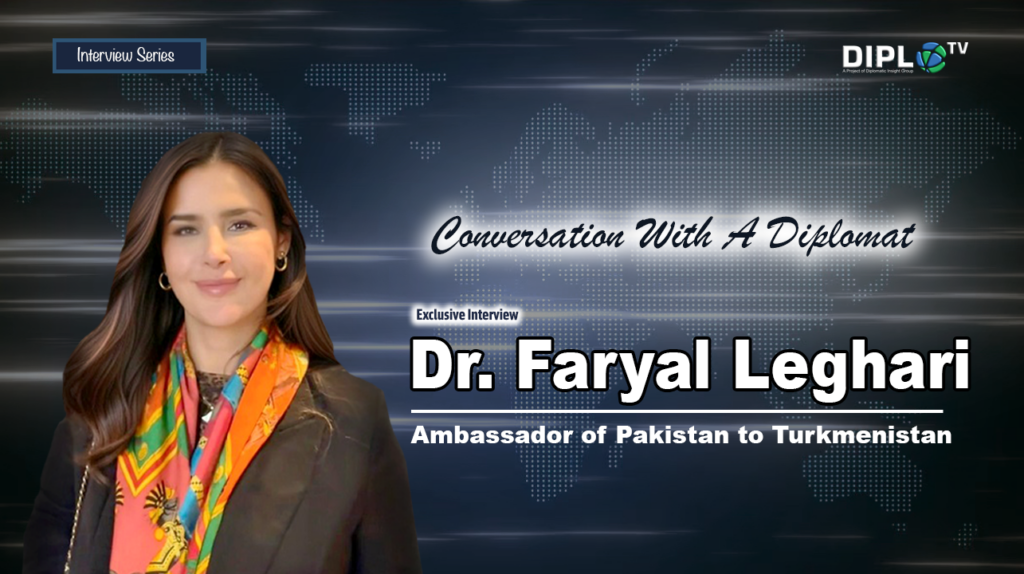
In this episode of Conversation with a Diplomat by DiploTV, we spoke with H.E. Dr. Faryal Leghari, Ambassador of Pakistan to Turkmenistan. With an impressive career spanning academia, journalism, security research, and diplomacy, Dr. Leghari reflects on her personal journey, the importance of education, women in diplomacy, Pakistan-Turkmenistan relations, and the values that have shaped her career.
To watch the full interview, click the link below:
To begin, could you tell us about your personal journey, your early education, and how you eventually entered the field of diplomacy?
Dr. Faryal Leghari: Thank you very much for having me. It is a pleasure to be here, and I especially appreciate platforms that bring the voices of diplomats, particularly women diplomats, to a wider audience. It is a commendable initiative.
My journey has been somewhat unconventional. I often describe myself as an academic diplomat because education and research have always been central to my professional life.
Before entering diplomacy, I spent nearly a decade in the United Arab Emirates, working in various capacities as a political and security analyst. During that time, I also served in senior editorial positions at two leading English-language newspapers, Khaleej Times and Gulf News. My work primarily focused on research, policy analysis, and opinion writing.
Throughout my career, I remained closely connected to Pakistan. Whether through research, journalism, conference presentations, or policy work, I consistently sought to project a positive image of Pakistan and counter negative narratives surrounding the country. My work focused extensively on security, development, regional affairs, and international relations.
Although journalism was never my original career goal, it became an important chapter in my professional life because it allowed me to combine writing with research. However, I always knew I wanted to return to academia.
Eventually, I applied to the University of Oxford’s Foreign Service Programme. Although the program is primarily designed for career diplomats, it also admits a limited number of professionals from outside the diplomatic service. I was fortunate to be selected.
The experience at Oxford became a turning point. The program provided comprehensive training in diplomacy, strategic communication, negotiations, administration, mediation, and international affairs. It strengthened my academic foundation while preparing me for diplomatic responsibilities.
Looking back, I realize that every stage of my career—from research and journalism to academia and policy analysis—was preparing me for diplomacy, even though I did not fully realize it at the time.
Before Oxford, I had also worked with the Gulf Research Center, where I participated in Track II diplomacy initiatives and research on regional security, including discussions related to Iran’s nuclear diplomacy. Those experiences gave me valuable exposure to mediation and international dialogue.
Education has always been my greatest passion. I firmly believe there is no age limit for learning. After marriage, I returned to university to continue my studies, and despite personal challenges, including divorce, I remained committed to my academic goals.
One of the greatest sources of encouragement throughout my life was my late father, Sardar Farooq Khan Leghari, the former President of Pakistan. He strongly believed in women’s education and continuously encouraged me to pursue higher studies and build an independent career. Even after his passing in 2010, his guidance and values have remained my greatest source of inspiration. I carry his legacy with me every day.
In 2024, I completed my DPhil in Political Geography at the University of Oxford. Shortly afterward, I was entrusted with the honor of serving as Pakistan’s Ambassador to Turkmenistan.
Representing Pakistan on the international stage is an immense privilege and responsibility. I remain deeply grateful for this opportunity and strive every day to serve my country with dedication, integrity, and humility.
You entered diplomacy as a non-career diplomat. What were some of the biggest challenges you faced during your initial days as Ambassador?
Dr. Faryal Leghari: There were quite a few challenges, especially because my first days in office coincided with a regional crisis.
I assumed charge as Ambassador in June 2025, just as tensions escalated following military developments involving Iran. Since Turkmenistan shares a border with Iran, we immediately had to deal with the evacuation of Pakistani nationals who were stranded there.
Without much time to settle into my new role, I found myself managing an emergency situation. We had to coordinate with the Turkmen authorities, facilitate transit visas, and ensure the safe evacuation of Pakistani citizens. Thankfully, the Government of Turkmenistan was extremely cooperative and supportive throughout the process.
Although I had received extensive diplomatic training at Oxford, practical diplomacy presents a completely different set of challenges. Real-world situations require quick decision-making, coordination, and leadership under pressure.
Beyond the immediate crisis, there were other responsibilities, including managing the embassy, improving administrative systems, expanding Pakistan’s cultural outreach, strengthening engagement with Turkmen institutions, and building stronger bilateral relationships.
Every one of these experiences became a valuable learning opportunity and helped me grow into my role as Pakistan’s representative.
What interests you beyond diplomacy, research, and academia? How do you spend your time outside your professional responsibilities?
Dr. Faryal Leghari: One of my greatest passions is horse riding. In fact, I was delighted to be posted to Turkmenistan, a country renowned for its magnificent Akhal-Teke horses, which are among the oldest and most prized horse breeds in the world.
Horse riding has been an important part of my life for many years. I even played polo competitively and was honored to receive the Best Women’s Polo Award during my time in Pakistan.
Although there is no polo culture in Turkmenistan, the country’s deep appreciation for horses makes it a wonderful place for someone who shares that passion. Whenever my schedule allows, I make time for riding.
Beyond pursuing my personal interest, I also see an opportunity to strengthen Pakistan-Turkmenistan relations through equestrian cooperation. We have been working with Turkmen sports authorities and the equestrian federation to organize events showcasing Pakistan’s expertise in traditional equestrian sports, particularly tent pegging.
I am especially pleased to see the growing number of talented Pakistani women participating in equestrian sports. I hope we will soon be able to bring some of them to Turkmenistan to perform and further strengthen cultural ties between our two countries.
Looking back, did you ever imagine that one day you would become a diplomat?
Dr. Faryal Leghari: To be honest, I initially thought I would pursue a career in politics. Coming from a political family, politics was naturally a part of my upbringing.
As a child, I witnessed many aspects of political life from behind the scenes. While the women in our family generally maintained a low public profile, I often assisted my late father during his years in politics. I still remember helping with various party-related matters, including administrative work connected with party affairs.
However, as I grew older, I began to understand the realities and complexities of politics. I realized that my temperament and interests were better suited to another path.
I had always been deeply interested in international affairs, geopolitics, security studies, and energy politics. Gradually, I discovered that diplomacy offered the perfect balance. It would allow me to serve Pakistan while remaining engaged with international relations, policy, and strategic affairs.
Looking back now, I believe diplomacy is where my strengths truly lie.
Having experienced both political circles and now diplomacy, how do you see the difference between politics and bureaucracy?
Dr. Faryal Leghari: The two are closely connected, particularly within our system, but they serve different purposes.
Politicians work directly with the public and are constantly accountable to the people. Their responsibilities are dynamic and often shaped by changing political realities.
Bureaucrats, on the other hand, provide institutional continuity. Regardless of political transitions, they ensure that the machinery of the state continues to function efficiently.
Both roles require dedication and hard work, but they operate under different responsibilities and expectations. Each plays an essential role in governance, and together they contribute to the functioning of the state.
You have now spent almost a year in Turkmenistan. What has your experience been like, and what aspects of the country have impressed you the most?
Dr. Faryal Leghari: Before arriving, I naturally did extensive research about Turkmenistan. Much of what I found online created a particular perception of the country.
However, my experience on the ground has been very different.
Turkmenistan is an exceptionally peaceful and stable country. As a constitutionally neutral state, it follows the principle of neutrality with remarkable consistency in its foreign policy. Considering its geographical location, bordering both Iran and Afghanistan, maintaining that neutrality is an impressive achievement.
I have also found the people and government officials to be welcoming and cooperative. Like every country, Turkmenistan has its own administrative system and cultural traditions, but I have always received warmth and support.
One aspect that has particularly impressed me is the country’s commitment to preserving its cultural heritage and traditions. There is a genuine sense of pride in history, identity, and national culture.
Another remarkable feature is the important role women play in society. Women hold senior positions across government institutions and are entrusted with significant responsibilities. Whether in public administration, education, or local government, women are actively contributing to national development.
It has been encouraging to witness this level of female participation in public life.
I have also been impressed by Turkmenistan’s emphasis on education. The country provides free education and encourages young people to participate in music, arts, cultural activities, and other creative pursuits alongside their academic studies.
I believe such a holistic approach to education nurtures well-rounded individuals. It is something from which many countries, including Pakistan, can draw valuable lessons.
As someone who has spent many years abroad, do you miss Pakistan? What do you miss the most?
Dr. Faryal Leghari: There is no substitute for home.
What I miss most is visiting my village and spending time with my people. I have always maintained a strong emotional connection with my roots.
Whenever I am in Pakistan, I make it a point to visit the resting place of my late father to pay my respects. It remains one of the most meaningful moments whenever I return home.
I also miss our family home in the Sulaiman Mountains, where we spent our summers. Those memories remain very close to my heart.
Of course, I miss my family as well. My son lives in Pakistan, and being away from loved ones is perhaps the greatest sacrifice many diplomats make while serving their country abroad.
And naturally, I miss authentic home-cooked Pakistani food. Although I cook myself and have someone who prepares Pakistani meals, there is always something special about enjoying food in your own country, surrounded by family.
As a woman representing Pakistan on the international stage, how important is it for more young women to enter diplomacy? What message would you like to give to aspiring female diplomats?
Dr. Faryal Leghari: Diplomacy is a wonderful profession for anyone who is passionate about serving Pakistan, engaging with the world, and contributing to international relations. It is not simply about representing your country at official events. It is about building relationships, understanding different cultures, strengthening international partnerships, and presenting Pakistan’s true image to the world.
For young women who aspire to become diplomats, I strongly encourage them to consider joining Pakistan’s Foreign Service. If I had the opportunity to begin my career again, I would probably join the Foreign Service much earlier in life.
Although I entered diplomacy through a different route, I believe it is one of the most rewarding careers a person can pursue. It allows you to represent your country while continuously learning from different cultures and societies.
Women have an important role to play in diplomacy. They bring valuable perspectives to international dialogue, conflict resolution, cultural exchange, and public diplomacy. I hope to see many more Pakistani women representing our country across the world in the years ahead.
You returned to higher education later in life and eventually earned a doctorate from the University of Oxford. That journey must have required extraordinary determination. What kept you going?
Dr. Faryal Leghari: I have always believed that education has no age limit.
When I decided to return to university, I knew it would not be easy. In many of my classes, I was studying alongside students who were much younger than me. Initially, it felt unusual, particularly during university traditions and social events, but I reminded myself why I was there.
My purpose was clear. I wanted to learn, to grow, and to complete my academic journey to the best of my ability.
Getting into Oxford was itself a long journey. I faced several rejections before finally receiving an acceptance. Those setbacks never discouraged me. Instead, they strengthened my determination to keep trying.
Sometimes people see success and assume it happens overnight. In reality, every achievement is built on persistence, patience, and the willingness to continue despite disappointment.
Looking back today, I can say every challenge was worth it.
Was there a particular moment in your life that inspired your pursuit of higher education?
Dr. Faryal Leghari: I cannot point to a single defining moment because learning has always been part of my life.
From childhood, books were our constant companions. During summer vacations, my family would visit a bookstore in Lahore before travelling to our home in the Sulaiman Mountains. We spent those holidays reading, walking, and enjoying nature.
We were encouraged to read extensively. Television was never a major part of our lives, so books became our window to the world.
That habit stayed with me throughout my life.
Although formal education is important, I believe reading is equally valuable. Degrees provide structure, but reading broadens your perspective, develops your thinking, and continues throughout your life.
I have always loved literature and writing. I write poetry, short stories, and fiction whenever time permits. Writing has always been one of my greatest passions.
Interestingly, I originally wanted to become a medical doctor. That dream did not materialize, and for some time I considered it one of my greatest disappointments.
However, life often takes us in unexpected directions.
Instead, I pursued a Master’s degree in English Literature and Language at Kinnaird College. For me, studying literature never felt like an obligation because I genuinely loved reading and writing. That passion eventually became the foundation for everything else I achieved later in life.
Many people struggle after facing rejection or setbacks. What advice would you give to young people who are trying to achieve their dreams?
Dr. Faryal Leghari: The most important advice I can give is this: never stop dreaming.
There will always be obstacles. There will be moments when things do not go according to plan, and there will be disappointments. But those moments should never define your future.
Keep working towards your goals. Keep improving yourself. Every setback is an opportunity to become stronger.
I also believe in taking a leap of faith.
Throughout my life, I have relied on faith, prayer, and trust in Allah’s guidance. There are times when we cannot see the path ahead, but if we continue to work sincerely and remain committed to our purpose, new opportunities often appear in ways we never expected.
Success requires hard work, perseverance, and patience, but it also requires the courage to believe in yourself.
If you truly believe something is worth pursuing, do not let fear stop you from trying.
Finally, what message would you like to share with young Pakistanis who aspire to succeed, regardless of the profession they choose?
Dr. Faryal Leghari: My message to young Pakistanis is very simple: believe in yourselves, work hard, and never stop learning.
Every individual has the potential to contribute to the country’s progress, regardless of their profession. Whether you become a diplomat, a teacher, a scientist, an entrepreneur, or an artist, what matters most is your commitment to excellence and your desire to serve society.
At the same time, I would encourage everyone to represent Pakistan with pride.
Like every country, Pakistan has its challenges, and it is perfectly natural to have differences of opinion on domestic issues. However, when we represent our country internationally, we should always remember that we are ambassadors of Pakistan in our own way.
It is important to present a balanced and positive image of our country. Pakistan has remarkable people, a rich cultural heritage, immense resilience, and tremendous potential. We should highlight these strengths while continuing to work towards improving the areas where change is needed.
National unity and a sense of shared purpose are essential for any country’s progress. I hope we continue to promote a positive narrative about Pakistan and contribute, in our own capacities, to its development and international standing.
Before we conclude, do you have a message for DiploTV and The Diplomatic Insight?
Dr. Faryal Leghari: I would like to congratulate your entire team for this wonderful initiative.
After your embassy approached us, I had the opportunity to watch several episodes of Conversation with a Diplomat. I found them both informative and engaging. These conversations provide valuable insights into the experiences and perspectives of diplomats serving around the world.
Such platforms are important because they help audiences better understand diplomacy, international relations, and the people behind diplomatic missions. They also create opportunities for learning, dialogue, and greater public awareness.
I have known Dr. Farhat Asif and greatly admire her dedication to promoting Pakistan through public diplomacy. She has made significant contributions in this field, and I sincerely appreciate the work being carried out by The Diplomatic Insight and DiploTV.
I would also encourage the organization to expand its efforts by organizing workshops and training programs on diplomacy and public diplomacy, particularly for young people and women who aspire to represent Pakistan internationally. Such initiatives can inspire future diplomats and equip them with the knowledge and confidence to contribute meaningfully to the country’s global engagement.
I wish your entire team continued success and hope your platform continues to grow as an important voice in promoting diplomacy and international understanding.

Established in December 2008, The Diplomatic Insight is Pakistan’s premier diplomacy and foreign affairs magazine, available in both digital and print formats.