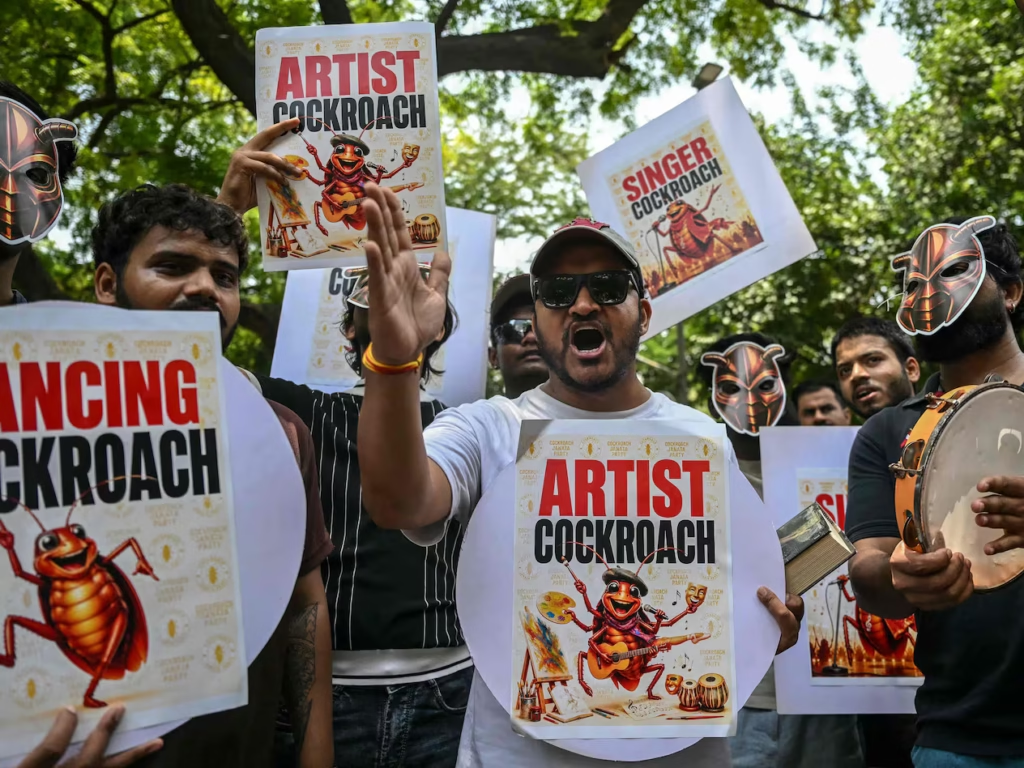
Sri-Lanka, Bangladesh and Nepal – South Asian countries that recently witnessed a revolutionary movement particularly led by youth. In India, hundreds of young people gathered at New Delhi’s Jantar Mantar for a protest against the system and the government.
They call themselves as the Cockroach Janta Party (CJP). This is the youth-first uprising which reflects the South Asian trend of revolutionary movement.
Last month, during a court hearing, India’s Chief Justice Surya Kant criticized unemployed youth and compared them with “cockroaches” and “Parasites”. As a result, this triggered and outraged young people. Abhijeet Dipke, an Indian graduate of Boston University, founded a satirical “Cockroach Janta Party (CJP)” with the slogan, “A political front for the youth, by the youth, for the youth.”
Within a week, he launched a website and social media accounts (X, Instagram). In a very short time, the followers reached 22.2 million which is triple that of the ruling Bharatiya Janta Party (BJP) and Indian National Congress (INC). Initially, the movement was online-centric, but it soon expanded into Delhi’s roads, Dipke fled from the US to India to lead this protest.
On Friday, the official CJP account posted on X, “Time to turn this tiny joke into a revolution”. He is encouraging supporters by saying that “cockroaches don’t ever fear”. School student, College goers, parents, activist gathered at Jantar Mantar. Their main demand is the resignation of Education Minister Dharmendra Pradhan. CJP supporters chanted slogan like “Cockroaches are coming, Dharmendra Pradhan is going”.
Behind the humor lies a deeper crisis. For decades, Indian youth have been facing unemployment problem, repeated question paper leak, recruitment process delay, and inhuman mental pressure from the entrance exam, for example, NEET. What makes the Cockroach Janta Party exceptional is not simply its unusual name or viral online presence, but its ability to transform individual grievances into collective political action.
The characteristics between the CJP and recent South Asian movements are striking. Sri-Lanka’s Aragalaya movement in 2022, Bangladesh’s July revolution in 2024, Nepal’s youth-led antigovernment uprising in 2025, all are led by young people.
These protests challenged political parties, raised questions about the government, demanding transparency, economic opportunities, and democratic reforms that expanded into nationwide movement. Like these movements, in India, the CJP has transferred the social media platform into a Political Organization and seeking to challenge institutions.
It reflects a growing decline in public trust toward conventional political parties. Not only this, but also a growing number of Indian youths are becoming frustrated with the BJP because of Modi’s Hindu Nationalist policies, which are leading to rising religious polarization, creating inequality, and increasing economic pressure.
The emergence of the Cockroach Janta Party (CJP) indicates a broader regional phenomenon: the rise of a generation that is politically connected, digitally mobilized, and increasingly unwilling to accept traditional forms of political representation. Across South Asia, young people are demanding transparency, accountability, economic opportunities, and institutional reforms. Their methods may differ, but their frustrations are remarkably similar.
At the same time, it is difficult for India to create a single revolutionary front and collapse the government due to its large geographical area, federal structure, political fragmentation, and different electoral system. In this case, India may face state-specific waves of mass mobilization on local grievances.
The future scenario can be assumed that the Cockroach Janta Party (CJP) asks for examination reform, recruitment transparency, employment creation, institutional reform and accountability. There is one significant lesson from South Asian movements that actions by authorities to dismiss or suppress youth-led protest often strengthen rather than weaken them.
So, we notice here mainstream political parties tried to oppress them; as a result, the supporters of the CJP became more aligned and connected. From a joke, an ordinary citizen created an online political party, and now it is visible on the road of India. Thousands of young people are mockingly identifying themselves as “Cockroaches” and their political party is the Cockroach Janta Party.
The question is no longer whether Indian youth are angry. The real question is whether that anger can be transformed into a sustained political movement capable of reshaping India’s political landscape. Now it is time to see that this mass mobilization protest turns into a revolutionary movement like Sri-Lanka, Bangladesh, and Nepal or not.
*The views presented in this article are the authors’ own and do not necessarily reflect the views of The Diplomatic Insight.

Mst Samiha Akter Salma
Mst Samiha Akter Salma is an undergraduate student in the Department of International Relations at Jahangirnagar University, Bangladesh. She also serves as Vice-President of the Jahangirnagar University Research Society (JURS). Her research interests- South Asian politics, Public Policy, and International Political Economy (IPE). she can be reached at samihasalma203@gmail.com