Cairo (TDI): Expanding Chinese investments are playing a pivotal role in reshaping Egypt’s industrial landscape, helping the country move from trade dependency toward localized, export-oriented manufacturing, as bilateral ties between Cairo and Beijing deepen.
In recent years, Chinese investment in Egypt has increasingly focused on factory-based projects and industrial expansion, supporting the government’s efforts to localize production, enhance value-added industries, and position Egypt as a regional manufacturing hub amid global trade uncertainties, according to Xinhua.
Egyptian business leaders see this trend as a clear reflection of the growing depth of the Egypt-China comprehensive strategic partnership. “Egypt is pursuing industrial localization. Some countries invest by buying existing factories, which is merely a transfer of ownership, not a genuine investment. China, however, comes to build real factories,” said Mostafa Ibrahim, vice chairman of the China Committee at the Egyptian Businessmen’s Association.
He added that the expansion of Chinese projects signals the current strength of economic and political ties between the two nations, which he described as “at their best.”
Hassan El-Khatib, Egypt’s Minister of Investment and Foreign Trade, emphasized that the next phase of cooperation should prioritize joint production and the growth of export-oriented domestic manufacturing.
Read More: China, Egypt to Boost Maritime Archaeology Cooperation
He noted that Egypt’s Vision 2030 aligns closely with China’s Belt and Road Initiative, particularly in areas of regional integration, industrial connectivity, and cross-border trade. Egypt’s strategic location, competitive labor costs, and extensive trade agreements make it a key bridge linking China to global markets.
“Egypt is part of the Belt and Road and can serve as a bridge connecting China, Egypt, and international markets.” Much of this industrial push is taking place in Egypt’s designated industrial platforms, especially the Suez Canal Economic Zone (SCZone), which has emerged as a central hub for Chinese manufacturing investment. Over the past three and a half years, SCZone has attracted $11.6 billion in investments, with Chinese investors contributing roughly half of the total, according to Waleid Gamal El-Dein, chairman of the SCZone Authority.
Read More: China, Egypt Agree to Promote Local Currency Settlement
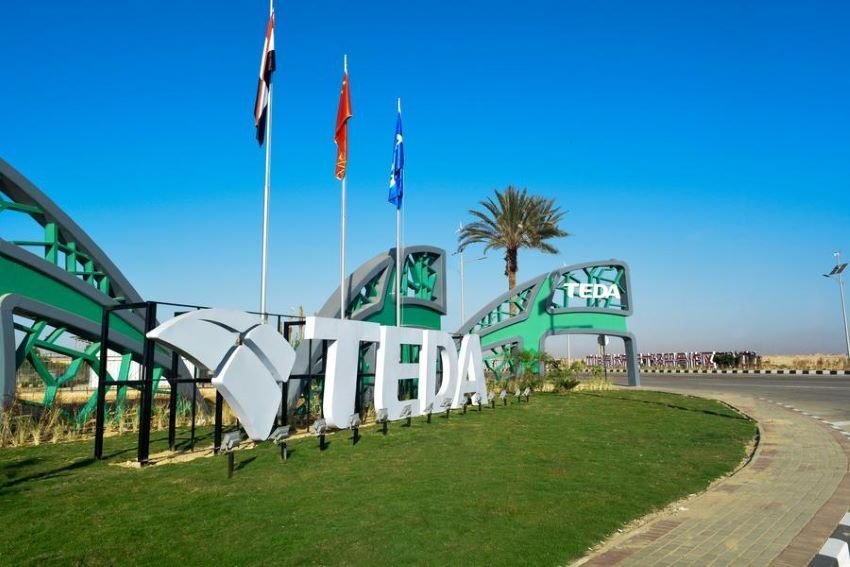
Within SCZone, the China-Egypt TEDA Suez Economic and Trade Cooperation Zone hosts over 200 industrial, service, and logistics projects with total investments of approximately $3.8 billion. Chinese fiberglass giant Jushi has operated a major plant there for more than a decade, establishing Egypt as a notable global fiberglass producer. Chinese home appliance manufacturers Haier and Midea have also expanded their production bases in the country.
Recent project launches illustrate the growing role of Chinese investment in local manufacturing. SCZone has approved a $70 million glassware project, a $40 million microfiber production line, and a $100 million fully integrated textile and garment complex, with much of the output targeted at export markets.
These developments reflect a broader strategy of fostering sustainable industrial growth, creating jobs, and integrating Egypt more deeply into regional and global supply chains, highlighting the increasingly strategic nature of Egypt-China economic cooperation.