Islamabad (TDI): Pakistan and the Netherlands have reaffirmed their commitment to strengthening bilateral ties, particularly in trade and investment.
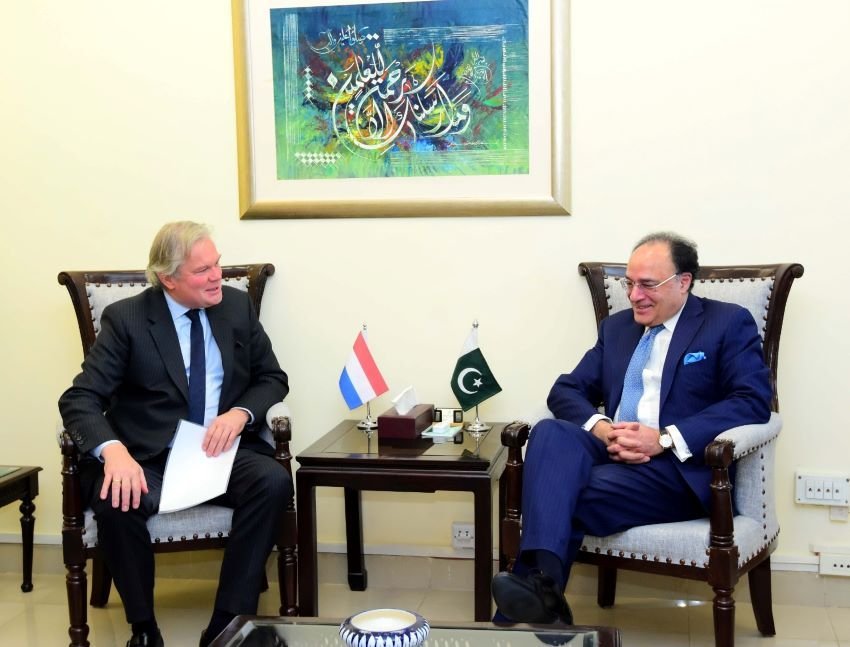
This understanding emerged during a meeting between Federal Minister for Finance and Revenue, Senator Muhammad Aurangzeb, and the newly appointed Ambassador of Netherlands to Pakistan, Robert–Jan Siegert, at the Finance Division.
The Finance Minister welcomed the Ambassador on his diplomatic assignment in Pakistan and conveyed appreciation for the longstanding and historic ties between the two countries, acknowledging Dutch support across development, trade and private sector-led initiatives.
He shared that Pakistan, after navigating a difficult period of macroeconomic adjustment, has now transitioned towards stability with a renewed emphasis on investment and structural reforms. He highlighted that Pakistan’s economic fundamentals have strengthened over the past two years, with all three global rating agencies upgrading the country’s outlook.
Aurangzeb briefed the envoy on the progress under the IMF program, noting that the Fund’s management has expressed confidence in Pakistan’s reform trajectory, particularly with respect to tax reforms, energy sector stabilization, governance improvements in State-Owned Enterprises (SOEs), and the ongoing privatization agenda.
Read More: Poland Ready to Share Development, Technology Expertise with Pakistan: Sikorski
He informed that the government is focused on restoring investor confidence and creating an enabling ecosystem for private sector investment. He shared that profit repatriation constraints faced by foreign investors have been eased, and the profits and dividends are being repatriated as a routine matter.
The minister added that Pakistan is now shifting from consumption-led growth to investment- and export-led growth to break the recurring boom-bust cycles of the past.
He underscored that major areas of investment interest whether from GCC, Europe, the US or China remain consistent, with actionable opportunities in minerals and mining, agriculture, IT, infrastructure and pharmaceuticals. He added that Pakistan is now moving towards sustainable foreign inflows through trade and investment partnerships rather than reliance on bilateral deposits or external loans.
The Finance Minister elaborated on efforts to broaden the tax base, reduce informality and ensure equitable taxation across sectors including retail, real estate and agriculture. He highlighted the rapid digitalization of revenue processes through AI-based monitoring systems to curb leakages in multiple sectors.
Read More: Pakistan, Netherlands Vow Stronger Economic Ties
He also apprised the Ambassador of progress on SOE reforms, right-sizing of federal entities, and the privatization of select institutions, noting the recent successful divestment of a financial institution and upcoming transactions for power distribution companies.
Recalling the Netherlands’ export-led economic model, the Minister emphasized the need for Pakistan’s industries to enhance competitiveness in global markets. He pointed out that Pakistan has initiated a phased reduction in additional customs duties over the next four to five years to gradually remove long-standing protectionism and strengthen export orientation.
Ambassador Siegert reaffirmed the Netherlands’ commitment to expanding trade and investment ties with Pakistan. He noted that around 50 Dutch companies are currently operating in the country and expressed interest in exploring opportunities in agriculture, IT, textiles and other sectors where the Netherlands has strong expertise.
Sohail Majeed
Sohail Majeed is a Special Correspondent at The Diplomatic Insight. He has twelve plus years of experience in journalism & reporting. He covers International Affairs, Diplomacy, UN, Sports, Climate Change, Economy, Technology, and Health.