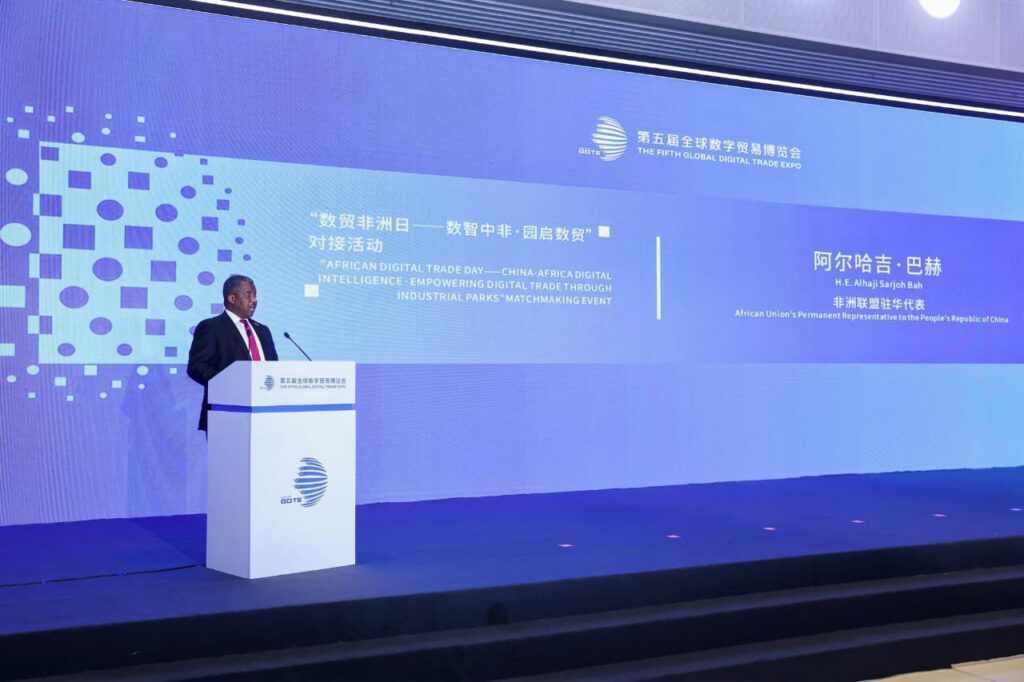
Speaking at this year’s Global Digital Trade Expo in Zhejiang Province, Ambassador Sarjoh Bah called on China and African nations to formalize their growing digital trade ties.
He proposed a five-pillar China–Africa Digital Trade Cooperation Framework aimed at converting business matchmaking into lasting commercial partnerships.
Addressing delegates at the event, whose theme centered on digital intelligence and industrial parks, the ambassador argued that “today’s matchmaking must become tomorrow’s contracts” and that existing zero-tariff arrangements must translate into concrete orders for African businesses.
The first pillar focuses on trade facilitation and cross-border e-commerce, calling for interoperable digital customs systems, mutual recognition of electronic trade documents, and priority access to Chinese platforms and logistics networks for African SMEs, women and youth entrepreneurs.
Speaking at this year’s Global Digital Trade Expo in Hangzhou, Zhejiang Province, China, Amb @sarjohbah3 called for the establishment of a China–Africa Digital Trade Cooperation Framework, anchored on five planks.
First, trade facilitation and cross-border e-commerce. Today’s… pic.twitter.com/nd82HQvQCa
— African Union Permanent Mission to China (@AUMission_China) September 26, 2026
Second, the ambassador urged exploration of interoperability between Africa’s Pan-African Payment and Settlement System and Chinese payment platforms, describing payment friction as “a hidden tax on small traders” that undermines exporters’ returns.
The third pillar addresses data governance and dispute resolution. The ambassador emphasized that African states require policy space to regulate data in accordance with the Malabo Convention and the African Union’s Data Policy Framework, while Chinese investors need clarity on cross-border data flows.
He proposed a standing bilateral dialogue on data governance, closer cooperation between cybersecurity response teams, and accessible online dispute-resolution mechanisms modeled on the AfCFTA Investment Protocol’s emphasis on prevention over formal litigation.
Read More: AU Representative to China Calls for Horn of Africa Reconciliation Compact
Fourth, the ambassador called for systematically pairing Chinese digital-trade industrial parks, including those in Zhejiang, with African special economic zones.
He framed this as essential to Africa’s dual transition, from exporting raw minerals to processed goods, and from generating raw data to producing “processed intelligence,” with local content, skills transfer and Africa-relevant AI systems built in from the start.
The fifth pillar centers on people-to-people ties, proposing exchanges for young entrepreneurs, digital-skills training, scholarships, joint university research, and eased business travel for African merchants attending trade fairs.
The ambassador linked this to the “Year of People-to-People Exchanges” agreed upon by leaders at the Beijing Summit.
The proposal was delivered alongside a “Smart Africa” cultural exhibition showcasing the continent’s creative and artisanal heritage alongside its commercial offerings.