Labor ministers from African Union member states and Gulf Cooperation Council countries will gather in Dar es Salaam on 5–6 October for the second Africa–GCC+ Dialogue on Labor Mobility.
Jordan and Lebanon will also take part, which is where the “plus” comes from. The African Union Commission announced the meeting on 18 September.
It says governments on both sides now share the view that origin and destination countries cannot manage this movement separately if it is to be safe, orderly and humane.
The scale of the corridor explains the urgency. About 4.7 million African migrants lived in GCC countries in 2024, according to the AU.
Demand for their labor remains strong in domestic and care work, construction, hospitality, transport, agriculture and services.
*Ministers from Africa and the Gulf set for High-level Labour Mobility talks in Dar es Salaam*
Labour ministers from African Union (AU) Member States and Gulf Cooperation Council countries, together with Jordan and Lebanon (GCC+), are set to meet in Dar es Salaam on 5–6 October…— African Union (@_AfricanUnion) September 29, 2026
Across the wider Arab States region, roughly 24.1 million migrant workers make up 41.4% of the labor force, against a global average of 5%.
Both sides have something to gain. For African countries, well-governed mobility brings jobs, remittances, skills and stronger diaspora ties. For Gulf and partner states, it supports labor-market stability, productivity and growth.
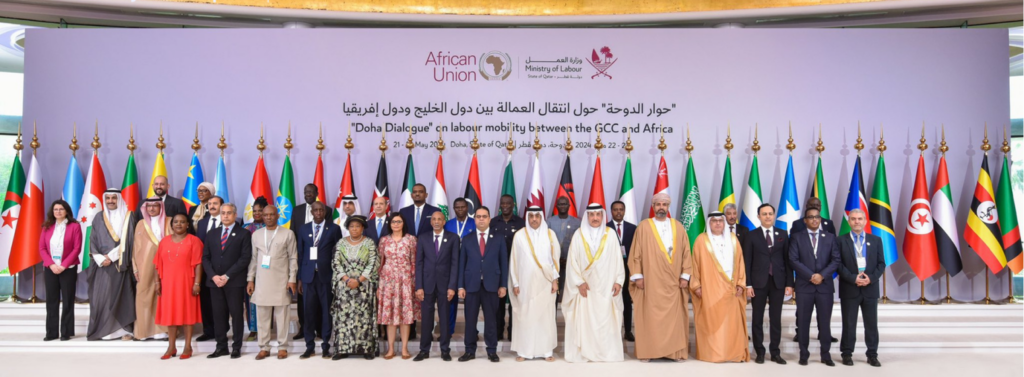
The dialogue is a state-led platform formally adopted through the Doha Declaration on Labor Mobility on 22 May 2024.
The declaration set priorities on recruitment, skills, occupational safety and health, access to justice, technology and the needs of women migrant workers. The Dar es Salaam meeting is meant to move from those priorities to specifics.
Ministers will focus on fair recruitment, recognition of skills, social protection, access to justice, protection of workers in vulnerable sectors, and data-sharing and monitoring of bilateral labor agreements.
Read More: African Union Reviews Draft Policy on Mental Health Support for Peacekeepers
The talks come as the AU marks 20 years of its Migration Policy Framework for Africa. Its key labor migration recommendations are being pursued through the continental Joint Labor Migration Program.
Dr. Sabelo Mbokazi, the AU’s Head of Labor, Employment and Migration, said the timing was deliberate. “There is no better time than this for these honest conversations,” he said, adding that he was confident given the political will on both sides. “What we need are timely, specific and actionable priorities,” he said.
Ministers and heads of delegation will be joined by senior officials and representatives of the International Organization for Migration, the International Labor Organization and the UN Economic and Social Commission for West Asia.
Also attending will be the Executive Bureau of the GCC Council of Ministers of Labor, African regional economic communities, employers’ and workers’ organisations, and civil society groups.