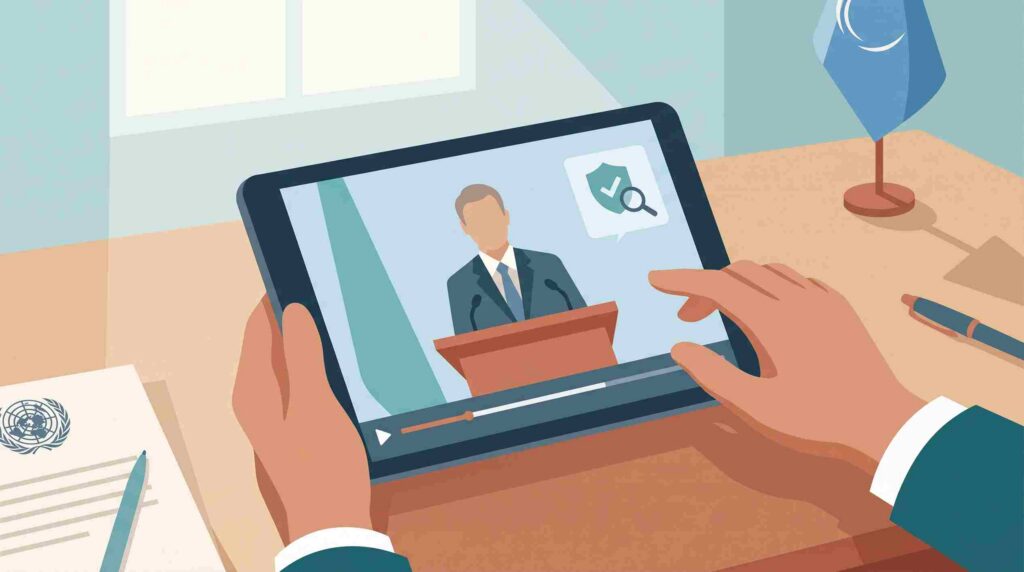
Consider a fabricated video appearing just before a sensitive diplomatic meeting. It seems to show an official abandoning an agreement, but nobody has verified where it originated. The immediate challenge is not simply identifying an artificial image. It is preventing an uncertain claim from shaping an official response.
This hypothetical scenario illustrates why digital authenticity deserves a place in diplomatic preparedness. The Global Digital Compact, adopted at the United Nations on September 22, 2024, provides a framework for international digital cooperation. A practical priority should be translating that cooperation into trusted communication.
Distinguish Authenticity From Accuracy
The first task is to separate three questions: who published the material, how it was produced, and whether its claims are correct. These questions require different evidence.
A genuine recording could be presented with a misleading translation. Conversely, an openly labeled illustration could accurately explain a development project without documenting an actual event. Treating every artificial image as deception would miss this distinction.
The US National Institute of Standards and Technology recognizes that synthetic content has beneficial and benign uses alongside risks involving impersonation and information integrity.
Diplomatic teams should therefore assess the specific claim before debating the technology behind it. For a disputed statement, the original transcript, recording, and confirmation from the issuing office should take priority over speculation about visual style.
Use Detection Without Delegating Judgment
An AI checker can provide an additional signal when reviewing a suspicious text, but its result should not determine an institution’s response.
A 2023 study found that several tested detectors misclassified writing by people whose first language was not English. Those findings concern particular tools and datasets, not every current system, but they demonstrate why independent evaluation matters.
For diplomatic services, the practical lesson is to test tools against the languages and document types they actually handle. Procurement should include questions about false positives, confidentiality, and how results are explained.
Analysts should record what a tool indicates alongside other evidence. A classification is not confirmation of authorship, factual accuracy, or responsibility for circulating a document. Those judgments require a broader investigation.
Preserve the Evidence Behind Digital Images
Watermarking and provenance records offer different ways to examine digital material. NIST identifies both among approaches to content transparency. The Coalition for Content Provenance and Authenticity develops standards for recording information about a file’s origin and editing history.
Crucially, the coalition explains that provenance alone cannot establish whether the depicted content is true. A documented editing history is useful evidence, not a guarantee about the scene itself.
When a communications team receives a request to remove AI watermark information from an official illustration, it should consider what evidence might be lost. Retaining an original, documenting authorized changes, and clearly identifying generated illustrations should be part of publication policy.
The objective should be understandable disclosure rather than a technically polished image with an unexplained history.
Prepare Verification Channels Before a Crisis
Foreign ministries should establish verification contacts before disputed content begins circulating. Embassies, spokespersons, and partner institutions could maintain authenticated channels for checking whether an announcement genuinely came from the claimed source.
A useful protocol would assign someone to preserve the original file, someone to contact the issuing institution, and someone to approve public updates. Each update should distinguish confirmed facts from unresolved questions. An on-call roster should specify backup contacts and response deadlines so that verification does not depend on one official being available at the moment.
Exercises could test a fabricated announcement, an inaccurate translation, and genuine footage presented with a false date. Teams should practice correcting information across languages without repeatedly amplifying the misleading material.
They should also distinguish correcting a false claim from attributing a coordinated operation. Rejecting an inaccurate statement does not establish who created it or whether a foreign government was involved.
Build Cooperation Around Shared Capacity
The UN Global Principles for Information Integrity call for consistent platform policies across countries and languages, alongside transparency and independent research. These priorities offer a basis for practical diplomatic cooperation.
Universities and diplomatic academies in Pakistan, the United States, and other countries could jointly develop training exercises using publicly available material. Such collaboration should evaluate verification methods rather than attempt to align political interpretations.
Regional initiatives could support translation expertise, secure evidence handling, and accessible verification tools. Funding should cover staff development and maintenance, not merely the purchase of software.
Success should be measured through reliable confirmations, clearer corrections, and participation across languages. Counting how many suspicious posts a system flags would provide a much narrower picture.
Protect Openness Alongside Trust
Authenticity initiatives should not become mechanisms for suppressing disagreement. The UN principles emphasize freedom of expression and independent media alongside efforts to address harmful information.
Governments should publish accessible originals, explain corrections, and allow independent scrutiny of disputed claims. Verification systems should also protect confidential sources and personal information rather than require indiscriminate disclosure.
For diplomacy, the strongest approach combines technical evidence with accountable institutions. Better tools can support that work, but credible communication ultimately depends on officials who explain what they know, acknowledge uncertainty, and correct mistakes.

Established in December 2008, The Diplomatic Insight is Pakistan’s premier diplomacy and foreign affairs magazine, available in both digital and print formats.