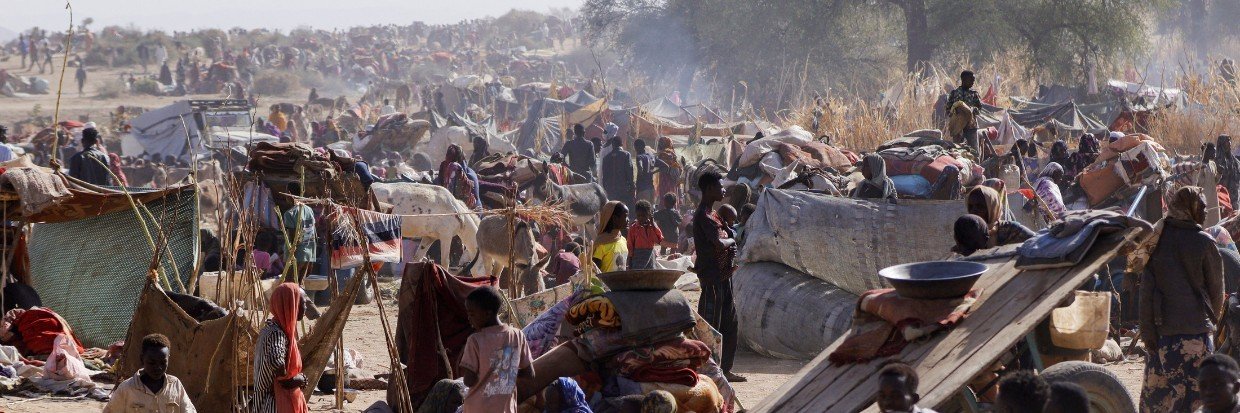
On 26th October, the Rapid Support Forces (RSF), a Sudanese paramilitary force formerly operated by the Sudanese government, claimed control of the Sudanese Armed Forces’ (SAF) Sixth Infantry Division Headquarters in El Fasher, the last Sudanese government and SAF stronghold in the Darfur region.
The fall of the city came after a brutal 18-month long siege that culminated in the El Fasher Massacre, which killed an estimated 2500 civilians. The Yale School of Public Health’s Humanitarian Research Lab (HRL) has reported the killing of 10,000 people within the first three days of the fall of the city.
There have been reports of systematic violence perpetrated by the RSF forces, including burning civilians alive, extrajudicial killings, and deliberate targeting of certain non-Arab ethnic groups.
Who are the RSF and what do they want?
The origins of the RSF can be traced back to the Janjaweed (devils on horseback) militias used by Sudan’s former authoritarian leader Omar al-Bashir to quell a rebellion in the Darfur region. In 2013, they were restructured as a paramilitary organization under the command of Mohammed Hamden Dagalo, also known as Hemedti.
However, President Omar al-Bashir, who had ruled Sudan since 1993, was ousted in a popular uprising against his government in 2019. In the aftermath of the revolution, many civil society organizations asked the military to oversee the transition of Sudan to civilian and democratic government.
Therefore, a Transitional Sovereignty Council (TSC) was established, composed of five military and six civilian leaders. The military-civilian government soon wrecked the economy, thereby paving the way for a military coup in 2021. The coup was led by General Abdel Fattah al-Burhan, the head of the SAF, and General Mohammed Hamden Dagalo, the commander of the RSF, despite their placement on the TSC.
Read More: Renewed Fighting in Central Sudan Displaces Over 2,000 People
After throwing the civilian government under the bus, both generals went after each other. The disagreements between the two leaders arose due to the distribution of state resources among their respective forces. However, the major bone of contention between the two generals became the proposal to incorporate the 100,000-strong RSF into the army.
The unwillingness of either general to lose their positions of immense wealth, power, and privilege resulted in shootings between the two sides in April 2023. Soon, the RSF was redeployed around the country, and the fighting quickly escalated into a civil war.
Who is backing whom?
The escalation of the conflict has prompted the international community to take sides in the conflict. The UN-recognized government forces, the SAF, are backed by Egypt, Turkey, Iran, and Russia, while the RSF is being funded by the United Arab Emirates (UAE).
The UAE has been accused of providing funding and weapons to the RSF. Though the UAE has denied any such involvement, intelligence reports by the US authorities have confirmed the accusation.
Moreover, Amnesty International has said that it has also found evidence of weapons manufactured in Serbia, Russia, China, Turkey, Yemen, and the UAE being used in Sudan. Another UN expert report has also shed light on the smuggling route taken by weapons into Sudan.
The report highlighted the detection of ‘multiple flights’ that had been carrying weapons from the UAE through Chad into the Darfur region. The RSF
The largest humanitarian crisis
The United Nations has dubbed the conflict in Sudan as “the largest humanitarian crises”. Both the SAF and RSF have been accused of committing atrocities, and both have been sanctioned by the international community, in particular, by the United States. The SAF has been involved in deliberately obstructing lifesaving humanitarian assistance, expelling aid workers, refusing visas for humanitarian workers, and launching airstrikes on civilian populations.
The willingness to starve the population by denying them access to humanitarian aid demonstrates the utter contempt of the SAF for the Sudanese populace despite claiming the legitimate representation of the population.
Read More: Thousands Flee as Sudan War Expands into Kordofan
The RSF, on the other hand, has gone one step further by organizing systematic violence against the non-Arab populations of the Darfur region. In March, reports emerged that RSF fighters were involved in raping children as young as one to horrify the population into submission.
In the same month, the Human Rights Watch (HRW) also said that the RSF was committing a genocide by launching an ethnic cleansing campaign in the city of El-Geneina that killed thousands of the Masalit people. However, the RSF has denied the accusations of genocide. The subsequent UN investigation claimed that both forces have been involved in war crimes but was unable to verify systematic ethnic cleansing by the RSF.
Global Apathy
Despite the deaths of more than 150,000 people in the Sudanese Civil War, the international community has been slow to react. Most of the attention for the past few years has been diverted to the war in Ukraine and the genocide in Gaza, leaving the catastrophe in Sudan unnoticed.
However, the recently released reports of systemic violence by the RSF have led the United States and the United Kingdom to impose an arms embargo on the UAE. After these developments, the UAE has sought to distance itself from the RSF and has been open to playing a productive role in the peace process.
Nevertheless, further international pressure would be required to make a permanent settlement. Till then, the RSF has declared a separate administration alongside the government administration, which might mean further division of Sudan in any future peace process with the SAF controlling the eastern half of Sudan and RSF controlling the western.

Muhammad Omer Rafiq
Muhammad Omer Rafiq is a student of politics with a passion for making sense of our tumultuous political world that always seems to be on the edge. He recently graduated in International Relations from Lahore Garrison University. He can be reached at muhammadomerrafiq@gmail.com