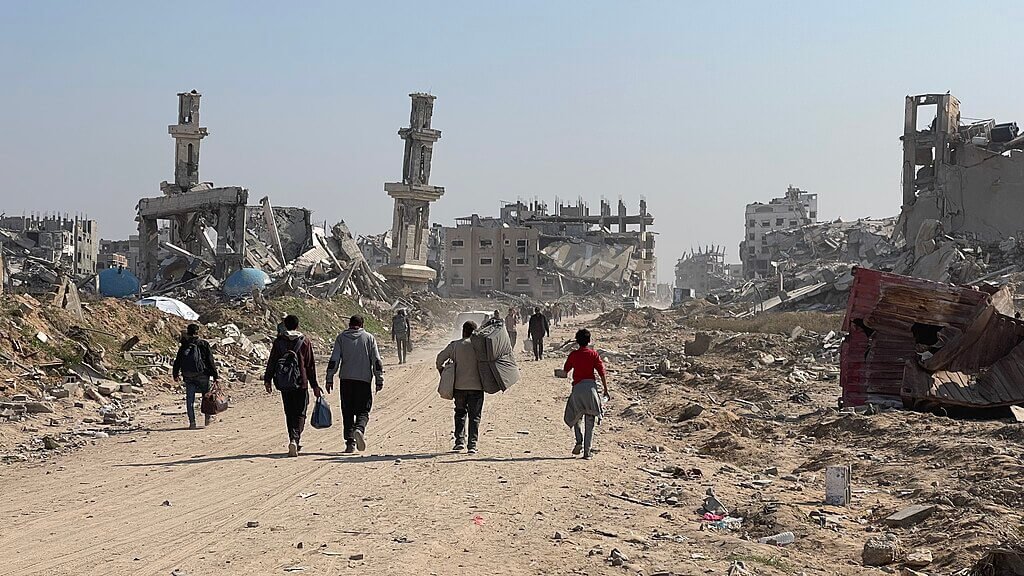
On 17th November, the United Nations Security Council (UNSC) passed Resolution 2803 with a 13-0 vote. The ambitious US-backed resolution, crafted within the framework of Trump’s 20-point peace plan for ending Israel’s war on Gaza, is set to reinforce the ceasefire and rebuild Gaza within a two-year period. Within the resolution, two clauses have particularly grabbed the attention of the public.
First, that the territory of Gaza would be governed by an apolitical and technocratic committee overseen by an international “board of peace”, and second, that an “international security force” would be created to train and support the Palestinian police forces, help secure Gaza’s borders, secure the rapid flow of goods, and stop munitions from entering Gaza.
Though the idea of a technocratic government in charge of Gaza has raised some questions about the participation of Palestinians in governing themselves, it is the second clause involving the creation of the International Stabilization Force (ISF) that garnered the most scrutiny from the media and the wider public.
Nevertheless, the UN mandate behind the ISF means that it is not an illegitimate force arbitrarily selected by the United States anymore but an internationally recognized legal body that has legitimate authority to achieve its stated mission in Gaza. Moreover, many Arab and Muslim states, like Egypt, Jordan, Saudi Arabia, Qatar, the UAE, Pakistan, and Indonesia, have come forward in support of the resolution and ISF, thereby further increasing its legitimacy.
Role and Controversy
According to Resolution 2803, the ISF will oversee both the ‘demilitarization’ and ‘stabilization’ of Gaza. In this respect, the ISF differs substantially from the traditional peacekeeping missions with their focus on preventing conflict between different state actors by acting as a bulwark. The ISF, on the other hand, is tasked with ensuring the demilitarization of Gaza by coercing Hamas into giving up its arms and taking control of the security situation in the territory till 2027. This has led to controversy among former supporters of the resolution because Hamas is a state actor and has repeatedly rejected the demand to disarm. Hamas has made it clear a number of times through their official Telegram channel that it has only agreed to step down from the government, and any attempt at disarming them would be met with fierce resistance.
Read More: New UN Gaza Plan Sidesteps International Consensus: Russia
The Response of the Muslim World
What makes the situation all the more tense for Muslim countries backing the resolution is that there are still more than 20,000 armed Hamas fighters in Gaza. If the Israel Defense Forces (IDF) have been unsuccessful in getting rid of Hamas, how would the ISF be able to do it? This has led many Muslim states to backtrack on their initial commitments to the resolution. Indonesia, for example, initially announced a commitment of 18,000 troops for the ISF but has backtracked on that number and said that they will send a contingent of 1,200 troops.
Moreover, after the passing of the resolution, reports emerged that countries like Egypt, Qatar, and the UAE were also on board with the resolution. However, the role of the ISF, which was previously unclear and still suffers from ambiguities, has made these states reluctant to send their forces to Gaza. An Emirati official later confirmed that the UAE would not place its troops in Gaza to demilitarize Hamas. Pakistan has also stated that it will be more than happy to be part of the ISF but is “not ready” to disarm Hamas. The Turkish president, Tayyip Erdogan, has also said that his country is ready to provide support to Gaza, but the tensions between Türkiye and Israel caused Israel to veto the possibility of Turkish troops on the ground in Gaza.
Due to the sensitive nature of ISF’s stated aims, it is not at all surprising that most Arab and Muslim states have shown reluctance to move forward. Most leaders of Muslim states are afraid of being perceived as acting against the interests of Palestinians. This is further aggravated by the popular perception of the ISF as a Western tool employed by the United States to do the ‘dirty work’ of Israel. Therefore, though many Muslim states support the resolution, they are also hesitant to invite the wrath of their own populations.
The Response of Israel
The government of Israel, on its part, has nonetheless maintained its commitment to the disarmament of Hamas. The Israeli Prime Minister Benjamin Netanyahu told the Knesset Israel’s war in Gaza “has not ended” and that “Hamas would be disarmed.” Danny Danon, Israel’s UN envoy, also proclaimed in the United Nations that his country would “demonstrate determination in ensuring that Hamas is disarmed.”
This stalemate between Israel and the Muslim world, however, was long in the coming. Though Trump has claimed to end the war, the region is far from moving in a peaceful direction. This is because most of the Trump administration’s efforts went into designing the grand optics of peace conferences that illustrate his peace-building prowess rather than addressing the underlying issues that cause the conflict to erupt in the first place. In this respect, Resolution 2803 and the ISF would not be the final arbiters of peace in the Middle East but one of many weak initiatives for peace, which would eventually be relegated to the dustbin of history.

Muhammad Omer Rafiq
Muhammad Omer Rafiq is a student of politics with a passion for making sense of our tumultuous political world that always seems to be on the edge. He recently graduated in International Relations from Lahore Garrison University. He can be reached at muhammadomerrafiq@gmail.com