AUKUS is a trilateral security partnership between Australia, the United Kingdom, and the United States. It was announced jointly by the leaders of the respective countries in September 2021. The partnership is centered on defense and security cooperation between the Anglo-Saxon nations on two lines of effort.
The first line of effort focuses on the acquisition of nuclear submarines by Australia, and the second intends to enhance the military collaboration between the three nations in six key technological areas: undersea capabilities, quantum technologies, artificial intelligence, electronic warfare, hypersonic capabilities, and information sharing.
The Origins
The development of AUKUS can be understood in the backdrop of US President Barack Obama’s “Pivot to Asia” policy announced in 2011. By the end of the first decade of the US’ War on Terror, it was clear to many in the US foreign policy circles that their ambitions in Afghanistan may come to no avail but could inadvertently allow China to dominate the Asia-Pacific by keeping the US bogged down in an insignificant theater.
Therefore, in 2011, Barack Obama announced “Pivot to Asia” to counter the growing Chinese influence in the Asia-Pacific.
The policy continued under the first Trump administration. However, it was Joe Biden who oversaw the US withdrawal from Afghanistan and was therefore able to focus solely on cementing alliances in the Asia-Pacific. Hence, just after a year of assuming office, Joe Biden signed the AUKUS agreement with his British and Australian counterparts, Boris Johnson and Scott Morrison, respectively.
The move was widely viewed as containment against China, but the AUKUS leaders denied any such allegations, claiming that the intent of the agreement was “to promote a free and open Indo-Pacific that is secure and stable.”
Read More: Trump, Australia’s PM Sign Critical Minerals Deal as China Dominates the Industry
The Evolution
The AUKUS security partnership has become a key component of the US foreign policy in the Asia-Pacific region since 2021. On the first line of effort, the US has pledged to deliver three nuclear-powered Virginia-class submarines to Australia from 2032. Therefore, the Australian Submarine Agency was established in July 2023 to manage the nuclear submarine program.
Moreover, on 26th July 2025, the Australian and the British governments signed the Geelong Treaty within the AUKUS framework to affirm the collaborative efforts in the construction of nuclear submarines for Australian defense.
On the second line of effort too, AUKUS has made significant breakthroughs. Since 2023, AUKUS partners have participated in joint military exercises, joint exercises to demonstrate the capabilities relating to the protection of underwater infrastructure, and joint collaborations in developing quantum, cyber, and hypersonic technologies. These engagements have also, from time to time, caught the ire of other regional powers such as Malaysia and Indonesia.
However, it is China who has felt most threatened by these developments. China has been the most fervent critic of the partnership, has protested against it on many occasions, and has issued many warnings since 2021 to AUKUS states for creating a security dilemma in the Indo-Pacific.
Ironically, this Chinese assertiveness against the AUKUS states has also made smaller states in the region like Japan, South Korea, and Taiwan nervous about their own security prospects. As a result, these states have made some attempts to join the partnership, but the US has resisted any such initiatives so far. AUKUS, therefore, has remained an exclusively Anglophone club.
The Future
Since the return of Donald Trump to the White House, the future of AUKUS had been ambiguous. The White House announced in June this year that the AUKUS agreement was under review, leading many to forecast that the US might walk away from the deal. The possibility of the US walking out of the deal naturally created anxiety for the administrations in London and Canberra.
Therefore, both governments had been working diligently for the past few months to ensure that the US remains in the security partnership.
Read More: Caught Between Allies and Trade: Australia’s Geopolitical Challenges
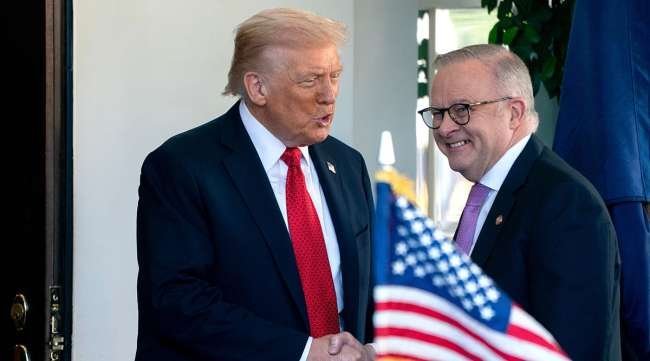
However, the Australian Prime Minister Anthony Albanese’s visit to the US to sign a critical mineral deal on 20th October has made it clear that the US remains intent on supporting the AUKUS deal. In a press conference before the meeting of the two leaders, US President Donald Trump told the reporters that the US had no better friend than Australia and affirmed that the submarine deal will proceed as planned.
Though the Pentagon said in a statement that the pact was still under review, Albanese left the White House confident about US intent to remain, owing to the President’s affirmation.
Albanese’s success in the White House has dispelled any doubts on the continuation of US foreign policy in the Asia-Pacific. It seems, therefore, that the US will continue to work with its partners in Asia-Pacific to contain the rising Chinese influence in the region. Abandoning Australia would be the final nail in the coffin for American hegemony in the Asia-Pacific. In this respect, AUKUS will remain a core component of the foreign policies of Australia, the US, and the UK in the foreseeable future.

Muhammad Omer Rafiq
Muhammad Omer Rafiq is a student of politics with a passion for making sense of our tumultuous political world that always seems to be on the edge. He recently graduated in International Relations from Lahore Garrison University. He can be reached at muhammadomerrafiq@gmail.com