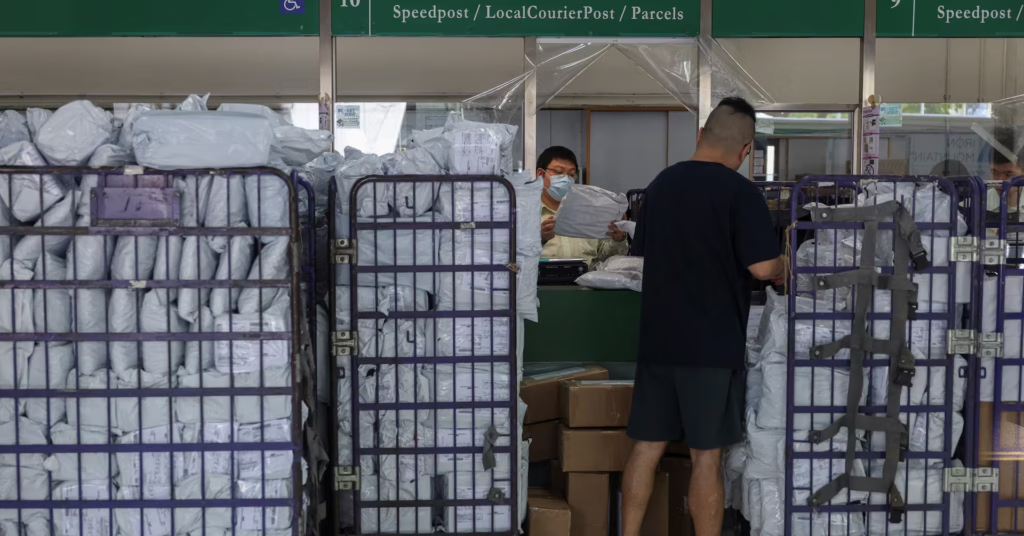
For nearly a decade, a customs provision few people outside trade law had ever heard of quietly built one of the largest cross-border shopping habits in history. Section 321 of the Tariff Act let any package worth $800 or less enter the United States free of duty, with no formal customs entry and no broker required.
A T-shirt from Guangzhou, a phone case from Shenzhen, a small electronics order for a startup in Ohio: all of it moved across the Pacific and through customs almost invisibly. That invisibility is gone.
Between February and August 2025, a series of executive orders dismantled the exemption first for China and Hong Kong, then for the rest of the world, and Congress has since voted to eliminate it entirely for commercial shipments by 2027.
What looked like a technical customs adjustment has become one of the more consequential, and least discussed, instruments of American trade policy in years.
The first executive order targeting de minimis treatment, signed in February 2025, was framed around synthetic opioids rather than trade competitiveness. The administration’s stated rationale was that the exemption had become a channel for precursor chemicals and counterfeit goods to enter the country with minimal scrutiny, a claim consistent with Customs and Border Protection’s own guidance on the policy.
By April, a follow-on order extended the logic to essentially all low-value goods from China and Hong Kong, and by August the suspension had broadened to cover low-value shipments from every country of origin.
The scale of what had grown under the old rule helps explain why the change registered as more than a technical adjustment. CBP has reported collecting over a billion dollars in duties on more than 246 million low-value shipments in the months following the initial rollback, according to a summary compiled in a Congressional Research Service brief. That is revenue that, under the previous regime, would never have reached the Treasury at all.
The Case for the Rollback
Proponents of the change, inside the administration and among domestic manufacturers, have made an argument that predates the opioid framing by years: that de minimis had become a structural advantage for foreign platforms selling directly to American consumers, one that domestic retailers subject to full duties and compliance costs did not enjoy.
Under the old threshold, a shipment broken into many parcels under $800 each could avoid the tariffs, including Section 301 duties, that the same goods would owe if imported in bulk by a domestic retailer.
Critics of the exemption argued this was not a loophole so much as an unintended subsidy for a specific business model, one that companies such as Shein and Temu had built entire logistics networks around.
There is also a straightforward compliance argument. A rule that allows hundreds of millions of parcels a year to cross the border with no formal entry and minimal product data is, almost by definition, a rule that is difficult to enforce against contraband, counterfeit goods, or mislabeled products, regardless of what share of the volume such goods actually represented.
The Case Against It
The counterargument is less about the principle than the transition. Small and mid-size importers, many of whom built dropshipping or private-label businesses on the assumption that low-value parcels moved duty-free, absorbed the change with little warning and less flexibility than the large platforms the policy was arguably aimed at.
A business importing single units to fulfill individual orders now faces formal entry requirements, HTS classification, and duty payments on every shipment, a cost structure that scales far worse for a small operation than for an importer able to consolidate volume into fewer, larger shipments.
That shift has also pushed landed-cost estimation into the ordinary course of business for importers who never had to think about it before. Where the exemption once made the calculation unnecessary, small importers now need to know, before a shipment leaves the factory, what duties will apply once it arrives.
Tools such as Ship4wd’s tariff calculator, built for exactly this kind of estimation, have become a routine step in the booking process rather than a specialized function reserved for customs brokers and large importers.
There is also a consumer-facing cost. Duties that were previously absorbed within the $800 exemption now show up, one way or another, in the price a shopper pays, whether through the seller passing on the cost directly or through the postal surcharges CBP has authorized for low-value international mail. For consumers accustomed to inexpensive direct-from-factory goods, the change functions less like an abstract trade policy and more like a tax increase on everyday purchases.
And for trading partners, particularly developing economies whose small exporters had used platforms built around de minimis shipping to reach American consumers without the overhead of a formal export operation, the rollback removes a channel that had, whatever its flaws, functioned as a genuine on-ramp to the U.S. market.
Whether a replacement channel emerges at comparable cost is an open question, and one with real consequences for small producers far removed from the policy debate in Washington.
What makes this episode worth attention beyond its immediate trade effects is the precedent it sets. A customs threshold that had stood, with periodic upward adjustment, for the better part of a century was suspended by executive order within months and then codified into permanent repeal by legislation shortly after.
That is a notably fast timeline for a change touching hundreds of millions of transactions a year, and it demonstrates how a comparatively obscure administrative rule can be repurposed as a rapid, broad-based instrument of trade policy, one that does not require a new tariff schedule or a renegotiated agreement, only a redefinition of who qualifies for an existing exemption.
Whether that precedent is used again, and against which categories of goods or countries, will likely say more about the future shape of U.S. trade policy than the opioid rationale that first introduced it.

Established in December 2008, The Diplomatic Insight is Pakistan’s premier diplomacy and foreign affairs magazine, available in both digital and print formats.