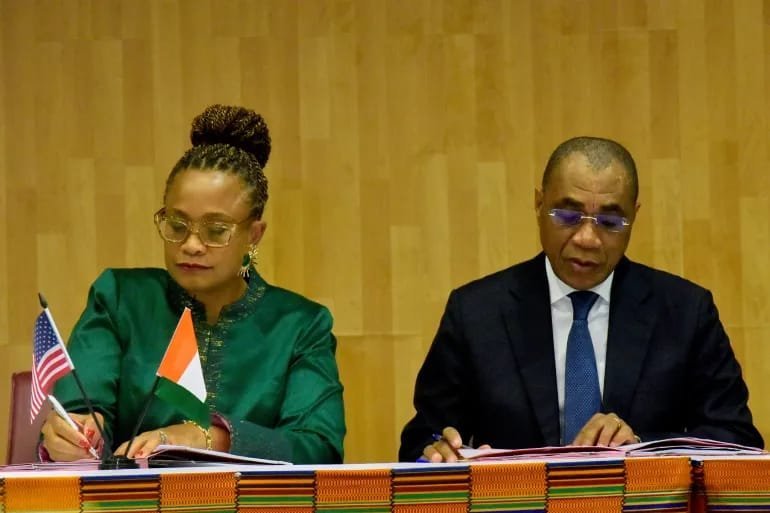
Abidjan (TDI): The United States administration has finalized a significant public health agreement with the Ivory Coast involving $480 million in aid. This deal was signed in Abidjan and represents a key component of the America First Global Health Strategy.
This strategy prioritizes bilateral agreements over traditional aid programs. The shift follows a substantial reduction in funding and the dismantling of the US Agency for International Development (USAID). The American government argues that previous aid models were inefficient and lacked proper oversight. By shifting to direct government-to-government deals, the administration aims to foster accountability and eventual self-sufficiency in partner nations.
US Ambassador Jessica Davis Ba stated that the new model moves “beyond the traditional aid approach toward a model focused on trade, innovation and shared prosperity”. Under this specific arrangement, the Ivory Coast has committed to providing approximately $292 million of its own funding toward the health sector by the year 2030. This contribution represents about 60% of the total commitment.
The deal focuses on critical areas such as HIV prevention, malaria treatment, maternal health and general global health security. It is currently the largest of more than a dozen similar arrangements reached with African nations. Experts have expressed serious concerns regarding the overall strategy. Previous cuts to international aid have already disrupted essential services across the African continent.
Warning that maternal health and infectious disease detection may suffer during this transition. There are also fears that the transactional nature of these deals might prioritize political objectives over urgent medical needs. A recent analysis by the Center for Global Development suggested that while the strategy introduces some beneficial changes, the risks to established public health gains are high.
Question remains regarding how health services will be protected if a partner nation fails to meet its financial obligations. There is also uncertainty about how aid will reach populations in regions without stable or credible governments. The speed and scale of this reconfiguration are considered unprecedented in the history of global health assistance.
While the administration views this as a path toward eliminating waste and ideology, critics see it as a high-stakes experiment. The strategy aligns with a broader pattern of transactional diplomacy that uses direct negotiations to advance specific foreign policy agendas.

Tayyaba Arif is a student of International Relations, and takes keen interest in conflict reporting and the dynamics of regional and global affairs. She is especially committed to SDG 17, and believes in effective partnerships and promoting cooperative initiatives. She can be reached at tayyabarrif0@gmail.com