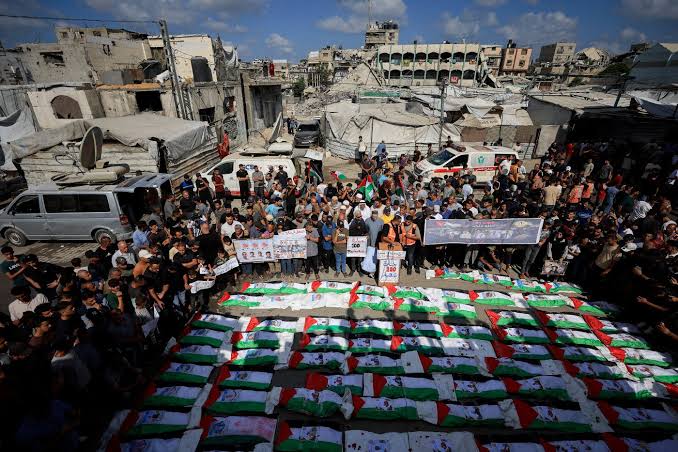
The United Nations has called for international investigators to be granted access to Gaza as hundreds of bodies continue to be recovered from buildings destroyed during the conflict, raising renewed questions over accountability and the preservation of evidence.
UN High Commissioner for Human Rights Volker Türk said the discovery of remains beneath destroyed structures reinforced concerns surrounding possible violations of international humanitarian law during Israeli military operations.
More than 630 bodies have reportedly been recovered from rubble since November 2025, while Palestinian authorities estimate that thousands of people remain missing beneath destroyed buildings.
Türk stressed the need for international investigators to enter Gaza and assist in gathering evidence before large-scale debris removal potentially alters or destroys material relevant to future investigations.
The UN’s concern increasingly links Gaza’s reconstruction with the question of accountability. Earlier this month, UN Special Rapporteur Francesca Albanese warned that large-scale rubble removal must not destroy human remains or physical evidence potentially relevant to investigations of alleged international crimes.
The issue has practical as well as legal consequences: Gaza contains enormous quantities of debris that must be removed for reconstruction, restoration of infrastructure and the return of displaced communities, but some destroyed sites may simultaneously contain bodies and forensic evidence.
The UN Development Programme and European Union have already launched a €15 million initiative supporting debris management and Palestinian-led forensic capacity, including the recovery and identification of human remains.
Türk’s intervention does not itself establish that individual Israeli attacks constituted war crimes. Such determinations require investigation into the circumstances of particular strikes, including the intended military objective, proportionality, precautions taken to protect civilians and other requirements under international humanitarian law.
Israel has maintained that its forces operate in accordance with international law and has accused Hamas of embedding military activity within civilian areas.
The emerging diplomatic issue is therefore access: whether independent investigators will be able to examine sites and preserve evidence as Gaza moves from war toward reconstruction.
With entire neighborhoods reduced to rubble and thousands of people still unaccounted for, decisions made during debris clearance could shape not only Gaza’s physical recovery but also future international efforts to establish what happened during the conflict and whether those responsible for violations can ultimately be held accountable.

Anoush Taimur is an International Relations graduate from DHA Suffa University, Karachi, currently based in Doha. Her research interests include Gulf politics, small-state diplomacy, Global South studies and conflict
mediation. Her work examines how states create influence through connectivity, institutions and strategic relationships. She can be reached at [email protected]