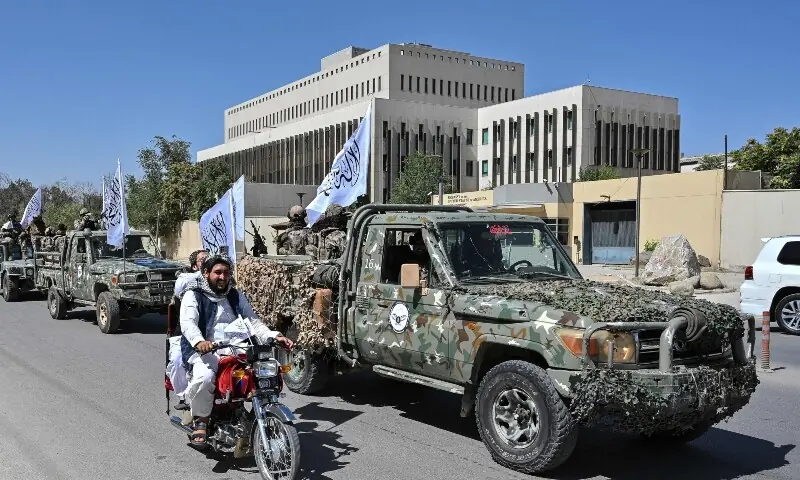
Kabul (TDI): The Taliban marked five years in power in Afghanistan on Saturday, portraying their rule as a period of stability and independence, while aid agencies and rights groups warned of worsening humanitarian and social crises.
A military parade was held outside the former US embassy in Kabul, with Taliban vehicles, flags and banners displayed during celebrations the government described as “victory day” over Western domination.
Taliban Interior Minister Sirajuddin Haqqani said the return to power was achieved through “morale, courage” and “divine assistance”, while acknowledging that some problems still remained, Reuters reported.
The Taliban returned to power in August 2021 following the withdrawal of US and allied forces. They had initially promised a more moderate form of governance, but rights groups say those assurances were quickly undermined by sweeping restrictions on women and girls.
According to UNESCO, around 2.5 million Afghan girls and women have been barred from secondary schools and universities. UN Women has also reported that half of Afghan women now leave their homes only once or twice a month. The Taliban maintain that they respect women’s rights in accordance with their interpretation of Islamic law.
Read More: Beyond Border Strikes: Why Militancy Continues to Thrive in Afghanistan
Five years after their return, the Taliban government remains largely isolated internationally. Russia is currently the only country to have formally recognised the Taliban government, although several countries have expanded diplomatic engagement with Kabul.
The Taliban have also sought to strengthen ties with neighbouring and regional countries, while pursuing economic agreements based on Afghanistan’s strategic location linking South and Central Asia with the Middle East.
At the same time, Afghanistan continues to face severe humanitarian challenges. The International Rescue Committee has warned that humanitarian needs have reached record levels amid drought, earthquakes and the return of large numbers of Afghans from neighbouring countries.
The organization said the number of Afghans requiring humanitarian assistance has increased by 3.5 million since 2021, even as international aid budgets have declined.
The Taliban have also faced security challenges, including recent attacks targeting officials in the northeastern province of Badakhshan, with Islamic State claiming responsibility for one of the attacks.
Read More: Taliban Support Contributing to Deadlier TTP Attacks in Pakistan: UN
UN officials have warned that lasting peace in Afghanistan requires more than an end to armed conflict, stressing the need for development and the protection of the rights and potential of all Afghans.
As the Taliban enter their sixth year in power, Afghanistan continues to face the challenge of balancing the government’s push for international engagement and economic development with concerns over human rights, humanitarian needs and political isolation.