United Nations (TDI): Pakistan has urged the United Nations Security Council to avoid any hasty move to re-impose sanctions on Iran through the Joint Comprehensive Plan of Action (JCPOA) snapback mechanism, warning that coercive measures would deepen mistrust and disproportionately harm ordinary people.
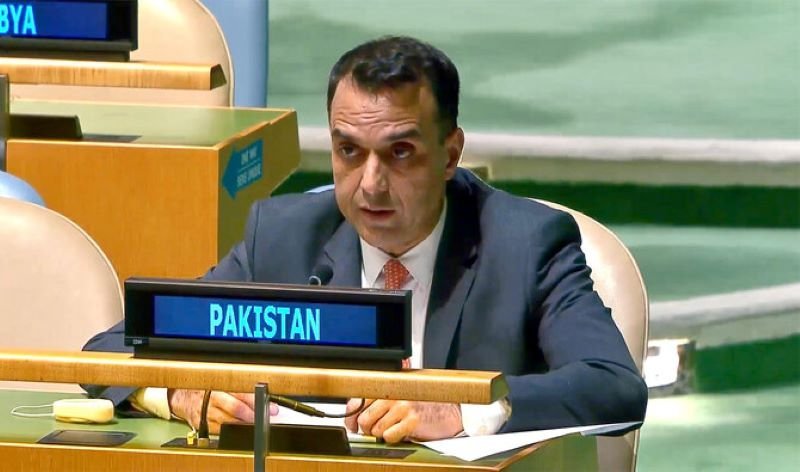
Addressing a Security Council briefing on Iran’s nuclear program on Tuesday, Pakistan’s Acting Permanent Representative to the UN, Ambassador Usman Jadoon, reiterated Islamabad’s firm support for resolving the issue through diplomacy and dialogue. He thanked UN Under-Secretary-General Rosemary DiCarlo for her briefing and stressed that more time should be given for diplomatic efforts to succeed.
Ambassador Jadoon said Pakistan believes all issues related to Iran’s nuclear program must be addressed through engagement rather than confrontation, while preserving the JCPOA framework until a mutually acceptable successor arrangement is reached. He recalled that the Council last discussed the matter in September amid renewed debate over the snapback mechanism.
Expressing concern over growing divisions within the Security Council and beyond, the Pakistani envoy described the situation as “deeply regrettable,” noting that recent developments had pushed the international community further away from a solution. He said the issue had been further complicated by unilateral actions, the use of force, violations of the UN Charter, and differing interpretations regarding the invocation of the snapback mechanism.
Read More: Pakistan, Iran Pledge Closer Cooperation to Promote Regional Peace
Reaffirming Pakistan’s consistent position, Ambassador Jadoon said diplomacy and dialogue must remain the guiding principles in resolving outstanding issues in line with the rights and obligations of all parties. He cautioned that sanctions would not bridge differences but instead widen the trust deficit, negatively affecting trade, economic development, and prospects for regional connectivity, while placing the greatest burden on civilians.
While acknowledging that the JCPOA was not implemented as originally envisaged, he said the agreement still provided a vital framework grounded in international law, mutual respect, and acceptance. He added that its core principles could still be useful if there is genuine willingness among all parties to move forward through compromise and accommodation.
The envoy called for reviving the spirit of the JCPOA and said existing divisions could be overcome by bringing all stakeholders together in a conciliatory, solution-oriented manner. He stressed that trust and confidence in diplomatic engagement, damaged in recent months, must be carefully restored.
Read More: Pakistan, Iran Explore Stronger Economic and Strategic Links
Ambassador Jadoon also underscored the importance of the International Atomic Energy Agency (IAEA) in verifying compliance with nuclear safeguards, urging the agency to carry out its mandate in an objective, credible, and impartial manner consistent with its technical role.
Concluding his remarks, he said constructive efforts, including through the Security Council, should continue to facilitate a compromise acceptable to all sides, adding that there is no alternative to sustained diplomacy and dialogue for the peaceful resolution of disputes.