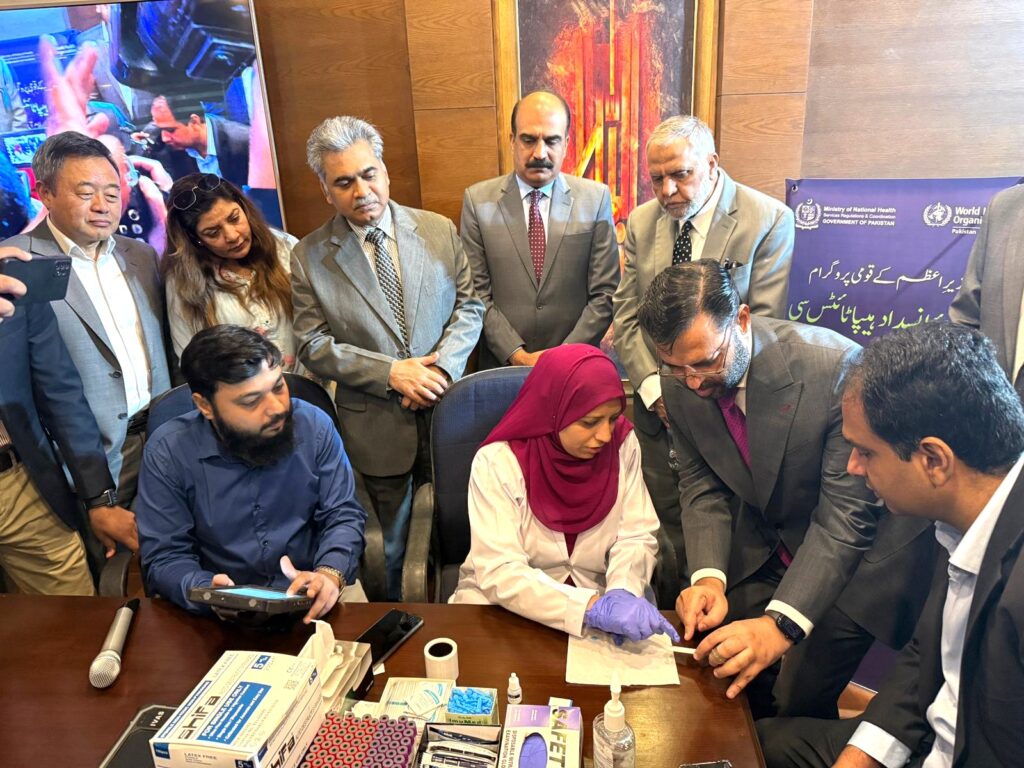
Islamabad (TDI): In collaboration with the World Health Organization (WHO), Pakistan officially launched the Prime Minister’s Hepatitis C Elimination Program, on Wednesday.
The initiative began with an initial phase in the Islamabad Capital Territory, aiming to reach and screen 1.6 million people over the next six months.
This strategic rollout aligns with the World Health Assembly global mandate to eliminate hepatitis C as a public health threat by the year 2030.
The official records from the Ministry of National Health Services, Regulations & Coordination (NHSR&C) emphasize that the program will eventually expand nationwide to screen over 160 million citizens.
Pakistan & @WHO launched Prime Minister’s Hepatitis C Programme to reach 1.6 M people in Islamabad Capital Territory. The initiative will be introduced in phases nationwide to advance the World Health Assembly goal to eliminate hepatitis C as a public health threat by 2030. pic.twitter.com/kCwILW9LDv
— WHO Pakistan (@WHOPakistan) May 14, 2026
The Federal Health Minister Syed Mustafa Kamal reported that the government has integrated the initiative with the National Database and Registration Authority (NADRA) to ensure transparency and effective tracking.
The program further offers free screening and full treatment courses using Direct-Acting Antivirals (DAAs), services that would otherwise cost citizens thousands of rupees.
This public health intervention focuses on Pakistan’s status as a high-burden country, with an estimated 8 to 10 million cases.
It is estimated that roughly 80% of those infected remain undiagnosed, often due to a lack of accessible screening. This situation is further involved by transmission risks associated with unsafe injections and blood transfusions.
By shifting the focus from “sick-care” to proactive healthcare, the initiative could prevent over 210,000 new infections and save approximately 150,000 lives by the 2030 deadline.
Read More: WHO Says Low Risk After Suspected Hantavirus Outbreak on Cruise Ship
The WHO is providing extensive technical support to ensure the program meets international best practices. The WHO Representative in Pakistan, Dr. Luo Dapeng affirmed that the organization aims to lead efforts in safe injection practices and mother-to-child transmission prevention alongside the testing surge.
The Pakistani government remains committed to funding this multi-billion rupee project through federal and provincial contributions and focuses on public awareness to ensure eligible populations participate in the free screening.
This historic launch marks a major point in Pakistan’s healthcare trajectory and its commitment to global health standards.
The Health Minister Kamal has emphasized that the establishment of specialized screening counters in federal hospitals is just the first step toward a hepatitis-free nation.
Further, the success of this program is expected to significantly reduce cases of liver cirrhosis and cancer providing significant long-term economic savings for the state.

Muhammad Usman Hashmi is a researcher in International Relations, focusing on climate diplomacy, global governance, and political economy in the Global South. He has contributed to policy dialogues with the Foreign Policy Community of Indonesia and serves as a Senior Research Fellow at the International Council on Human Rights, Peace and Politics. He is also associated with Rethinking Economics Islamabad, contributing to research on development and sustainability.