New York (TDI): At a high-level gathering hosted by Pakistan’s Mission to the United Nations on Friday, speakers cautioned that India’s unilateral decision to suspend the Indus Waters Treaty (IWT) poses severe humanitarian and legal consequences, threatening regional peace and food security.
India announced earlier this year that it would hold the treaty in abeyance following an April 22 attack in Pahalgam, IIOJK, which left 26 people dead. New Delhi blamed Islamabad, though it has provided no concrete evidence. Pakistan has rejected the suspension outright, calling any attempt to cut its water share an “act of war.”
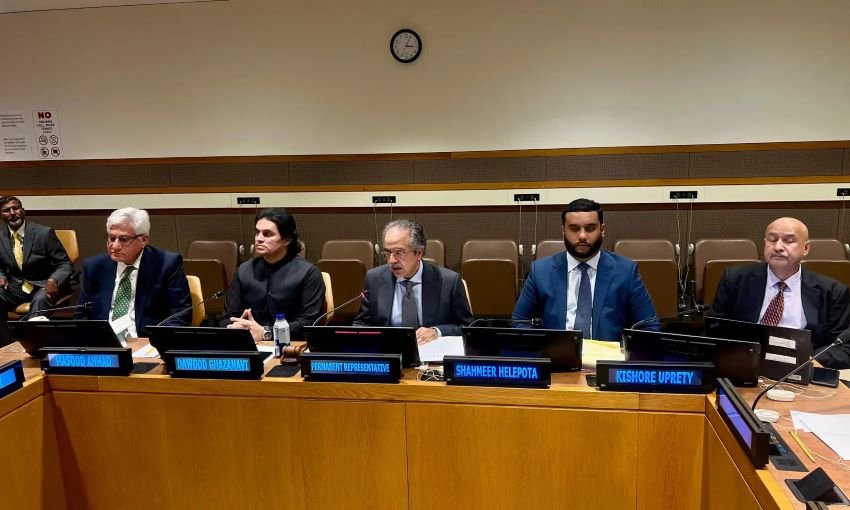
The UN event, organized jointly with the Muslim-American Leadership Alliance (MALA), focused on “Indus Waters Treaty and Pakistan’s Water Crisis: Challenges and the Way Forward.” Participants included diplomats, academics, water experts, lawyers, students, and civil society representatives.
Pakistan’s Permanent Representative to the UN, Ambassador Asim Iftikhar Ahmad, delivered the keynote address. He stressed that attempts to “weaponize water” would have devastating implications for regional stability, and reminded participants that recent rulings of the Permanent Court of Arbitration (PCA) reaffirm Pakistan’s rights to the western rivers.
“These rulings leave no ambiguity,” Ambassador Ahmad said. “No state can unilaterally suspend this agreement. The IWT is alive, binding, and remains the backbone of water cooperation between our two countries.”
Read More: Pakistan Warns of Water War Risk, Urges UN Action Over IWT Suspension
Ambassador Usman Jadoon, Pakistan’s Deputy Permanent Representative, closed the event by warning that India’s actions could trigger “grave humanitarian crises” in Pakistan. “Denial of critical data and river flows translates directly into food insecurity, forced migration, and heightened risks for vulnerable groups, especially women and children,” he said.
Other speakers echoed these concerns. Dawood Ghazanavi, a Supreme Court lawyer, linked India’s refusal to share hydrological data with the scale of devastation during recent floods in Punjab. He argued that nearly half of Pakistan’s population relies on the Indus for survival, warning that water insecurity threatens both livelihoods and political stability.
MALA chairperson Maha Khan highlighted the humanitarian dimensions of water security. “This is not a distant concern but an immediate challenge,” she said. “Protecting water rights is essential to peace, stability, and dignity in Pakistan.”
Read More: Pakistan Urges India to Reinstate IWT After Hague Court’s Ruling
Technical perspectives were provided by Dr. Masood Ahmad, a former World Bank water expert, who emphasized the treaty’s role in enabling large-scale infrastructure development. He urged Pakistan to modernize irrigation systems and build resilience against future shocks rather than relying solely on legal arguments.
Legal experts including Kishor Uprety and Shahmeer Halepota also weighed in. Uprety described the IWT as a “remarkable cooperative framework” but warned that its credibility is under pressure due to India’s unilateral steps. He underlined that terrorism allegations cannot be treated as a legal basis to suspend the treaty, which has no exit clause. Halepota praised the IWT as South Asia’s most enduring multilateral agreement but criticized delays and inconsistencies in dispute resolution, citing the World Bank’s muted recent role.
The discussions underscored a consensus: undermining the IWT risks not only humanitarian suffering in Pakistan but also regional security. As Ambassador Ahmad concluded, “Water in our region is a shared heritage. To weaponize it is to deny humanity itself.”