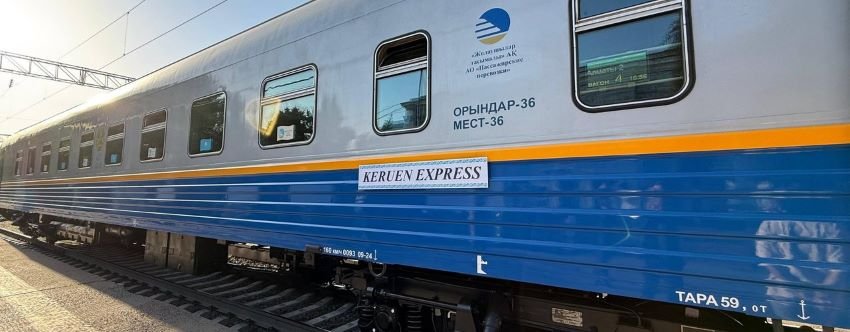
Astana (TDI): Kazakhstan’s national railway company, Kazakhstan Temir Zholy (KTZ), together with Uzbekistan Railways, organized the second Keruen Express tourist train of the year, running from May 1 to May 6.
The journey carried over 130 passengers along a cultural route connecting Almaty, Turkestan, Samarkand, Tashkent, and back to Almaty.
During the five-day tour, travelers explored several key historical and architectural landmarks in both countries. These included the Khoja Ahmed Yasawi Mausoleum in Turkestan, the Registan Square and Gur-e-Amir Mausoleum in Samarkand, and the Hazrati Imam Complex in Tashkent.
The Keruen Express initiative is designed to promote rail-based tourism while highlighting the rich cultural heritage of Kazakhstan and Uzbekistan, and strengthening ties between the two countries.
Rail tourism is becoming increasingly popular across Central Asia. In earlier reports, KTZ also expanded its “Jibek Joly” (Silk Road) tourist train route to Tajikistan, now extending services to Dushanbe and broadening regional connectivity.
Read More: Kazakhstan, Uzbekistan to Build Joint Petrochemical Complex
These tourism projects are part of wider efforts to position Central Asia as a unified travel destination. Regional leaders have also suggested introducing a visa-free travel system similar to the Schengen model to make cross-border tourism easier and attract more international visitors.
At the 59th Annual Meeting of the Asian Development Bank’s Board of Governors in Samarkand on May 4, Uzbekistan’s President Shavkat Mirziyoyev proposed the creation of a “Central Asia Tourism Ring.” This initiative aims to link regional countries into a single tourism zone supported by joint development projects and international funding.
Read More: Azerbaijan, Kazakhstan, Uzbekistan Unite for Caspian Green Energy Corridor
He also emphasized the region’s strong tourism potential, noting that in a time of global uncertainty, Central Asia can attract travelers interested in pilgrimage, culture, food, ethnography, adventure, and medical tourism.