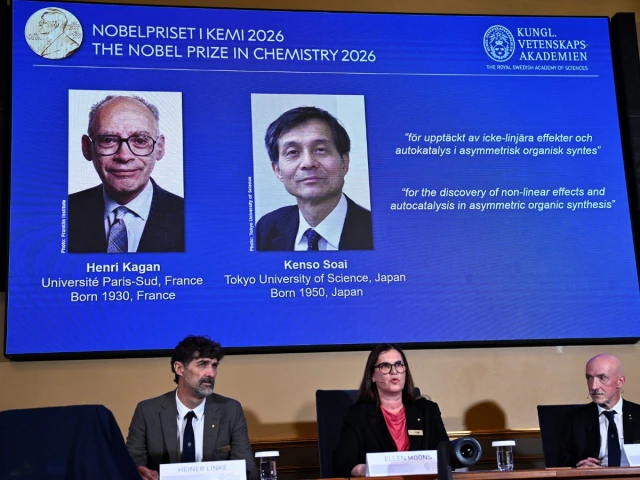
Stockholm (TDI): Scientists Henri Kagan and Kenso Soai have won the 2026 Nobel Prize in Chemistry for discoveries that helped explain how chemical reactions can be directed to produce a single version of a molecule’s mirror image, advancing research with important applications in pharmaceutical manufacturing.
The Royal Swedish Academy of Sciences announced the award on Wednesday, recognizing work addressing a long-standing question in chemistry: why many molecules exist in two mirror-image forms, while biological systems frequently rely on only one of them.
“This is the most exciting day in my life; I am very glad to share this prize with Professor Henri Kagan,” Soai said by telephone during the Nobel announcement, adding that he had been shopping when he received the news.
Heiner Linke, chair of the Nobel Committee for Chemistry, described the award as recognition of foundational chemistry that has helped researchers understand and control the formation of molecular mirror images.
The phenomenon is known as homochirality. The term relates to the concept of handedness: just as a person’s left and right hands are mirror images that cannot be perfectly superimposed, certain molecules also exist in two distinct mirror-image forms.
Read More: Belgian-Born Physicist Francis Halzen Wins 2026 Nobel Prize in Physics
Although these forms may appear nearly identical, their interactions with living organisms can differ significantly. This distinction is particularly important in medicine, where the two versions of a drug molecule can produce different biological effects.
According to the Nobel Foundation, one molecular form may provide the intended therapeutic effect, while its mirror image may be less effective or cause unwanted, potentially harmful side effects.
The discoveries recognized by this year’s prize have helped chemists develop methods for favouring the production of one molecular form over the other. Such control is important when designing chemical reactions for medicines and other compounds used in biological applications.
Producing a desired molecular form more selectively can help improve the efficiency of chemical synthesis and reduce the need for processes that separate unwanted molecular variants after a reaction.
Read More: Trio Wins Nobel Prize in Medicine for Controlling Brain with Light
The award highlights the importance of fundamental chemical research in addressing practical challenges across drug development and industrial chemistry. Understanding how molecular handedness emerges and how it can be controlled remains relevant to the design of more selective chemical processes.
The Nobel Prize in Chemistry is the third scientific award announced during Nobel week, following the prizes in medicine and physics. The awards were established through the will of Swedish inventor and industrialist Alfred Nobel and have been presented, with some interruptions, since 1901.
Nobel, a chemist and engineer, accumulated substantial wealth through his inventions, including dynamite. The economics prize was established separately in 1968 by Sweden’s central bank in memory of Alfred Nobel.
Last year’s Chemistry Nobel was awarded to Susumu Kitagawa, Richard Robson and Omar Yaghi for the development of metal-organic frameworks. These porous molecular structures have potential applications in areas including gas storage, carbon capture and water harvesting.
The 2026 laureates will receive their medals from Sweden’s King Carl XVI Gustaf at the Nobel Prize ceremony in Stockholm on December 10, the anniversary of Alfred Nobel’s death.
Kagan and Soai will share the prize money of 11 million Swedish kronor, approximately $1.2 million, alongside the recognition associated with one of the world’s most prominent scientific honours.