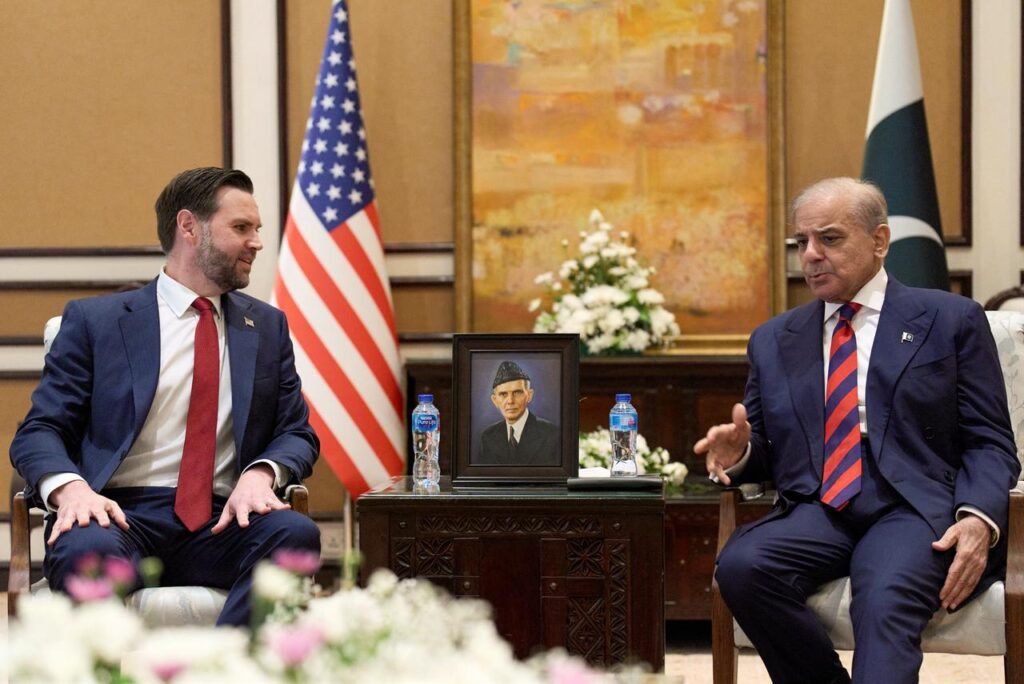
Islamabad emerged as the unlikely yet pivotal stage for one of the most consequential diplomatic engagements of the 21st century the direct peace talks between the United States and Iran. Hosted and mediated by Pakistan, these negotiations marked the first high-level, face-to-face dialogue between the two adversaries since the 1979 Islamic Revolution, ending over four decades of estrangement and hostility.
While the talks concluded without a formal agreement, their importance transcends the immediate outcome. They represent a symbolic thaw in one of the most entrenched rivalries in international politics and signal the opening of a new diplomatic chapter one in which dialogue, however difficult, has replaced total disengagement.
The Islamabad Talks, held on April 11–12, 2026, were not merely another round of negotiations; they were historic by their very nature. For 47 years, the United States and Iran had avoided direct, high-level engagement, relying instead on intermediaries, backchannel diplomacy, or confrontation.
This meeting, therefore, symbolized a profound shift. It demonstrated a mutual recognition however reluctant that sustainable peace in the Middle East cannot be achieved without direct dialogue between the principal actors involved. The talks were convened against the backdrop of the 2026 Iran war, a conflict that had already destabilized the region, disrupted global energy markets, and heightened fears of a broader international escalation.
The urgency of the situation forced both Washington and Tehran to step beyond decades of mistrust. Islamabad became the neutral ground where adversaries, long defined by hostility, chose conversation over confrontation.
Pakistan’s Diplomatic Moment
Pakistan’s role in hosting and facilitating these talks cannot be overstated. Positioned at the crossroads of South Asia, the Middle East, and Central Asia, Pakistan leveraged its strategic relationships with both Iran and the United States to act as a credible mediator.
In the weeks leading up to the talks, Islamabad had already played a critical role in brokering a fragile two-week ceasefire between the two sides, creating the necessary diplomatic space for negotiations.
This mediation effort reflects Pakistan’s long-standing foreign policy objective: to position itself as a bridge between competing powers. Despite maintaining official neutrality during the conflict, Pakistan engaged in active shuttle diplomacy, balancing its ties with Tehran, Washington, and regional stakeholders.
The Islamabad Talks thus represent more than a diplomatic event they mark Pakistan’s re-emergence as a significant player in global conflict resolution. By hosting these negotiations, Pakistan not only enhanced its international standing but also demonstrated its capacity to influence outcomes in one of the world’s most volatile regions.
Read More: PM Shehbaz Meets Iranian Delegation in Islamabad Peace Talks
Despite the historic nature of the talks, the negotiations were fraught with deep-seated disagreements. Over 21 hours of intense discussions, both sides struggled to reconcile fundamentally opposing positions.
The United States prioritized curbing Iran’s nuclear ambitions and ensuring freedom of navigation in the Strait of Hormuz, a vital artery for global energy supplies. Iran, on the other hand, demanded sanctions relief, access to frozen assets, war reparations, and broader regional ceasefire commitments, particularly in Lebanon.
These differences were not merely technical they reflected decades of strategic mistrust and conflicting geopolitical objectives. The U.S. approach emphasized security guarantees and non-proliferation, while Iran framed its demands in terms of sovereignty, economic justice, and regional influence.
Moreover, ongoing tensions in the Middle East, including Israeli military actions and instability in Lebanon, further complicated the negotiations, limiting the scope for immediate compromise.
The Symbolism of Dialogue
Even in the absence of a concrete agreement, the Islamabad Talks carry immense symbolic weight. For decades, U.S.-Iran relations have been defined by hostility, sanctions, proxy conflicts, and rhetorical escalation. The mere act of sitting across the table represents a departure from this pattern.
Diplomacy, particularly in deeply polarized conflicts, is rarely linear. The Islamabad Talks should therefore be viewed as the first step in a longer process rather than a final destination. As Iranian officials themselves acknowledged, expecting a comprehensive agreement in a single session would have been unrealistic.
Instead, the talks served as a confidence-building measure an opportunity to test intentions, establish communication channels, and identify areas of potential convergence. In conflict resolution theory, such initial engagements are critical for reducing misperceptions and creating the groundwork for future negotiations.
Read More: Live: All Eyes on Islamabad as Tricky US, Iran Talks Get Underway
The implications of the Islamabad Talks extend far beyond U.S.-Iran relations. The Middle East remains a center of global geopolitics, with conflicts in the region influencing energy markets, security dynamics, and international alliances.
A sustained dialogue between Washington and Tehran has the potential to stabilize not only bilateral relations but also broader regional conflicts. Issues such as the Strait of Hormuz, proxy engagements, and nuclear proliferation are deeply interconnected with global economic and security concerns.
Furthermore, the talks signal a shift in the international system toward renewed emphasis on diplomacy. In an era marked by great power competition and regional conflicts, the willingness of adversaries to engage directly offers a rare moment of cautious optimism.
Pakistan’s role also highlights the growing importance of middle powers in global diplomacy. As traditional power structures evolve, countries like Pakistan are increasingly stepping in to facilitate dialogue and manage conflicts.
A Door Opened, Not Closed
Despite the positive symbolism, significant challenges remain. The structural issues underlying U.S.-Iran tensions nuclear policy, regional influence, sanctions, and ideological differences are deeply entrenched.
The failure to reach an agreement in Islamabad underscores the complexity of these issues. It also reflects the limitations of short-term negotiations in addressing long-standing conflicts.
Trust, or the lack thereof, remains the biggest obstacle. Decades of confrontation have created a deep reservoir of suspicion that cannot be easily overcome. Any future progress will require sustained engagement, incremental compromises, and strong political will on both sides.
The Islamabad Peace Talks may not have produced a formal agreement, but to measure their success solely by that metric would be to overlook their broader significance.
For the first time in 47 years, the United States and Iran engaged in direct, high-level dialogue on neutral ground. This alone marks a turning point a shift from absolute disengagement to cautious interaction.
Pakistan’s role as a mediator has not only elevated its diplomatic stature but also demonstrated the potential of regional actors in facilitating global peace. By providing a platform for dialogue, Islamabad has contributed to breaking a decades-long deadlock.
While the talks ended without a definitive conclusion, they have opened a crucial pathway for future negotiations. The willingness of both sides to come to the table suggests that diplomacy, however fragile, remains possible.
In the complex landscape of international relations, breakthroughs are rarely immediate. They are built through incremental steps, difficult conversations, and persistent engagement. The Islamabad Talks represent one such step a beginning rather than an end.
If sustained, this fragile momentum could evolve into a broader process of reconciliation, offering hope not only for U.S.-Iran relations but for peace and stability across the Middle East.
*The views presented in this article are the author’s own and do not necessarily reflect the views of The Diplomatic Insight.

Filza Younus
Filza Younus is a student of International Relations and takes interest in strategy, peace studies, and conflict resolution.