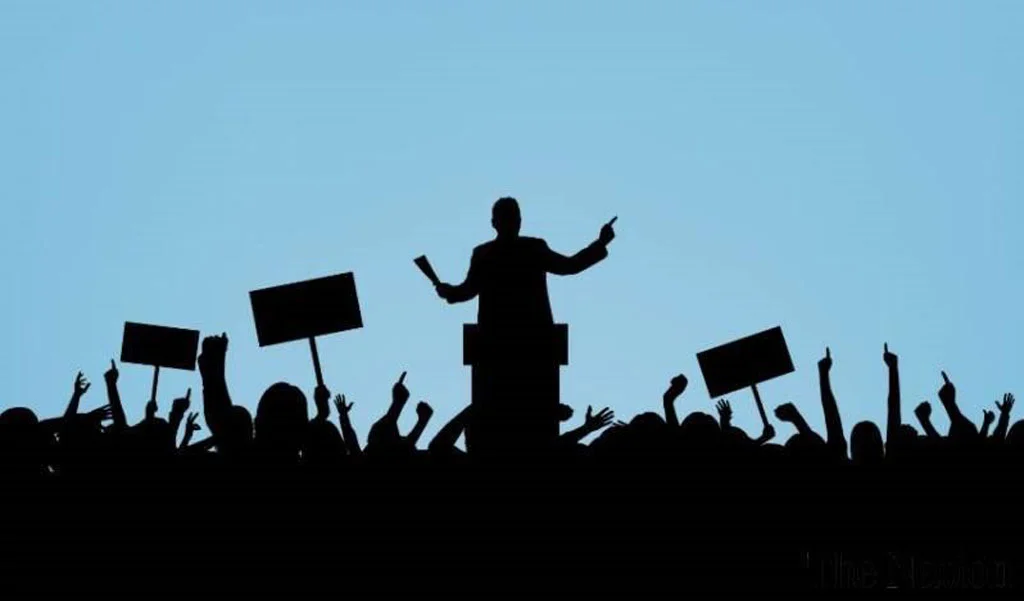
It never usually starts with tanks in the streets. More often, though, it starts with a promise which sounds almost democratic: to rescue ‘the people’ from corrupt elites, to break the deadlock, to punish the untouchables, to make politics finally listen. Populism can come via the ballot box and still end up altering what elections, what rights and accountability actually mean.
In many countries nowadays, the key struggle is not just who gets power; it is often whether the institutions that curb power can even survive leaders who insist that any limit on them is an insult to the popular will.
To see why populism has become such a disruptive force for democratic institutions, it is useful to be precise about what populism is and what it’s not. In much of the scholarship, populism is treated as a “thin-centered” ideology: it separates society into two moral camps, “the pure people” vs. “the corrupt elite,” and insists that politics should express the general will of the people.
Because it is thin, populism can attach itself to different “host” ideologies, appearing in right wing nationalist forms, in left wing redistributive forms, or in hybrids of the form of religion, anti colonial memory, or securitization. This flexibility is part of its international range. The major narrative of multiculturalism, which can speak the language of economic justice in one context, isolation or cultural protection in another, and yet hold on to the underlying same moral story, is that the one who they were represents instead the true side of the nation.
Populism is also not automatically synonymous with authoritarianism. There are movements and leaders operating with populist rhetoric who nevertheless embrace pluralism, tolerate opposition and abide by constitutional limits. Yet the evidence from comparative study suggests more and more that where populists have been able to gain sustained executive power, the risk of democratic erosion has increased, at least in such liberal democratic elements as constraints on government, judicial independence, and media freedom.
Read More: From Populism to Persona: Rise of Celebrity Politicians
The best-known democracy-monitoring projects converge on a worrying picture of long-running decline. V Dem’s Democracy Report 2025 describes a world in which autocratization has been on the upswing for years and has expanded in regions. Freedom House’s Freedom in the World 2025 also warns of democratically elected leaders overriding institutional checks to achieve their goals. International IDEA’s Global State of Democracy 2024 finds that downgrades in the quality of democracy continue to outweigh improvements, including any related to representation and rights.
The important thing to note is that far too many of today’s democratic reversals are not classic coups. They often are incremental, legalistic and justified as reforms. Populist leaders, particularly those with powerful electoral mandates, may view institutions as barriers set up by self serving elites: courts become “political,” oversight organizations become “deep state,” independent media “enemy propaganda,” universities “indoctrination centers,” and civil society “foreign agents.”
This framing can be politically powerful because it uses real public frustrations. In many societies, citizens are under inequality, suffer from corruption, slow service delivery and cultural alienation. When mainstream parties seem indifferent or bought by the opposition, the populist narrative is more compelling to provide clarity and to let people feel better: that you’ve been burned, that you’re not helpless, that you’ve been betrayed by the world, and now there I am with a strong representative who will take back the world.
That is why populism is often the result of real democratic deficits. It takes advantage of the gap between the formal democratic procedures and the lived democratic outcomes. In countries where the electorate feels that elections have introduced the change of faces, but have certainly not changed their economic insecurity or dignity, populist appeals can become a shortcut to political meaning.
Research on “cultural backlash”, for example, examined how value polarization and identity-based anxieties can contribute to the support of authoritarian populist leaders and parties, particularly when social change is felt to occur rapidly, and status hierarchies are perceived to be under threat. At the same time, economic shocks, uneven globalization and perceptions of unfairness can amplify anti elite sentiments, so the “people vs elite” story can be plausible across the classes.
Once in power, though, the institutional effects of populism tend to follow recognizable paths. The first is pressure on the judiciary and the process of constitutional review. Courts are one of the few institutions that can void the actions of the executive, safeguard the rights of minorities, and retard majoritarian tendencies. That makes them bullseye damn targets.
Populist governments may increase the number of courts, change the rules for judicial appointment, discipline judges, change the structure of judicial councils, or delegitimize judicial rulings as sabotage. European Union rule of law monitoring, for instance, repeatedly puts the spotlight on judicial independence and checks and balances as areas of concern in other member states under democratic stress.
The larger pattern, however, is not only the pattern of legal change but a pattern of narrative change insofar as citizens are led to believe that courts are partisan. Resistance in the courts becomes more readily dismissed.
The judicial story is also complicated. In some cases, it is the courts, unintentionally, that open up opportunities for backsliding when they intrude into overtly political positions or try to substitute representative institutions, opening a window for populists to argue that unelected judges have stolen democracy.
A 2025 work on courts and democratic backsliding states that when judges attempt to serve as primary representative institutions of opposition to “corruption,” the rhetoric may become ammunition for populist authoritarians seeking power. This calls attention to a very uncomfortable truth: the resilience of democracy needs not only strong courts but courts which are trusted, consistent and institutionally modest enough that they do not create convenient villains.

A second route is the erosion of the landscape of media freedom and pluralism. Populist leaders often require a direct channel to the public that bypasses intermediaries. They can use state advertising, regulatory agencies, licensing, defamation law and public broadcasters to punish opponents and reward loyalists. In the EU context, debates about media pluralism and political influence have increased at the center of concerns on the rule of law and new regulatory initiatives such as the European Media Freedom Act.
Even outside Europe, the pattern is the same: unmask independent journalism as elitist hostility; then limit its ability to operate through legal threats and financial constraints. The result is not necessarily total censorship. More commonly, however, it is a slow warping of the information world, in which the citizenry is not entirely without choices, but where the noise, the intimidation, and the strategic disinformation are growing.
Digital media accelerates these dynamics. Populists are capable of mobilizing their supporters quickly, making their opponents seem like mortal enemies, and living in a permanent campaign. But the same environment can undermine democratic deliberation by rewarding outrage as an enticement and by reducing complex policy trade-offs to moral battles.
Freedom House’s Freedom on the Net 2025 finds that internet freedom has deteriorated for many consecutive years worldwide and outlines the expansion of manipulation and control over internet space. When disinformation and harassment become routine, political competition becomes less about winning people’s minds and more about domination, which is very fertile for the erosion of institutions.
A third pathway is the politicization of the bureaucracy and oversight institutions. Populist governance often prioritizes speed and loyalty. Independent agencies, auditors, anticorruption agencies, civil service provisions and procurement regulations can be presented as a bureaucratic form of sabotage. Taking back the reins of experienced officials in favor of loyal appointees may feel like “taking back control”, but it may result in degrading state capacity and in turning state institutions into axes of partisan survival.
Over time this can change the shape of the state into a patronage machine, which is difficult to dislodge democratically as it controls resources, enforcement and outcomes of administration.
Fourth is the manipulation and normalization of electoral rules and the normalization of distrust in the election. The relationship between populism and elections is paradoxical. Populists rely on elections for legitimacy, but some destroy the conditions for elections to be meaningful: fair access to the media, neutral administration of elections, and acceptance of results.
Observer missions by international organizations are often quick to point to structural risks such as polarization, disinformation, and attacks on trust. For example, the resiliency of the administration of the 2024 United States general elections in the United States was mentioned favorably in the consortium of international governmental and nongovernmental organizations called the Organization for Security and Cooperation in Europe (OSCE) disparity group (ODIHR) final assessment on the elections, but the unfounded nature of consistent fraud assertions damaged people hazard and the environment was very polarized and subject to disinformation and violence.
When a substantial percentage of citizens come to believe that elections are rigged when their side loses, peaceful alternation becomes shaky, and institutional guardrails are easier to override “in defense of democracy.”
This leads us to a very important distinction in the analysis of comparative populism: populism as opposition versus populism as government. In opposition, populists can perform a corrective role by focusing attention on neglected grievances. In the case of government, the temptation of fusing the leader, party, and state is greater, especially if the leader claims to be the sole representative of morality.
What follows is often not a single dramatic rupture, but rather a fantasy of smaller moves: pressure on courts, media, universities, NGOs, regulators, justified by the rhetoric of cleaning up the system. V Dem’s latest reports emphasize that most democratic retreats now occur through elections and institutional shifts thereafter, rather than through open coups.
Comparative case reveals variation in speed, intensity and outcomes. Across parts of Central and Eastern Europe, issues have focused around judicial reforms, media capture and sought to restrict civil society’s ability to act, with a series of documentation and statements from EU institutions concerning disagreements relating to the rule of law. In the Americas, the narrative is frequently about the personalization of power, including security narratives and battles with independent media.

Reporting on El Salvador, for example, has mentioned both high levels of popular support for tough security measures and increasing pressures against journalists and democratic checks. In South and Southeast Asia, the stress of the democratic situation often intersects with majoritarian identity politics, security forces, and extreme online polarization, generating institutional pressures with a different appearance but the same rhyme as those in Europe.
The United States is of particular importance in comparative discussions around the world precisely because of its long history as a standard against which democratic norms have been judged. That is why recent warnings by democracy and civic freedom monitors have international significance. A Reuters report on an International IDEA assessment claimed that perceived US backsliding and executive overreach in early 2025 would give strongman leaders in other parts of the world encouragement by undermining the symbolic power of the US democratic example.
Separately, Time reported on a CIVICUS downgrade of US civic space, often cited, as well as concerns about restrictions on protest, pressure on the media, and wider civic freedoms. You do not have to accept all of the framing in these reports to see that, rather, the comparative logic is that, where the leading democracies appear internally brittle, it is easier for populists in other countries to say that liberal constraints are optional.
A popular misconception is that populism undermines democracy by rejecting elections. More usually, it alters democracy through redefining it. In populist discourse, democracy is synonymous with majority rule and leader authenticity, while liberal democratic institutions are defined as anti-democratic barriers.
This is where the most serious institutional damage takes place: where the principles of pluralism, minority rights, independent adjudication, and factual accountability are recast and captured into the language of elite tricks. Once that reframing becomes established, citizens are likely to support actions that undermine democracy because they are told that these actions restore democracy.
Still, a careful review has to admit that institutional dysfunction and elite irresponsibility often lead to populist breakthroughs. In some countries, courts were politicized long before populists attacked them. In others, media oligopolies, corruption and policy stagnation eroded trust.
Populism flourishes on that reality. Less a meteor, it hits an otherwise healthy system, and more so, it exploits cracks that were already there. That is also why some anti populist responses are unsuccessful. If the mainstream parties reply only with moral condemnation, without taking any action to address inequality, corruption, or governance performance, then the populists can claim vindication: “they still do not listen.”
So what distinguishes populism as a democratic correction from populism as a democratic threat? Comparative evidence suggests several factors. One is the strength and independence of institutions before populists come to power. Strong constitutional courts, professional civil services, independent electoral commissions and plural media ecosystems can slow down capture.
Another is the party system structure. When the parties are personal vehicles rather than durable organizations, populist personalization is easier. A third is the international environment. Regional organizations, trade agreements, and democratic conditionality can have their costs; however, they can also be politicized and resented as foreign interference. The EU’s rule of law mechanisms is one example of outside leverage, although enforcement is up for debate.
Another determinant is civil society and civic culture. Institutions fail to defend themselves. Courts depend on public cooperation, journalists depend on legislative protection and the support of their audience, and legislatures depend on the restraint of norms.
When polarization reaches a high level, institutional defense can be easily cast in partisan terms. That is why debates on election integrity are so important. When large groups come to believe that opponents are illegitimate enemies, institutional compromise seems like betrayal and hardball tactics become the norm.
In that sense, the democratic challenge may be not just the populist but indeed the broader set of conditions that make populism institutionally corrosive: Conditions of high distrust, economic anxiety, conflict of identities, missing media integration and weak accountability.
Democracy assessment and related analyses of International IDEA underscore over and over that democratic quality is not simply a matter of whether or not elections are present, but also that it requires representation, rights, and checks and balances. When representation seems hollow, populists can claim a monopoly on the popular will. When rights protections are perceived as selective, populists have justification for selective repression. When checks and balances seem to be taken, populists can point to that capture as being “rebalancing.”
So what would be a realistic democratic response if we take the evidence seriously? It would steer clear of the two extremes of romanticizing institutions as somehow virtuous and dismissing institutions as an impediment to popular sovereignty. Instead, it would attempt to make institutions visible, once again, as serving citizens. That includes anticorruption enforcement that is impartial and not partisan. It includes public services that limit the day-to-day humiliations that fuel the anger of the anti elite.
It includes electoral systems that are safe and trusted, have clear processes and credible systems for resolving disputes. It involves media ecosystems shielded from being bought and bullied, as well as enhancing standards and accountability so that journalism can replenish trust.
It also requires political leadership that will compete without burning the house down. The most precarious democracies, where political actors use every election as a last battle and every institution as a weapon. Populism increases this tendency, but neither creates it out of nothing.
Democratic resiliency, then, is to some extent a matter of returning to the notion that the loss of power is not the end of the world and that at least some form of opposition is legitimate. That’s easier said than done, however, in societies haunted by profound inequality, security concerns and identity conflict. Yet it is nevertheless the fundamental democratic norm which populism most frequently puts under attack: the acceptance that “the people” are plural.
Read More: Populism Vs Democracy
If there is one lesson to be drawn from reports, peer-reviewed research, and real-time observation, it is that democratic erosion is usually cumulative. Each attack on an oversight body can be justified as a discrete reform. Each of these restrictions on NGOs can be justified on national security grounds. Each pressure campaign against judges can be couched in accountability.
Each smear of journalists can be sold as a way to fight misinformation. Over time, the height of the cumulative effect of this is a democracy which still has elections, but with fewer real options, weaker rights and less meaningful accountability in V Dem’s global tracking of autocratization, Freedom House’s documentation of rights decline, and International IDEA’s assessments of democratic quality converge on that structural warning.
At the same time, the story is one of decline. Some countries see a recovery of democracy and even in countries where there is autocratization, resistance may arise through the courts, civic mobilization, investigative journalism and electoral backlash. And the fact that democratic institutions are under pressure means that they still matter. Populists go after them precisely because they are able to constrain power.
The comparative question is whether we believe that democracies are able to reform themselves fast enough to narrow the gap of legitimacy that populists exploit, while also able to defend the institutional boundaries between popular sovereignty and one person’s democratic sovereignty?
Populism, in the end, is a political morality talk. It can engage and enliven citizens left out of the political power structure and expose the hypocrisy of the elite, but it can also render the democratic promise of self rule a license of domination.
Democracies that survive this era will likely be those that do two things simultaneously: they will provide more fairly for ordinary people, and they will safeguard boring institutions that prevent any leader from claiming to represent the nation of one people.
*The views presented in this article are the authors’ own and do not necessarily reflect the views of The Diplomatic Insight.

Atiqullah Baig Mughul
Atiqullah Baig Mughul is a graduate in International Relations, specializing in security studies, Middle East politics, diplomacy, and policy-oriented geopolitical research. He can be reached at atiqullahmughal18@gmail.com