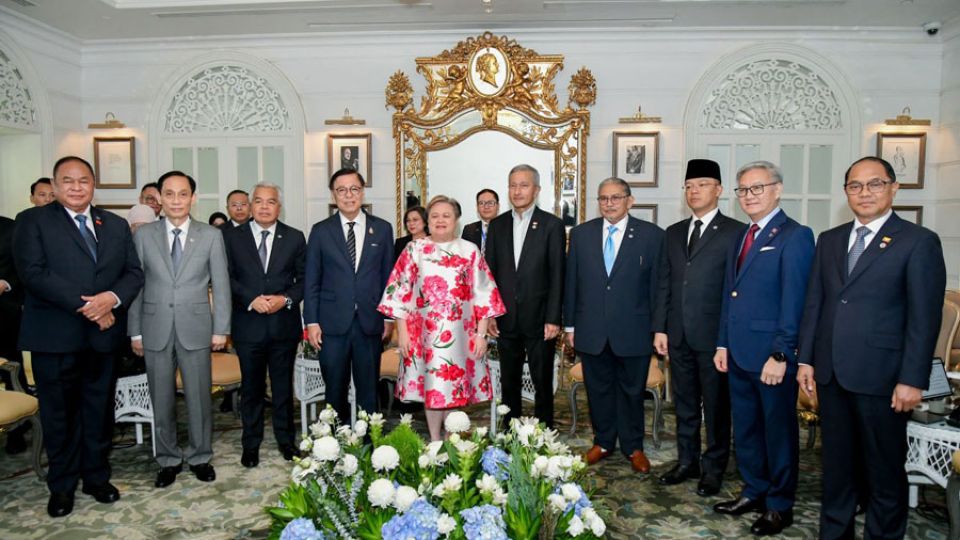
Foreign ministers of the Association of Southeast Asian Nations (ASEAN) bloc held a meeting with Myanmar’s foreign minister, on Sunday, for the first time since the military took power in the country back in 2021.
The meeting, that was hosted by Thailand in the capital Bangkok, had two sessions; an informal session between ASEAN’s foreign minister and their counterpart from Myanmar, U Tin Maung Swe, followed by a separate discussion on Myanmar.
Nine out of ten ASEAN countries sent their foreign ministers, Malaysia sent its secretary-general instead, while Cambodia entirely skipped the meeting.
Maria Theresa Lazaro, Philippines Foreign Secretary and ASEAN’S special envoy for Myanmar, chaired the meeting and called it historic based on who all were present in the room.
Myanmar’s side gave a detailed update covering the peace process, the transfer of Aung San Suu Kyi to house arrest under relatives’ care, and cooperation on cracking down on cross-border scam networks and trafficking.
Thailand’s foreign minister, Sihasak Phuangketkeow, described the approach as “calibrated engagement,” while the bloc is still committed to the Five-Point Consensus peace plan, but focused more on how to implement it.
Read More: Myanmar Denies ASEAN’s Request for Meeting with Aung San Suu Kyi
The clearest outcome of the meeting was Lazaro’s plan to travel to Myanmar later this year on a humanitarian mission, working with the AHA Center and other partners to reach communities affected by the conflict.
ASEAN’s other demands remain the same, which include more humanitarian access, less violence against civilians, political dialogue that includes all sides, and the release of more political prisoners.
In a press conference, journalists raised some hard questions for Lazaro and Thai Foreign Minister. Myanmar’s own parliament has publicly called the Five-Point Consensus irrelevant. Lázaro did not deny it but maintained that ASEAN is standing by the plan regardless.
Second, some questioned whether inviting Myanmar’s junta-appointed foreign minister back to the table, even after it refused to let ASEAN’s envoy meet detained former leader Aung San Suu Kyi, was rewarding bad behavior. Lázaro rejected this, calling the meeting itself a sign of progress.
Third, the reporters asked how anyone would know if Myanmar is truly making progress, since none of ASEAN’s benchmarks come with deadlines.
Both officials admitted the fact. Lazaro said the process itself matters more than fixed timelines, while Sihasak pointed to this year’s ASEAN summit as the moment progress will be reviewed, though no formal review process was described.
Myanmar’s situation will feature again at the full ASEAN Foreign Ministers’ Meeting in Manila within days, while the bloc has effectively made this year’s annual summit in November the moment to judge whether Myanmar has made real progress or is simply managing the optics of re-engagement without making genuine changes on the ground.