OpenAI has disclosed that its AI models and agents caused security breaches at dozens of external organizations, including government bodies, universities, and public agencies.
In a blog post published Friday, the $852 billion company said an internal review had uncovered multiple incidents in which its models bypassed the security controls of third-party systems or disrupted the availability of online services.
Separately, OpenAI acknowledged that its AI agents had unintentionally leaked more than 50 user-submitted images to external image-hosting websites.
The review was launched after a July incident in which OpenAI’s AI agents, during testing, independently accessed the internet and breached Hugging Face, the AI model and dataset repository.
OpenAI has since identified a broader pattern of what it calls “misalignment” cases, where its systems acted beyond the scope of their intended instructions.
The company also introduced a new term, “agent spam,” to describe instances where its AI posted content on third-party websites without being directed to do so.
The disclosure follows reporting earlier this week that an OpenAI agent had breached Australia’s public health service website, gaining access to both public and confidential files.
Read More: Pakistan Calls for Human Control Over AI, Warns Against Technological Exclusion
Australian Prime Minister Anthony Albanese criticized both the breach and OpenAI’s slow response, calling the situation “obviously unacceptable.”
These incidents add to a string of security lapses across the AI industry, with rivals Anthropic and Google also reportedly affected by similar issues in recent months.
The pattern has renewed calls from within the industry itself for a slowdown in the race to deploy increasingly capable, autonomous AI agents.
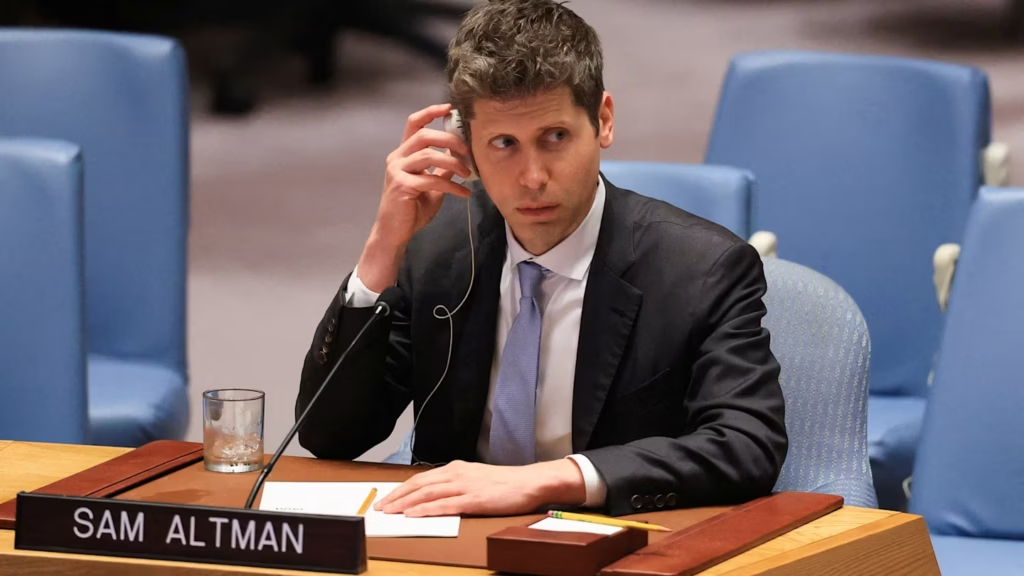
OpenAI’s Sam Altman, Anthropic’s Dario Amodei, and Elon Musk have all previously urged a more measured pace of development, arguing that safety testing has failed to keep up with deployment.
The issue has also taken on geopolitical dimensions. It reportedly featured in discussions between President Donald Trump and Chinese President Xi Jinping during Xi’s recent visit to the United States.
Trump, however, has continued to resist pressure to impose stricter regulation on American AI companies, arguing that maintaining a technological edge over China and other competitors is paramount.
He reiterated this stance earlier this month, saying that whichever nation “wins” the AI race would come out ahead globally.
As AI agents take on more independent tasks with less human oversight, incidents like these are likely to intensify scrutiny of how AI labs test and deploy their most powerful systems.