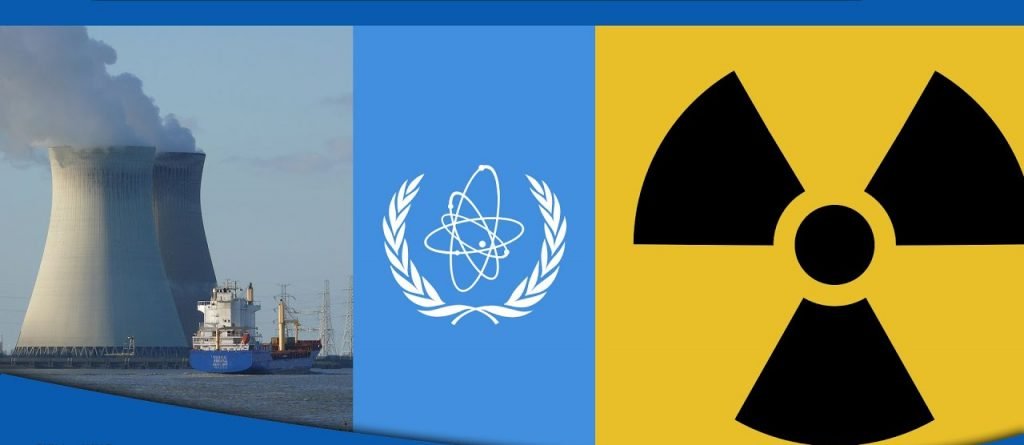
Kyiv, 4 March 2022 (TDI): Russian troops have taken over the control of the Zaporizhzhya nuclear plant in Ukraine. The Zaporizhzhya plant is the largest nuclear plant in Europe and houses six nuclear energy reactors.
Fall of Zaporizhzhya Nuclear Power Plant
In the wake of Russia’s invasion on 24th February, the regional situation has been rapidly escalating with the most recent news coming pertaining to the fall of the Zaporizhzhya nuclear plant. Consequently, the world is worried about nuclear safety in the region.
Ukraine authorities informed the nuclear watchdog about the situation on hand and also notified that all six nuclear reactors of the power plant are working as before.
Aside from that, they also assured that there hasn’t been any release of radioactive material though two people have been injured during the onslaught enacted by the Russian troops.
Reports have been coming about an explosion at the site, however, it has been clarified that no nuclear installation has been hit and there is no discharge of radioactive components.
Director-General Grossi also held a press conference to share the future course of action. He expressed his willingness to visit the Chernobyl Nuclear Power Plant.
He will do so to secure the commitment of all stakeholders to the safety and security of the Ukraine NPPs. Furthermore, He stated that the conflict must be stopped from putting nuclear facilities at risk.
Letter of Permanent Mission of the Russian Federation to IAEA
Earlier, on 1 March, the Permanent Mission of the Russian Federation to the International Organisations in Vienna wrote an official letter to the Director-General of the International Atomic Energy Agency (IAEA), Rafael Mariano Grossi.
The letter notified the IAEA about the Russian military taking control of the area around Ukraine’s Zaporizhzhya Nuclear Power Plant (NPP). According to the letter, the personnel working at the plant continued their work.
The personnel continue to provide nuclear safety along with monitoring radiation in the plant in the normal mode of operation. The letter also claimed that the radiation levels at the plant ‘remain normal’.

State Nuclear Regulatory Inspectorate of Ukraine Statement
The State Nuclear Regulatory Inspectorate of Ukraine (SNRIU) stated that it has made contact with all the nuclear facilities of the country to guarantee that they are working normally.
The Acting Chief State Inspector of SNRIU also wrote a letter to the Director-General of IAEA on 1 March to ask the organization for immediate assistance to monitor activities for the safety of the Chornobyl Nuclear Power Plant as well as other nuclear facilities.
Rafael Mariano Grossi has held meetings and maintained contacts in order to address the issue at hand. Energoatom had asked the nuclear watchdog to ensure the safety of 15 atomic reactors in Ukraine as the Russian incursions persist.
On 2 March, Ukraine informed the IAEA that all its NPPs remained under the control of Energoatom, the country’s national nuclear plant operator.
Energoatom is the National Nuclear Energy Generating Company of Ukraine. It is a Ukrainian state enterprise that operates all nuclear power stations in the country.
Zaporizhzhia Nuclear Power Station
The Zaporizhzhia Nuclear Power Station is situated in Enerhodar, Ukraine. It is the largest nuclear power plant in Europe and is amongst the 10 largest in the world. Zaporizhzhia was built by the Soviet Union in southeastern Ukraine.

The nuclear power plant is located on the southern shore of the Kakhovka Reservoir on the Dnieper River. The Kakhovka Reservoir is a water reservoir on the Dnieper River. It was built in 1956 along with the Kakhovka Hydroelectric Power Plant.
Zaporizhzhia Nuclear Power Station has 6 VVER-1000 pressurized light-water nuclear reactors (PWR). Each reactor is fuelled with U235 (LEU) and generates 950 MWe, for a power output of 5,700 MWe.
Pressurized water reactors (PWR) are a type of light-water nuclear reactor and constitute the majority of the world’s nuclear power plants. Uranium-235 or U235 is an isotope of uranium that makes up roughly 0.72% of natural uranium.
It is fissile and can sustain a nuclear chain reaction, unlike the predominant isotope Uranium-238. Enriched uranium has an increased percent composition of Uranium-235 through the process of isotope separation.
Water-water energetic reactor (WWER), or VVER as known in Russia is a pressurized water reactor design initially invented in the Soviet Union. Zaporizhzhia generates nearly half of Ukraine’s nuclear-powered electricity.
The Zaporizhzhia thermal power station is also nearby. Both plants have been captured by the Russian forces during the battle of Zaporizhzhia that transpired today.

Fall of Chernobyl NPP
On Thursday, February 24, Russian troops occupied the Chernobyl NPP on the first day of the invasion. It is pertinent to note here that Chernobyl is the site of a one-of-a-kind 1986 Nuclear accident that discharged radioactive material into the surrounding area.
Chernobyl is situated between the Ukrainian capital of Kyiv and the country’s border with Belarus. The government of Ukraine claimed that the radiation monitors in the area exhibited a surge in radiation levels subsequent to the Chernobyl attack.
However, according to Safecast, most likely this was because of the movement of the Russian military through the area that stirred up nuclear dust or a sensor malfunctioning. Safecast is a non-profit environmental data monitoring group.
The IAEA is closely monitoring developments in Ukraine related to the safety and security of the country’s nuclear power reactors. The organization is in regular contact and will persist to deliver regular updates on the situation on the ground.
Chernobyl Nuclear Power Plant
The Chernobyl Nuclear Power Plant is a closed nuclear power plant in Ukraine. During its active status, the power plant was cooled by an engineered pond that was fed by the Pripyat River.
Reactor No. 4 of the power plant was the site of the nuclear accident commonly known as the Chernobyl disaster in 1986. Presently, the power plant is within a large restricted area which is known as the Chernobyl Exclusion Zone.
The Chernobyl Exclusion Zone was the site of clashing between Russian and Ukrainian forces during the Battle of Chernobyl on 24 February 2022. Russian forces captured the plant on the same day.
Prior to the Russian takeover, the State Agency of Ukraine on Exclusion Zone Management administered both the zone and the former power plant. The other three reactors remained operational after the accident.
However, they were eventually shut down in 2000. As of 2021, the plant has remained in the process of decommissioning and the nuclear waste clean-up has been planned for completion in 2065.

I'm a detail-oriented, problem-solving, persistent multitasker. Having a magna cum laude MSc. in Strategic Studies from National Defense University, Pakistan, I believe in peaceful discourse & dialogue and have built my interest in nontraditional security threats.
I am an experienced writer with a primary focus on public policy, environmental security, nuclear strategy, and geopolitics!