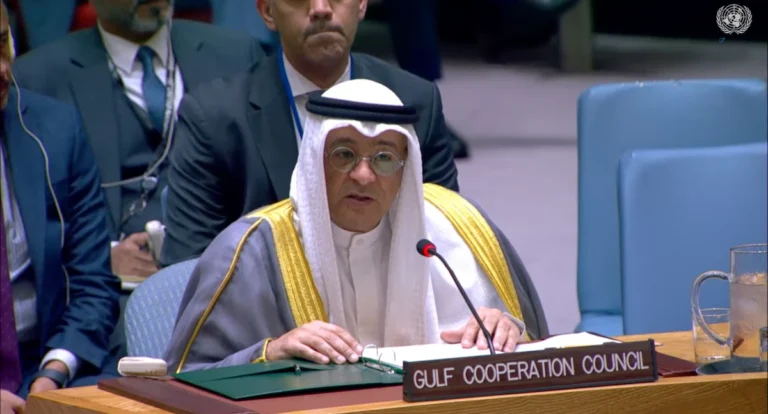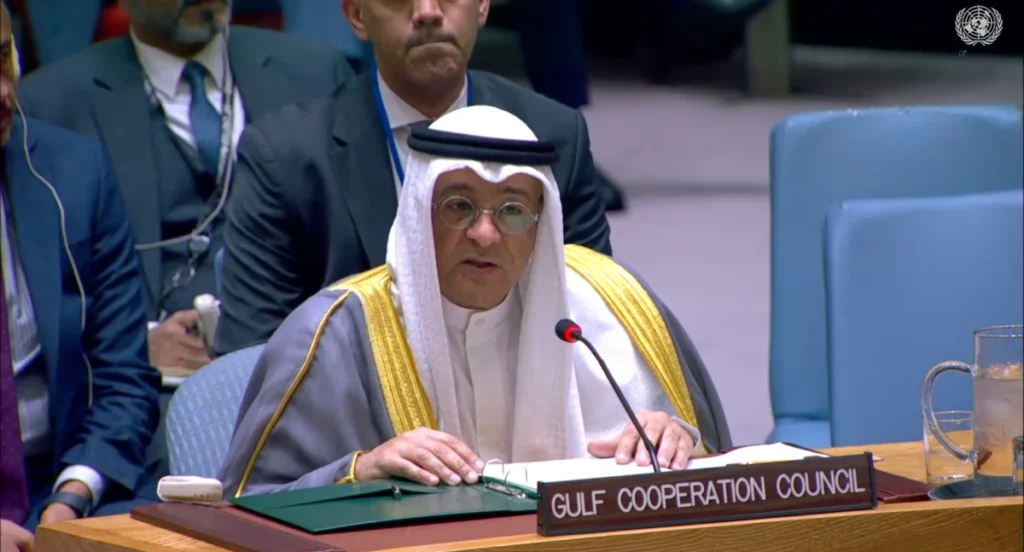
New York (TDI): Gulf Cooperation Council (GCC) Secretary-General Jasem Mohammed Albudaiwi has told the United Nations Security Council that Iran has fired more than 7,000 missiles and drones at GCC member states since February 28, warning that continued attacks and disruptions to shipping in the Strait of Hormuz are threatening regional security and global food supplies.
Addressing the Security Council on Friday, Albudaiwi said Iranian strikes over the past eight months had targeted airports, seaports, oil and gas facilities, power stations, desalination plants and residential areas across all six GCC countries.
He said the attacks had caused deaths and injuries, extensive infrastructure damage and serious environmental harm to the waters of the Arabian Gulf.
“We are addressing your council today with a unified Gulf voice,” Albudaiwi said, describing the attacks as a flagrant violation of the sovereignty and territorial integrity of GCC member states.
Read More: GCC States to Establish Joint Military Command in Kuwait Following Iranian Attacks
He urged the Security Council to take concrete action to ensure the attacks cease and prevent their recurrence.
The meeting was requested by Bahrain to discuss escalating regional tensions and threats to maritime security in the Gulf. Latvia, which holds the Security Council’s rotating presidency for November, convened the session.
Albudaiwi warned that disruptions to commercial shipping through the Strait of Hormuz had evolved beyond an economic challenge into a serious humanitarian concern.
Read More: Rubio Says Further US Military Action Against Iran Unnecessary
He said interruptions to global supply chains were affecting food and other essential commodities, particularly fertilizers and ammonia, which are critical to agricultural production and global food security.
Citing warnings by UN Secretary-General Antonio Guterres, Albudaiwi said developing and vulnerable countries could face famine and severe food insecurity because of fertilizer shortages and rising global inflation.
“Disruption of navigation in a single corridor affects factories, businesses and consumers across continents,” he said.
The GCC chief held Tehran fully responsible for the attacks, rejecting its justifications for targeting Gulf countries that, according to him, had not participated in the war and had instead made intensive diplomatic efforts to prevent regional escalation.
He welcomed the Security Council’s adoption of Resolution 2817 in March, which condemned Iranian attacks against GCC states and Jordan, demanded an end to the attacks and denounced Iran’s move to close the Strait of Hormuz.
Albudaiwi stressed that the council had a responsibility to ensure the resolution was implemented.