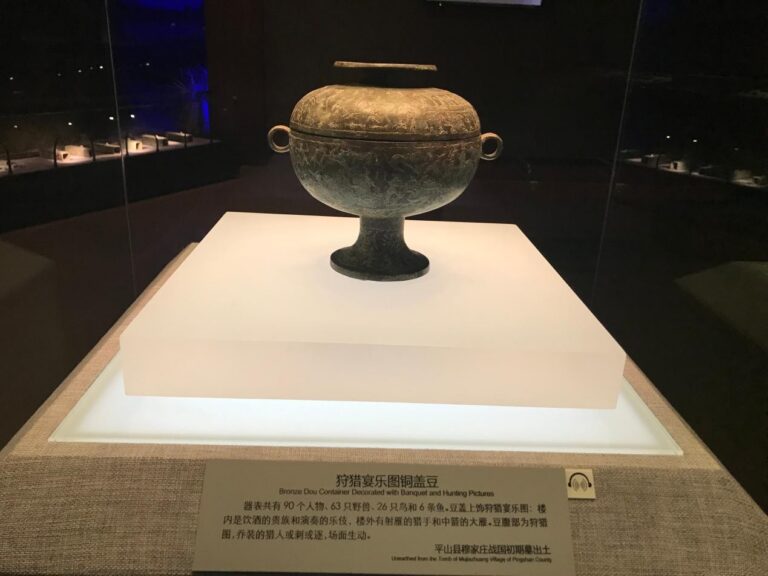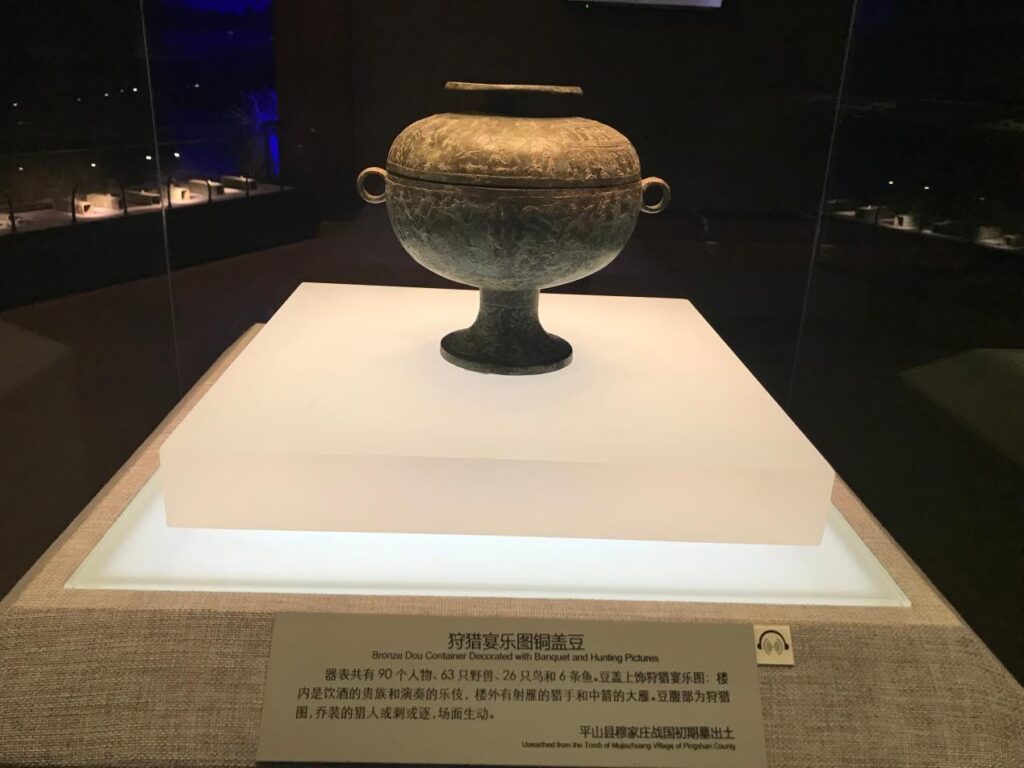
In the 1970s, a small bronze was unearthed in Pingshan County in Hebei province, China. The power of the Warring States age came back into view. It stands only 19.6 centimeters tall and is 17 centimeters across the mouth, small enough to hold in two hands. Yet its lid and belly carry a whole world in relief: nobles drinking and musicians playing in a pavilion, hunters shooting wild geese, and hunters chasing hares and boars. The dou slept in the tomb for thousands of years. Now it tells its story to anyone who stops in front of it.
More than three thousand years ago, nobody could make a bronze vessel alone. It simply wasn’t a one-person job. Think about what it took. Someone had to find the ore and dig it out of the ground. Someone had to design the vessel and build the mold. And then, at the big moment, someone had to pour in the scalding, glowing liquid metal and hope everything went right. Every single step needed hundreds, even thousands, of people working together. Next to a project this huge, one person was tiny. Only the power of a state could pull it off.
So who made these bronzes? For the most part, we will never know. The names of the makers were not recorded. But they left us something astonishing.
Ancient Chinese bronzes are grand in shape and dazzling in decoration. They mark the highest level of craft and taste of their time. Still, they were never just “pretty things to put on a shelf.” Imagine countless nameless craftsmen, filled with awe, pouring their clever ideas and their imagination into the mold along with the molten metal. Slowly the bronze cooled, and what came out became a symbol of an entire age. Through these vessels, we can watch Chinese civilization build itself up, piece by piece. Their elegance and harmony match the quiet, deep character of Chinese culture itself.
So, What exactly is Bronze?
Bronze is an alloy, a mix of copper, tin and lead. When freshly cast, it shines and looks almost like gold. Over time it oxidizes, turning the blue-green or dark color we usually see in museums today. It was also very, very expensive. The materials were hard to get, and casting was even harder. So even nobles brought out their bronzes only on important occasions: banquets, ceremonies and sacrifices.
During the Xia, Shang and Zhou, the three oldest dynasties in Chinese history (c. 2070–221 BCE), people cast bronzes in a very large number. There were food vessels for eating, wine vessels for drinking and water vessels for washing. There were also musical instruments, weapons and tools. Wherever a ritual took place, bronzes were there.
A Mystery Kingdom in Hebei
During the Spring and Autumn and Warring States periods (770–221 BCE), there was a mysterious kingdom called Zhongshan. Its ruins lie in today’s Pingshan County, Hebei Province.
It was founded by the Xianyu, a branch of the Baidi, a nomadic people from the north, and it lasted about five hundred years (770–295 BCE). Over those centuries, Zhongshan held its own among the powerful states around it, and for a while it grew quite strong. Yet the history books say very little about it, and what they do say is scattered and brief. For more than two thousand years, Zhongshan sat in a corner of history, a “mystery kingdom” whose story few people knew.
A Kingdom Written in Bronze
When archaeologists found more than 2,880 bronzes of Zhongshan Kingdom, each of these objects told the stories of kings, nobles and ordinary people. When you stand before them, you might see their hunting, banqueting , and their happy life. That is a library’s worth of artifacts, and for a kingdom the written records barely mention, it is a library that speaks loudly.
The ritual vessels are majestic and bold. The everyday objects are delicate and ingenious. The pieces inlaid with gold and silver glitter with color. The animal figures are lifelike down to their poses and expressions. Together they show how highly skilled Zhongshan’s casters were, and how strongly the bronzes carry the flavor of the Warring States age. In other words, Zhongshan may have left few words in the history books, but its craftsmen said plenty in metal.
A Bronze That Tells Stories
This lidded bronze dou, is decorated with banquet and hunting scenes, and these pictures describe the Zhongshan people’s happy life, chasing wild animals in the field and feasting with melodies and sweet wine. It is a vessel that tells stories, and the story it tells is Zhongshan’s own. You can even see the vivid dancing, hear the beautiful music, smell the fragrance, touch the exquisite bronze wares, talk to the nobles, and even feel the joy of their life. The vigorous people, lively animals, solemn buildings, and silent dou—all of them make you feel as if you were one of them, experiencing the exciting moment.
A Vessel You Can Hold
Here is a surprise. For stories on its surface, this dou is small. It stands only 19.6 centimeters tall, and its mouth is 17 centimeters across. It would sit comfortably on a school desk. That makes its decoration even more astonishing. Ninety people, 63 beasts, 26 birds and 6 fish are packed onto a surface you could almost wrap your arms around. The craftsmen were not painting on a wall. They were working at the scale of a mixing bowl, and they still found room for a whole world.
The Shape of a Dou
A dou was a food vessel used to hold seasonings, as well as a ritual vessel used by kings for ceremonies and sacrifices. This one has a very distinctive shape. A small round knob sits on top of the lid like a little handle. Two matching ring handles stand upright on either side. The belly is deep, the stem is short and solid, and the foot flares out at the bottom like a trumpet.
From the dou, we can see the Zhongshan people’s mastery of decoration, and this piece shows why. Some bronzes of the kingdom were finished with inlaid gold and silver, in which fine grooves were carved into the surface and threads or flakes of precious metal pressed in, some as thin as a strand of hair. On this dou, the real star is something else: the scenes cast in relief on its surface.
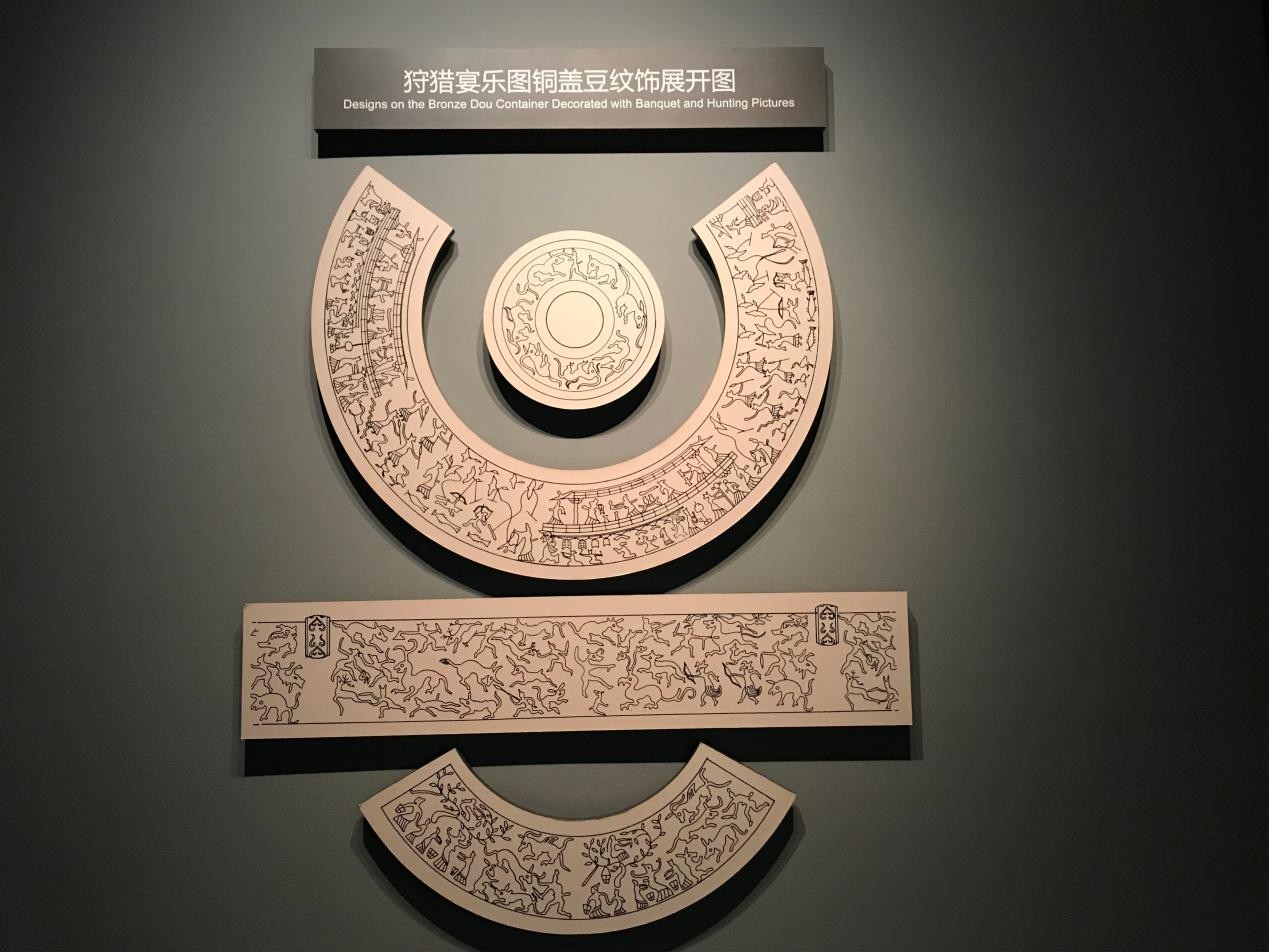
Seven Scenes, Ninety People
Across the top of the knob, the lid, the belly and the base, seven groups of scenes rise in relief. Count them, and you will find 90 people, 63 beasts, 26 birds and 6 fish. The pictures are packed together so tightly that there is hardly an empty spot, and every figure looks wonderfully alive.
What do these pictures show? They show a world of feasting and hunting at the same time, and many scholars read it as a glimpse of life in Zhongshan itself. The history is engraved in the bronze, the harmony is highlighted by the shinning figures.
A Feast Upstairs, Music Downstairs
In a two-story pavilion, nobles raise their cups and drink. On the floor below, musicians strike bells and chime stones. Their music seems to drift out over the whole scene.
Geese in the Sky
Outside the pavilion, hunters draw their bows and shoot at wild geese. Some of the birds are still flying high. Others have already been hit and tumble down, struggling as they fall.
Two Wild Hunts
Around the belly of the dou, two big hunts are in full swing, and every hunter has his own way of doing things. Some swing swords and stab at the beasts with all their strength. Some raise long spears and chase their prey as hard as they can. Some wear animal skins, pretending to be animals, and wrestle with the beasts up close. Meanwhile, hares and wild boars race away in panic. People and animals fill every inch of the surface, and everyone is moving. You can almost hear the shouting and the thudding of feet.
Unrolling the Dou
Here is a fun trick. Imagine you could peel the decoration off this bronze and lay it flat on a wall. A display in the museum does exactly that, and it shows that the dou is not one picture but four, stacked like chapters in a book. The four pictures are actually layers of this dou, depicting seven groups by scene.The two counts fit together. At the very top is a small round disc, the crown of the lid. Beasts chase and coil around its center in endless circles, as if the story begins with a gust of wind and fur. Below it opens a wide curved band, the lid itself, and this is where the story gets crowded. Two-story pavilions rise with railings and pillars, and tiny figures line their floors. Just beyond the walls, the world turns wild. Archers draw their bows, geese wheel across the sky, and animals bolt in every direction. A feast and a hunt share one stage. Then comes the belly, unrolled into a long strip. Here the music fades and the chase takes over. Beasts leap, bite and flee in tangled lines, and somewhere in the swirl a hunter takes aim. Last, at the bottom, a small curved band wraps around the foot. Animals and hunters crowd in so closely that there is hardly room to breathe. It is the final chapter, and like the others, it is full of life.
What Makes This Dou Special
What makes this dou special is that it is not cast only with solemn, mysterious patterns. Instead, it carries scenes of ordinary human life: feasting, making music and hunting. In the pavilion, a noble raises his cup, while below, musicians strike bells and chime stones. A grand scene of ritual, unfolds in a space no bigger than the palm of your hand. Outside the pavilion, hunters shoot geese, and around the belly, the great hunts rage on. Together they show an old tradition among the aristocrats before the Qin dynasty: training for war through hunting, and offering the catch in sacrifice. Ritual and martial skill, music and the chase, all live side by side on one vessel.
Even more remarkable is the way the craftsmen arranged the 90 people, 63 beasts, 26 birds and 6 fish. Some areas are dense and some are open, and stillness and motion play off each other. The calm of the banquet answers the energy of the hunt. This reflects the love of harmony and “vital resonance” that runs through Chinese art.
And there is one more thing. This vessel comes from Zhongshan, a state founded by a nomadic people from the north. It carries traces of the ritual and music of the Central Plains, yet it also holds the energy of life in the grasslands and mountains, where hunting was a way of living. In that sense, this little dou is a miniature of Chinese civilization itself: diverse yet unified, open and inclusive.
A Last Look
Welcome to China. Here you can stand before this dou and look closely at a bronze vessel from a mysterious ancient kingdom more than two thousand years ago. See its luster, feel its presence, and hear it speak. The precious bronze, the masterful craftsmanship, and every last detail reflect its people’s love of life and longing for peace. Remember there are more bronzes like it, and more stories are waiting to hear. Remember that a kingdom the history books nearly forgot left its portrait in metal, with a banquet upstairs, a hunt outside, and not a single empty corner. The ancient craftsmen did not leave blank space for silence. They filled the bronze with the sounds of a living world. You can see the harmony between the hunting and feast, the sweat and the sweet, the rising and the falling, even the hunters and the animals.

Dr. Wei Tao
Dr. TAO Wei is an Associate Professor at the School of Foreign Languages, Hebei Normal University. A graduate of Beijing Foreign Studies University in Translation Studies, Dr. Tao specializes in museum translation, audiovisual translation, and cultural translation, and has devoted many years to the translation and dissemination of Chinese museum culture. She has led a number of research projects and has published widely on museum translation in journals in China and abroad.