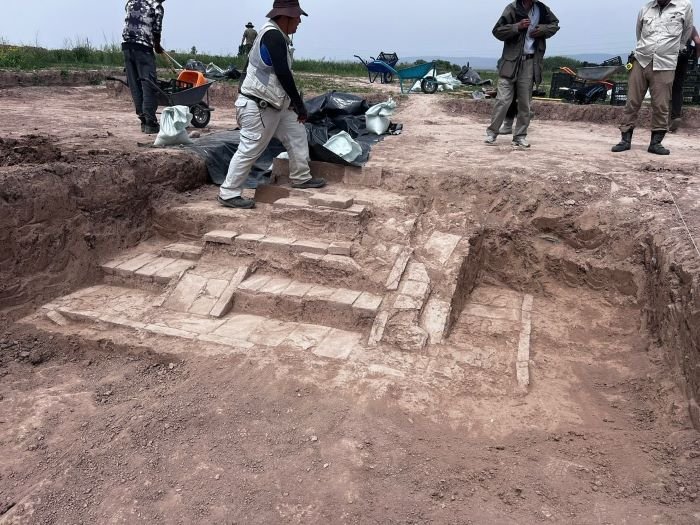
Bishkek (TDI): Archaeologists in Kyrgyzstan have uncovered the remains of what is believed to be a Buddhist temple dating back to the 7th and 8th centuries at the medieval Ak-Beshim archaeological site, according to Kyrgyz authorities.
The site contains the ruins of the ancient Silk Road city of Suyab, located near the modern city of Tokmok in northern Kyrgyzstan. Historically, Suyab served as a major commercial and political center along the Silk Road between the 5th and 8th centuries and was once the capital of the Western Turkic Khaganate.
The discovery was made by a joint Kyrgyz-Japanese archaeological team conducting excavations at the site since early May. Researchers uncovered structural remains including a raised platform, staircase, and ramp built from baked bricks. Experts believe the design reflects architectural influences from China’s Tang Dynasty and is consistent with Buddhist temple construction from that era.
The findings also appear to support a theory proposed decades ago by Soviet archaeologist Alexander Bernshtam, who suggested in the late 1940s that a Buddhist religious structure once existed in the area.
Read More: The Mysterious Fergana Valley and Regional Tourism
Suyab was an important hub for Sogdian traders on the ancient Chang’an–Tian Shan trade route, now recognized as part of a UNESCO World Heritage corridor. Chinese historical records also suggest that renowned poet Li Bai may have been born there in the early 8th century.
The city gradually declined during the 11th century as the nearby city of Balasagun rose to prominence in the Chui Valley region near the famous Burana Tower.
Officials say recent archaeological work has provided new insight into the historical presence of Buddhism in the region. Joint Kyrgyz-Japanese research at Ak-Beshim has been ongoing since 2012.
Read More: Kazakhstan Strengthens Foothold in Global Critical Minerals Market
Authorities are now seeking protected status for the excavation area, with plans to eventually establish an open-air museum at the site.
The discovery follows earlier reports of another major archaeological find in Kyrgyzstan — the remains of what is believed to be the country’s oldest known Christian structure, a Nestorian church dating from roughly the same period.