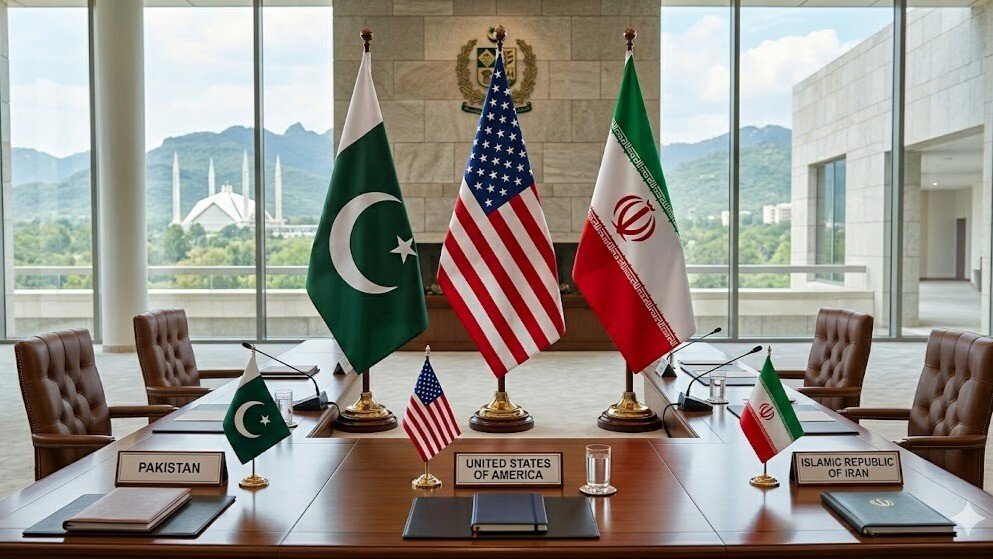
The world woke up this week to a geopolitical reality that would have seemed implausible just a year ago. Pakistan, a country simultaneously fighting its own war with Afghanistan, managing a fragile economy, and navigating one of the most combustible sectarian fault lines in the Muslim world, has placed itself at the center of the most consequential diplomatic effort of the decade.
As of writing these lines, Islamabad is the proposed venue for direct talks between the United States and Iran, and Trump’s envoys have delivered a 15-point ceasefire plan to Iran through Pakistan. There is a structural shift in how Middle East power is being brokered, and you need to understand why.
What Happened in the Last 72 Hours
Let us start with the timeline, because the speed of this matters. With every hour things are changing and as I am writing this, there are new developments happening and you might think this is old stuff but it is still fresh of few hours.
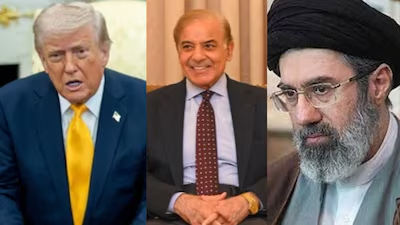
Pakistan is making a push to mediate talks to end the US-Israeli war against Iran, with its powerful army chief holding calls with President Donald Trump to find a resolution to the fighting. Field Marshal Asim Munir spoke with Trump on March 23, while Prime Minister Shehbaz Sharif held a phone call with Iranian President Masoud Pezeshkian the following day. Both calls happened within 24 hours of each other. One channel up to Washington. One channel crosses to Tehran. Simultaneously.
Trump’s envoys have sent a 15-point ceasefire plan to Iran via Pakistan, which includes a one-month ceasefire while the two sides negotiate terms to end the war. And on the Iranian side, Iran has consistently denied it is holding talks with the US, with Iranian leaders saying the US is “negotiating with itself.”
So let us be precise about what is actually happening: Pakistan is the wire between a US president who is claiming talks are going well and an Iranian government that publicly denies those talks exist. That gap, that deliberate ambiguity, is a feature. It is exactly the kind of diplomatic fog that allows both sides to test conditions without the domestic political cost of being seen to blink first.
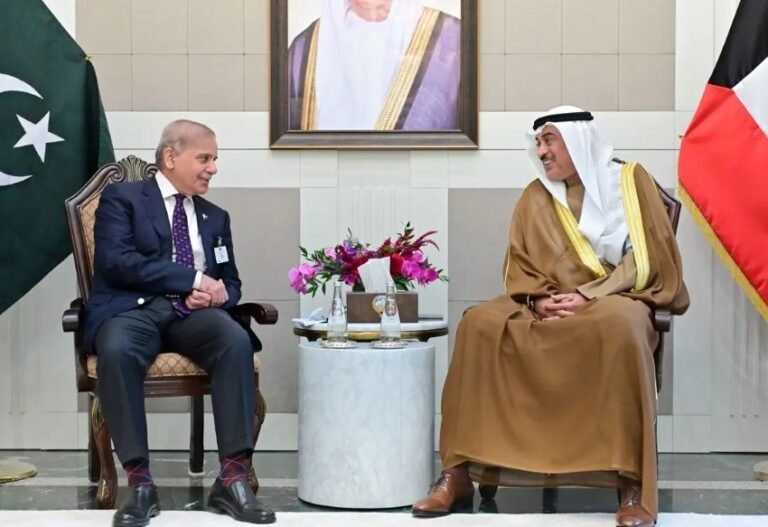
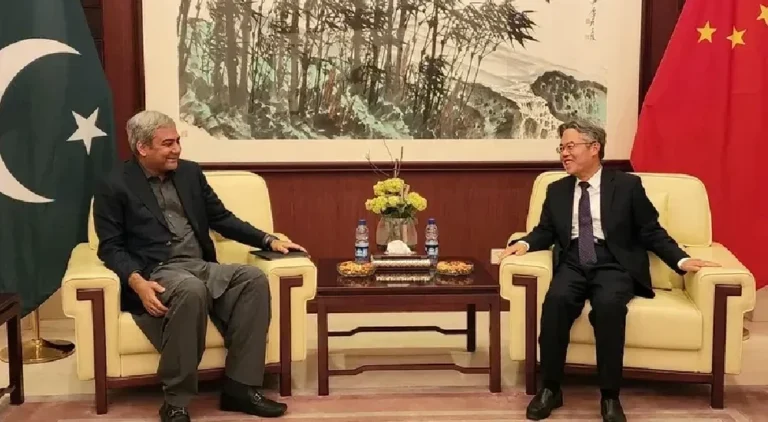
According to official press releases, over the past month, Sharif and Pakistan’s foreign minister have held over 30 conversations with counterparts in the Middle East, including half a dozen with Iranian officials. Even writing these lines, Prime Minister Sharif just spoke to the Qatari leader and assured him about the support. While the two sides are sending missiles and the world is watching, Pakistan is making quiet moves to build diplomacy and engagement.
Why Pakistan and Not Anyone Else
This is the question most commentary gets wrong, because most commentary focuses on what Pakistan is rather than on what Pakistan is not.
Pakistan is a No-US military base country. That single fact is doing enormous geopolitical work right now and makng possiblities of the trust that is required for a mediator at this point of the time and conflict. A trust that both sides are putting on Islamabad. Pakistan is in conversations with both the US and Iran and is “well poised to play an active role” in discussions to end the war. That credibility rests on something Qatar, Turkey, and Egypt cannot fully replicate. Pakistan hosts no American military infrastructure, which means Tehran does not read Islamabad through the same lens of suspicion it applies to every Gulf capital.
Pakistan is the only Muslim-majority country with nuclear weapons and does not host US military bases. It maintains longstanding ties with Saudi Arabia, dating back to 1947, reinforced by a strategic defence pact signed in September 2025. At the same time, it shares a 900-kilometre border with Iran and hosts the world’s second-largest Shia Muslim population.
Read that again. Nuclear state. No US bases. Defence pact with Riyadh. Nine-hundred kilometers of shared border with Tehran. The world’s second-largest Shia population lives inside its own borders. No other country in this conflict holds all five of those cards at once. I hope as you are reading along, understanding what Pakistan is not but what Pakistan is.
According to media reports, US envoy Steve Witkoff “has a direct connection” to Field Marshal Asim Munir, Pakistan’s army chief, and they have “a good working relation.” Trump himself has called Munir a “great general” and “a great guy.” That personal rapport is unique. Even earlier Field Marshal Munir had a detailed conversation with President Trump and then Prime Minister had a conversation with President of Iran. In Trump-era diplomacy, personal trust between principals is the actual infrastructure.
If talks happen, it could raise Pakistan’s global prominence to heights not reached since Pakistan helped mediate the secret diplomatic opening that led to US President Richard Nixon’s visit to China in 1972. That is the historical benchmark now being applied in Washington. The Nixon-to-China opening. Fifty-four years later, the same country, the same back-channel role, a different civilizational confrontation.
Saudi Layer
Pakistan is mediating between the US and Iran. Pakistan also has a mutual defence treaty with Saudi Arabia, a country that Iran has been striking. Both that Pakistan is leveraging.
Vali Nasr, a prominent Washington-based scholar, states that any Pakistani diplomatic initiative is unlikely to occur without the backing and support of Saudi Arabia: “Pakistan will only step up if it has Saudi backing, and prodding. Riyadh is likely very much in the picture.”
Saudi Arabia cannot formally mediate in a war where its own infrastructure is being hit. It would be politically and symbolically impossible. But Riyadh has the deepest interest of any actor in the region in this war ending fast and on terms that constrain Iran’s regional power. So what does Riyadh do? It moves through Pakistan. On the sidelines of an emergency Arab and Islamic foreign ministers meeting in Riyadh, the foreign ministers of Pakistan, Saudi Arabia, Egypt, and Turkey held a separate coordination meeting, described as the first in that format, and Islamabad’s emergence as a potential venue for dialogue between the US and Iran stems from that meeting.
That Riyadh sidebar is the origin point of everything you are seeing this week. It has been almost completely underreported.
And then there is what Pakistan’s Foreign Minister actually said to Tehran when the missiles started landing on Saudi soil. Pakistan said Islamabad was bound by the SMDA pact but was working to avoid entering the conflict through its backchannel talks with Tehran. According to media reports, Pakistan told Iran that we have a treaty obligation to Saudi Arabia, but we are working to keep Saudi soil out of the line of fire. That assurance, delivered directly to Iranian leadership, may be one of the reasons Iranian strikes on Saudi Arabia have remained limited. It is one of the most consequential and least reported diplomatic acts of this entire war.
Pakistan’s Strategic Gamble and What It Wants Back
Let us be clear about something here and it is fair enough for Pakistan to do this for its own interest and saving that apart from raising its prestige. Every country that mediates in a great-power conflict is buying something.
Pakistan is buying three things simultaneously.
First, it is buying goodwill with the Trump administration at exactly the moment it needs IMF breathing room, relief from financial pressure, and a more balanced US posture on India-Pakistan dynamics. Trump’s relationship with Pakistan is the warmest US-Pakistan relationship at the military and civilan level in over a decade.
Second, it is buying continued Saudi investment and economic partnership. The SMDA signed in September 2025 was not just a security pact. It was the framework for the Saudi investment corridor into Pakistan’s mineral sector, infrastructure, and energy grid. Pakistan cannot afford to let that relationship fracture.
Third, and most importantly, it is buying strategic identity. Pakistan hosting US-Iran talks represents a major upgrade in Islamabad’s strategic standing. For a country that has spent the last five years associated primarily with internal instability, economic crisis, and political turmoil, emerging as the indispensable broker in the most dangerous war since 9/11 is a civilizational repositioning. Pakistan is using this moment to establish that Pakistan is a global actor, not merely a regional one.
Limits and the Real Risk
Serious analysis requires honesty about where this ends.
Iran is still firing missiles. Its public position is that the US is negotiating with itself. President Trump postponed threatened strikes on Iranian power plants and spoke of “productive conversations,” but the five-day window is a clock and is ticking in a faster pace. If mediators were not able to produce any results by Thursday, the next move is kinetic and might be horrific to say the least.
And there is one actor Pakistan has zero leverage over: Israel. Israel does not want this war to end on terms that leave any Iranian nuclear capability intact or any Iranian regional influence preserved. Israel is a spoiler that no Pakistani diplomat can call, message, or assure. That asymmetry is the hidden fault line beneath all of this apparent diplomatic momentum.
The deepest structural risk is this: conducting backchannel diplomacy in the open is apparently a formula for failure. The more publicly Pakistan claims its mediator role, the more Iran is forced to publicly deny it, and the harder it becomes for Tehran to accept the political cost of being seen to capitulate. Pakistan’s greatest diplomatic asset right now is discretion. Its greatest liability is the domestic political temptation to take credit for something that has not yet happened.
Larger Signal
Step back from the immediate crisis and look at what this moment tells us about how the world is being reorganized.
The age of Western-led mediation, where Washington or Brussels convenes parties in a neutral European capital and issues a joint communiqué, is over. What is replacing it is the age of pivot-state mediation: countries that hold contradictory alliances, manage asymmetric dependencies, sit at civilizational crossroads, and operate in the grey space between great powers.
Pakistan is one of those states. Its contradictions are its credentials. Its ambiguity is its value. The country that the world spent a decade writing off as a failed state in waiting or the one which is isolated is now the most important phone call in the most important negotiation on the planet.
Whether Islamabad closes this deal is uncertain. The variables are too volatile, the gaps too wide, the spoilers too many.
**The information utilized is from Open Source and Media Reports coming in including official handles.
Dr. Farhat Asif
The writer is President, Institute of Peace and Diplomatic Studies. The writer teaches Conflict and Cooperation in South Asia to MPhil Students in IR Department. Riphah International University. The views expressed are her own and do not represent those of the Institutions she represents.