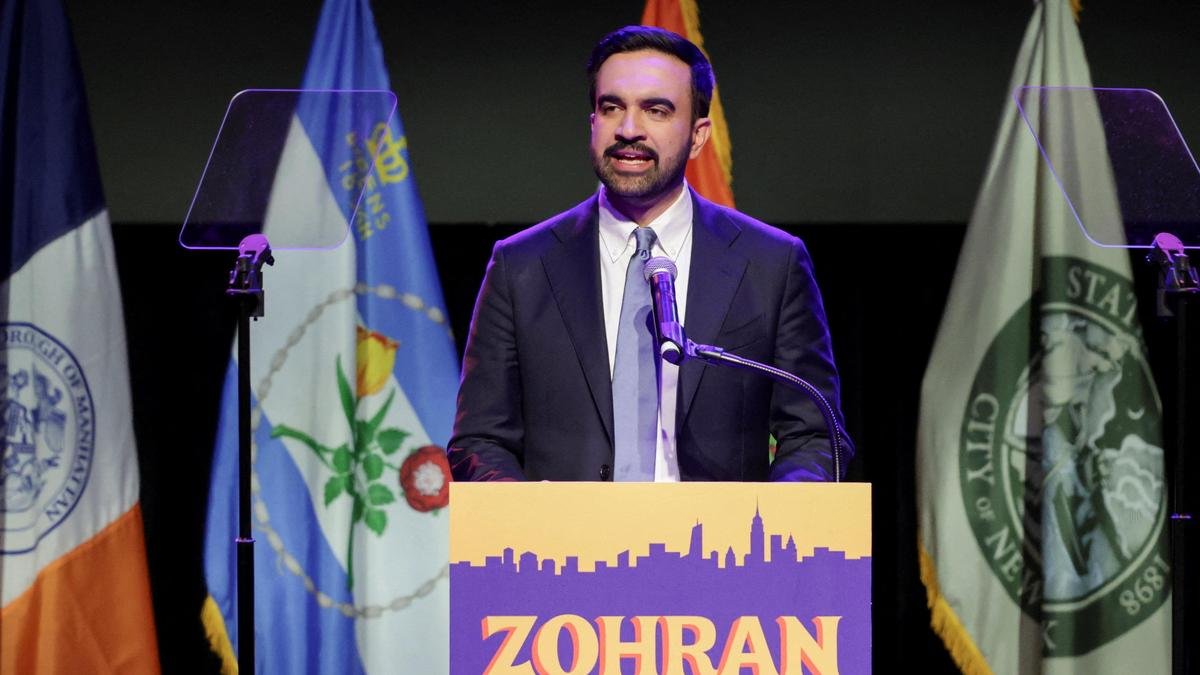
Zohran Mamdani’s progression from community organizer to politician in New York represents a key element of politics and political system in the United States. Born in Kampala, Uganda, he grew up in Queens, attended Bowdoin College, and entered politics through grassroots organizing rather than inheritance or family fortune. The outcome would probably be different if he had lived in Pakistan rather than New York. From activism to parliament, he would most likely never make it.
This is not because of a lack of skill or political ambition or leadership traits. Thousands of young people in Pakistan are politically literate and socially conscious. The institutional system is such that those without prior privileged status are mainly excluded from Pakistani politics.
Despite its flaws, New York’s political structure offers genuine avenues for grassroots organizing to result in representation. Mamdani organized campaigns for housing justice and immigrant rights, served as a housing counselor, battled eviction cases, and co-founded student activist initiatives. He transformed community organizing into a legitimate political endeavor. In contrast, privileged birth biradari (family/clan) power, inherited political capital, control over patronage networks, and financial access rather than civic engagement or grassroots labor is the usual path to elected office in Pakistan.
Political parties in Pakistan are dominated by family-based elites, and there is little democratic involvement, according to scholars who research the country’s dynastic political elite structure. Dynastic politics continues to skew representation, as noted in a recent 2025 study: “…the electoral politics is a family business… few families rule legislatures, turning them into oligarchies.”
Many competent Pakistanis continue to be excluded as a result of the mismatch between formal politics and civil society. The political class is not earned; it is inherited. Innovation in policy and representative democracy are compromised by their absence. The difference between Pakistan’s dynasty politics and Mamdani’s approach demonstrates that reform must be structural rather than ideological.
Read More: Mamdani Makes History as New York’s First Muslim Mayor
Civic competency could be transformed into political legitimacy with the aid of five institutional changes:
- Enforce democracy inside the party. It should be mandated by law that parties hold actual internal elections rather than merely postponed conventions. This would enable the emergence of true organizers instead of just dynastic heirs.
- Strengthen local government as actual power centers. Grassroots leaders, community activists, social workers, and city-level reformers might establish a track record and subsequently run for higher office on merit if districts and municipalities had administrative power and fiscal autonomy.
- Encourage civic engagement as a means of political recruiting. Acknowledge local leadership, social service, and advocacy as legitimate qualifications for political campaigns. Maybe through party quotas, public funding, or special seats for local candidates.
- Limit campaign funding and improve openness. Dynastic politics are fuelled by wealth and patronage. Election expenses and nepotistic advantages would be decreased by restrictions on private funding, public donor transparency, and public campaign subsidies.
- Encourage and safeguard independents. Due to their lack of elite support, many competent candidates are excluded. The field would be opened by legal provisions that guarantee independent voters fair access to ballots, campaigning, and the elimination of the requirement for established clan endorsements.
These expectations are not idealistic. The data demonstrates that representation is wider and more representative of society in nations where civic engagement influences politics. Mamdani’s election proves that even in a highly unequal city like New York, a former housing counselor-turned-organizer can defeat entrenched interest when the system allows it. In Pakistan, numerous peer-reviewed studies demonstrate that dynastic domination discourages voter participation, diminishes accountability, and distorts representation.
Ideological imports do not constitute the essential reforms. These are structural changes to political institutions that can be tailored to Pakistani customs and constitutional frameworks, such as local government, party democracy, campaign funding, and candidate eligibility. The narrative of Zohran Mamdani does not prove that America is superior. It is evidence that organizers can succeed regardless of their background or level of income if a democratic system permits them to run.
Pakistan’s issue is not a lack of skill, but rather a lack of designers. At the moment, the system favors those who are born into positions of authority rather than those who gain the public’s trust. Redesigning the infrastructure is necessary if Islamabad is to genuinely democratize politics and make representation reflect society rather than elite bloodlines. This entails creating ladders rather than gates and empowering organizers rather than endorsing heirs. Then and only then will Pakistani democracy reach the full potential of its people.
*The views expressed in this article are the authors’ own and do not represent TDI. The contributor is responsible for the originality of this piece.

Talha Zaib
Talha Zaib is a student of International Relations and can be reached at talhazaib969@gmail.com