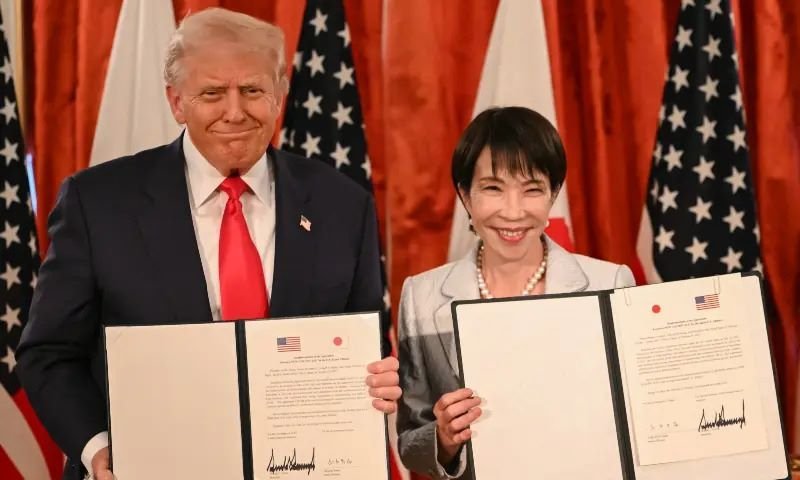
Tokyo (TDI): US President Donald Trump and Japanese Prime Minister Sanae Takaichi signed a landmark agreement on Tuesday to secure the supply of critical minerals, including rare earths, with the goal of reducing China’s dominance over the market for these vital electronic components.
The agreement, finalized at the grand Akasaka Palace in Tokyo, outlines steps for both countries to diversify their supply chains and strengthen market security for these critical minerals. Despite the absence of direct references to China in public statements, the deal comes amid growing concerns over China’s control of over 90% of global rare earth processing.
The timing of the agreement is notable, with Trump set to meet Chinese President Xi Jinping later this week on the sidelines of the Asia-Pacific Economic Cooperation summit in South Korea. The two leaders will discuss potential deals to pause escalating US tariffs and Chinese restrictions on rare earth exports.
Under the new framework, the US and Japan plan to collaborate on economic policies and investments that will accelerate the development of diversified, transparent, and fair markets for rare earths. The White House stated that both nations aim to provide financial backing for select projects over the next six months. A potential stockpiling arrangement is also under consideration to further secure the supply chain.
Read More: Trump’s Asia Tour Turns Regal: Meeting Japan’s Emperor After Six Years
While China dominates rare earth processing, the US and Myanmar collectively account for 20% of global extraction, with Malaysia and Vietnam contributing an additional 5%. The agreement reflects a shared interest in diversifying global supply sources.
Beyond rare earths, Japan has committed a $550 billion investment in the US economy, as part of a broader trade agreement. This investment could encompass various sectors, including power generation and liquefied natural gas (LNG).
Ahead of Trump’s trip to Asia, the US has also intensified its push to reduce Russia’s influence in global energy markets. The US imposed sanctions on Russia’s two largest oil exporters, Rosneft and Lukoil, to pressure the Kremlin into negotiations over the ongoing war in Ukraine. Japan, a key energy player, has been working to reduce its dependence on Russian energy sources and has significantly increased its LNG purchases from the US.
Read More: What Does Trump Hope to Achieve on His Tour to Asia and Will He Succeed?
In June, Japan’s Jera, the country’s largest LNG buyer, secured a deal to purchase up to 5.5 million metric tons per year of US LNG, beginning in 2030. This is approximately the same amount Japan currently imports from Russia’s Sakhalin-2 project, which is set to expire in the next few years.
Japan has also moved to diversify its energy imports from Russia, which still account for a small percentage of its oil supply, with most of its oil coming from the Middle East. Tokyo Gas, Japan’s biggest city gas supplier, recently signed a deal to purchase LNG from the Alaska LNG project, further bolstering its energy security.
However, despite these efforts, Japan’s energy needs remain tied to its closest and most cost-effective LNG sources, such as Russia’s Sakhalin-2. As the country seeks to keep electricity prices in check, the challenge remains whether the US can offer LNG at competitive prices, especially in comparison to Russian supplies.