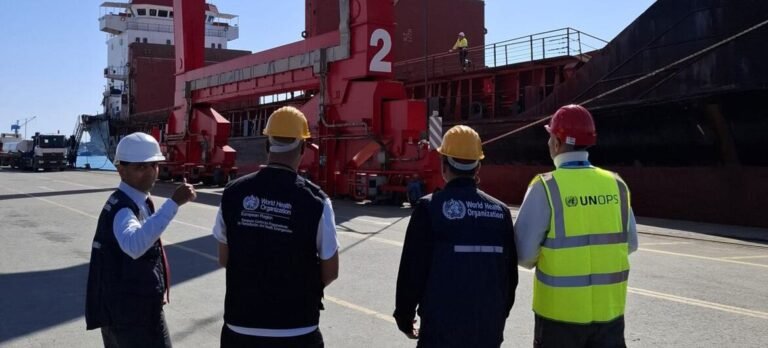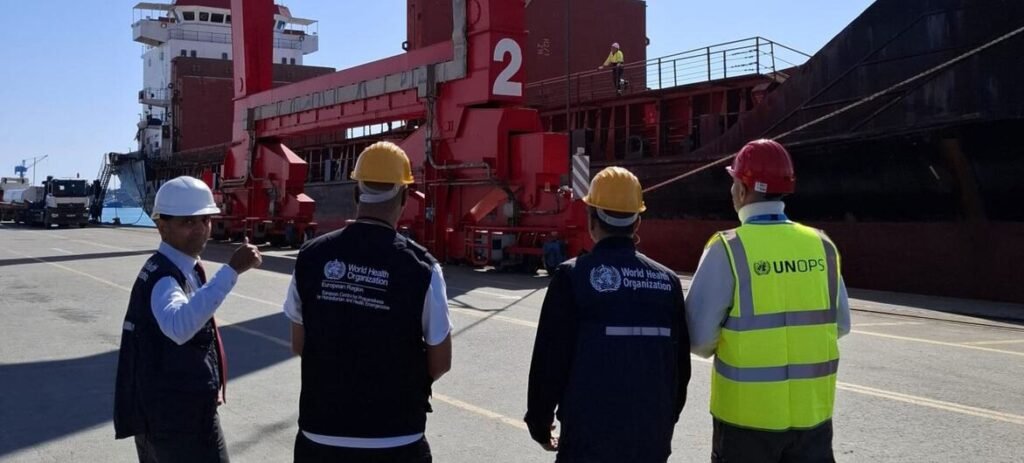
The United Nations health agency has delivered 106 tons of critical humanitarian supplies to Gaza through a newly established maritime corridor; the first under a sea-based logistics initiative designed to overcome severe restrictions on land access.
Transported from Cyprus to Israel’s Ashdod port, the aid is now being prepared for distribution inside Gaza, where shortages of food, medicine and essential supplies remain acute.
According to the UN, the delivery includes lifesaving nutrition and health commodities intended to support a population facing dire humanitarian conditions.
The operation is part of the WHO’s “Humanitarian Bridge Initiative,” which aims to create a more efficient and scalable supply chain for medical aid into Gaza.
Officials described the shipment as an “operational milestone,” underscoring the growing reliance on alternative routes as traditional land crossings remain constrained.
The initiative aligns with UN Security Council Resolution 2720 (2023), which called for mechanisms to accelerate aid delivery through neutral channels.
Read More: UN Maritime Agency Draws Attention to Seafarers Stranded in Hormuz
The move comes against the backdrop of a worsening humanitarian emergency in Gaza, where aid agencies have repeatedly warned of catastrophic shortages.
Years of blockade and the ongoing war have severely disrupted the flow of essential goods, leaving millions at risk of hunger, disease and displacement.
While maritime deliveries offer a partial solution, UN officials emphasize they are not a substitute for large-scale land access, which remains the most efficient means of delivering aid. Previous attempts to use sea routes have faced logistical and security challenges, limiting their overall impact.
Nevertheless, the successful delivery of 106 tons signals renewed international efforts to expand humanitarian access. Aid agencies hope the sea corridor can be scaled up in the coming weeks to meet the immense needs on the ground.
Despite this progress, the UN continues to call for sustained and unhindered access for humanitarian assistance, warning that current aid levels fall far short of what is required to address Gaza’s escalating crisis.