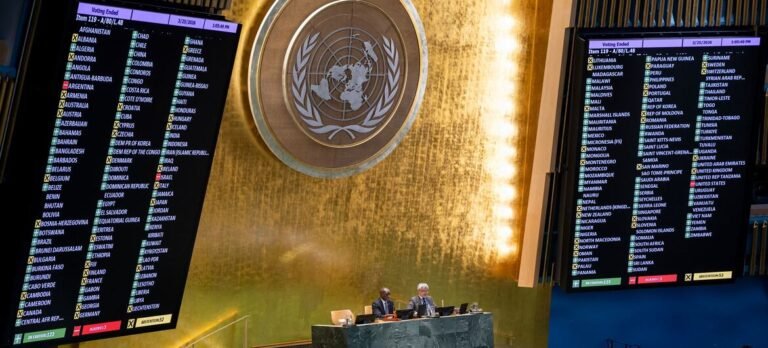
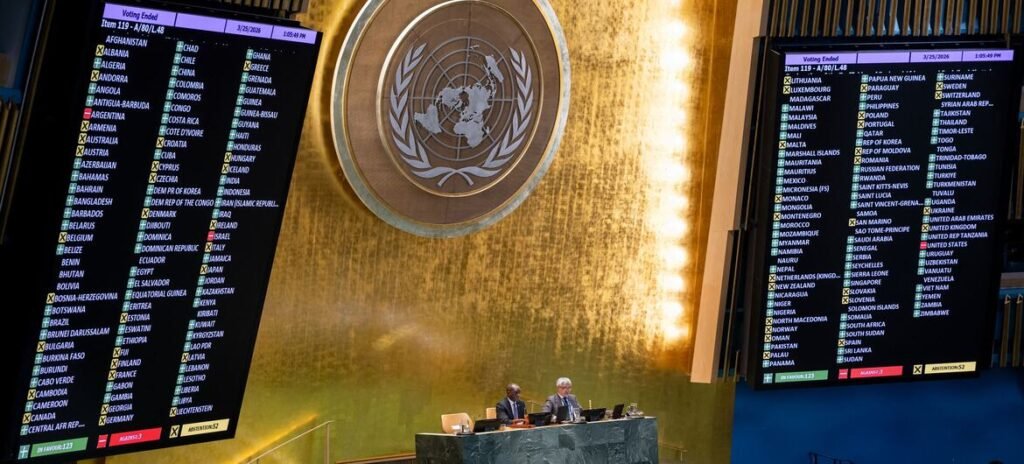
New York (TDI): The United Nations General Assembly voted to recognize the enslavement of Africans during the transatlantic slave trade as the “gravest crime against humanity,” on Wednesday. Ghana initiated the resolution which received 123 votes in favor and three against, while 52 countries abstained.
The United States, Israel, and Argentina opposed the text, while the United Kingdom and European Union member states abstained. The resolution urges member states to consider apologizing for the slave trade and contributing to a reparations fund.
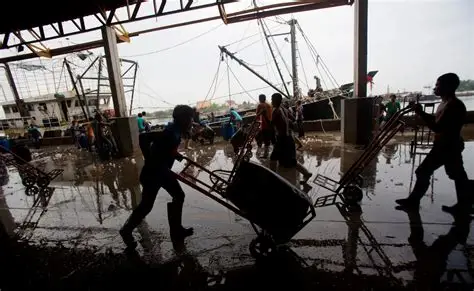
Between 1500 and 1800, an estimated 12-15 million Africans were captured and transported across the Atlantic, with many losing their lives during the harsh and overcrowded voyages.
The resolution describes the trafficking and racialized chattel enslavement as “the gravest crime against humanity” because of its scale, duration, systemic brutality, and enduring consequences that still affect Africans and people of African descent worldwide.
Read More: International Day for Abolition of Slavery
Ghana Pushes for Reparatory Justice
The President of Ghana, John Mahama, addressed the assembly just before the vote, saying “Let it be recorded that when history beckoned, we did what was right for the memory of the millions who suffered the indignity of slavery.”
He added that the adoption of the resolution serves as a safeguard against forgetting and challenges the enduring scars of slavery. Foreign Minister of Ghana, Samuel Okudzeto Ablakwa, said that African leaders are demanding compensation for the victims and not for themselves.
He said the goal is justice through educational funds, endowment funds and skills training programmes to support affected communities. Ablakwa also called for the return of cultural artefacts looted during the colonial era which represent Africa’s heritage, culture and spiritual significance.
United Kingdom Raised Objection
The United Kingdom abstained from the vote. Its chargé d’affaires to the UN James Kariuki said the wording creates a hierarchy of historical atrocities and that no single set of atrocities should be regarded as more or less significant than another.
The US representative Dan Negrea said his country does not recognize a legal right to reparations for historical wrongs that were not illegal under international law at the time. He added that the resolution is unclear about who would receive any reparatory justice.
The vote, however, reflects growing international support for reparatory justice. The African Union made it its official theme for 2025.
Commonwealth leaders agreed at their summit in Samoa last year that the time has come for a meaningful conversation on the issue. Though General Assembly resolutions are not legally binding, they carry the weight of global opinion.

Muhammad Usman Hashmi
Muhammad Usman Hashmi is a researcher in International Relations, focusing on climate diplomacy, global governance, and political economy in the Global South. He has contributed to policy dialogues with the Foreign Policy Community of Indonesia and serves as a Senior Research Fellow at the International Council on Human Rights, Peace and Politics. He is also associated with Rethinking Economics Islamabad, contributing to research on development and sustainability. He can be reached at musmanhashmi99@gmail.com