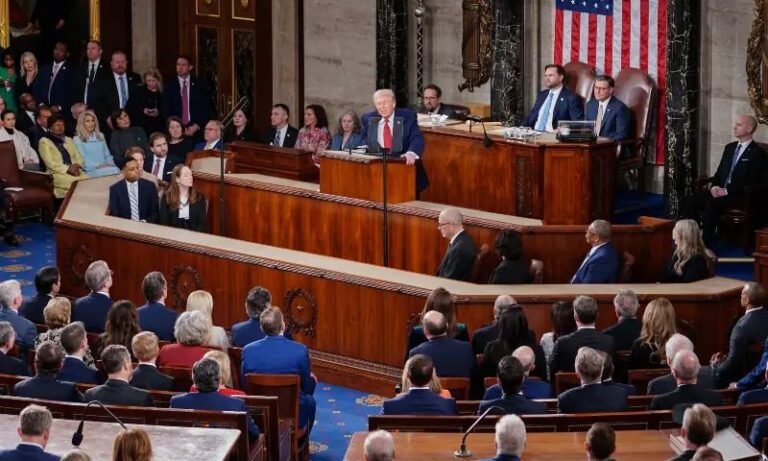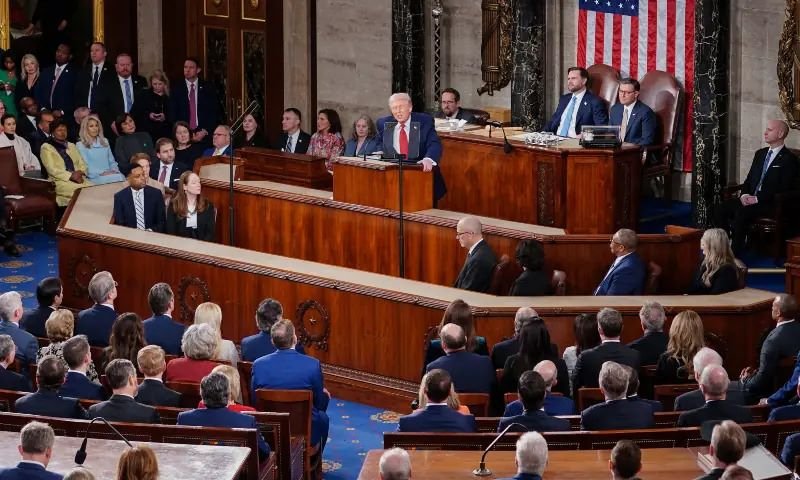
Washington (TDI): US President Donald Trump delivered a 107-minute State of the Union address Tuesday night, blending domestic political messaging with carefully measured foreign policy signals, particularly on Iran.
While emphasizing his preference for diplomacy, Trump left open the possibility of military action, stating he would “never” allow Tehran to acquire a nuclear weapon.
Trump framed his stance within a broader “peace through strength” doctrine, citing a rebuilt US military and increased defense spending by NATO allies as tools strengthening Washington’s negotiating position. He criticized Iran’s missile program, described Tehran’s nuclear ambitions as “sinister,” and referenced previous US strikes, including the killing of General Qasem Soleimani, which he said had a “big impact” on Iranian capabilities.
Turning to South Asia, Trump highlighted his role in ending the May 2025 war between Pakistan and India, claiming that his intervention prevented a potential nuclear catastrophe, saving “millions” of lives.
Read More: Pakistan, Iran Must Expand Joint Efforts to Counter Terror Threats: Iranian Envoy
Despite the largest US military buildup in the Middle East in two decades, Trump avoided any concrete statements on ordering strikes against Iran and largely followed a domestic-focused political script. He also referenced Venezuela, introducing opposition lawmaker Enrique Marquez, freed following the US abduction of President Nicolás Maduro, as a “colossal victory for the security of the United States.”
The speech was highly polarizing. Trump repeatedly directed applause toward Republicans while criticizing Democrats, claiming they are “destroying our country.” Democratic lawmakers, including Ilhan Omar and Rashida Tlaib, shouted objections over American casualties and other grievances.
On domestic policy, Trump attacked immigration from Somalia, defended tariffs despite a recent Supreme Court decision, and pledged to reduce inflation, blaming Democrats. He also called for the passage of the SAVE America Act, requiring proof of citizenship for voter registration, a measure opposed by Senate Democrats.
Read More: US Embassy in Lebanon Evacuates Staff as Tensions Rise with Iran
Overall, the address combined campaign-style mobilization with selective foreign-policy messaging, particularly on Iran, leaving the US approach to Tehran deliberately ambiguous while showcasing Trump’s domestic political priorities and regional interventions.